

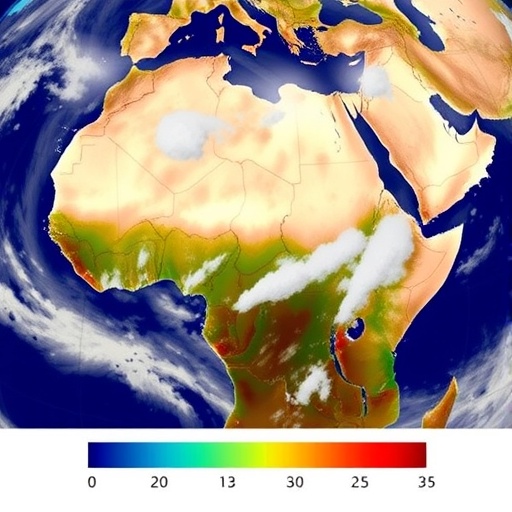
In a groundbreaking new study published in Communications Earth & Environment, researchers have unveiled a compelling argument that upends conventional wisdom about the drivers of climate change in the Sahel region of Africa. While global climate discourse has predominantly centered on greenhouse gases as the primary agents of climatic transformation, this investigation posits that anthropogenic aerosols—and not greenhouse gases—play a dominant role in shaping the Sahel’s climate dynamics. This revelation not only challenges existing paradigms but also opens new avenues for targeted climate mitigation strategies in one of the world’s most vulnerable and ecologically sensitive regions.
The Sahel, a semi-arid zone stretching across the breadth of Africa south of the Sahara Desert, has long been recognized as a climate hotspot with stark environmental and socio-economic ramifications. Characterized by erratic rainfall patterns, frequent droughts, and land degradation, the region’s climate fluctuations directly impact nearly 100 million inhabitants who rely heavily on agriculture and pastoral livelihoods. The study’s lead authors, H.C. Nnamchi and S. Fiedler, meticulously analyzed decades of atmospheric data, remote sensing observations, and advanced climate models to disentangle the specific contributions of aerosols and greenhouse gases to the changing patterns observed in this critical region.
Aerosols, microscopic particles or droplets suspended in the atmosphere, originate from a variety of sources, including industrial pollution, biomass burning, and natural processes such as dust storms. Unlike greenhouse gases, which principally trap outgoing longwave radiation and contribute to global warming, aerosols exert complex radiative effects by scattering and absorbing sunlight, therefore influencing temperature and cloud formation in nuanced ways. This study reveals that anthropogenic aerosols have exerted a cooling influence on the Sahel’s climate, modulating rainfall regimes and surface temperatures in ways that have historically been attributed solely to greenhouse gas forcings.
Pinpointing the atmospheric mechanisms involved, Nnamchi and Fiedler demonstrate how aerosols reduce solar radiation reaching the Earth’s surface—a phenomenon known as “solar dimming.” This reduction in surface heating alters regional atmospheric circulation patterns, ultimately leading to shifts in precipitation distribution. The researchers highlight how this dimming effect has contributed to observable trends in Sahel rainfall variability and drought occurrences, counteracting warming trends driven by increasing greenhouse gas concentrations. Such findings compel the scientific community to re-examine the relative weighting assigned to different climate forcings at regional scales, especially in vulnerable geographies like the Sahel.
The methodological rigor employed in the study is notable for its integration of multiple climate models incorporating aerosol-radiation and aerosol-cloud interactions at high spatial resolution. This advanced modeling approach allows for a dynamic representation of aerosol effects that surpasses conventional models often limited by coarse resolution or simplified aerosol parameterizations. By rigorously testing scenarios with and without anthropogenic aerosol influences, the team robustly isolates and quantifies the overriding impact of these particles on Sahelian climate trends from the mid-20th century onward.
These results bear significant implications for climate adaptation policies within Sahel countries. Historically, efforts have concentrated on mitigating greenhouse gas emissions as a global priority, but the pivotal role of aerosols underscores the urgency for addressing air quality issues and aerosol emission controls locally. For instance, reducing particulate emissions from biomass burning and industrial sources, which contribute heavily to regional aerosol loads, could inadvertently accelerate warming if done without a concurrent strategy to manage greenhouse gas levels and water resource sustainability.
Moreover, the research adds an indispensable layer of complexity to projections of future climate change in the Sahel. Climate models that omit or underrepresent aerosol effects risk miscalculating precipitation and temperature forecasts, thereby undermining resilience planning for agriculture, water security, and disaster risk reduction. The authors emphasize the necessity for policymakers to incorporate aerosol dynamics into current climate models as part of comprehensive climate risk assessments in the Sahel and similar regions marked by aerosol-heavy atmospheric compositions.
In addition to local consequences, the findings hold broader implications for understanding teleconnections—climatic interdependencies across continents. Aerosol-induced shifts in the Sahel’s atmosphere may influence the West African monsoon system, altering precipitation patterns not only in Sahel countries but also in adjacent regions. This ripple effect could impact food security across large swaths of Africa and contribute to migratory pressures that exacerbate political and economic instability.
The study also paves the way for refining the scientific community’s grasp on the paradoxical interplay between aerosols and greenhouse gases within the global climate system. While the world grapples with escalating carbon emissions projected to elevate global temperatures by several degrees this century, the cooling effects of aerosols emerge as a double-edged sword. Anthropogenic aerosol emissions have thus far partially masked some aspects of greenhouse gas warming, yet their reduction—necessary for clean air goals—may accelerate warming if transitions are not carefully managed. Sahel, therefore, emerges as a compelling natural laboratory to understand these competing effects in situ.
Furthermore, the paper brings into focus the challenges of observational constraints in aerosol science. Measurement difficulties arise due to the heterogeneous nature of aerosols, their short atmospheric lifespans, and interactions with clouds. The authors endorse advances in satellite remote sensing technologies calibrated with ground-based observations to enhance aerosol monitoring and verification. Improved datasets are critical for reducing uncertainties in aerosol-climate interactions, which are presently one of the largest unknowns in regional climate projections.
The revelations from this study reframe conversations about climate justice and equity. The Sahel suffers disproportionately from climate extremes driven by factors emitted predominantly elsewhere. Addressing aerosol emissions from industrialized regions becomes not just an environmental imperative but a matter of global solidarity and ethical responsibility. The intricate linkages between aerosol pollution and regional climate amplifies the call for integrative international frameworks that align air quality management with climate change mitigation strategies.
Finally, Nnamchi and Fiedler’s work highlights the importance of interdisciplinary approaches marrying atmospheric physics, climate science, environmental policy, and socio-economic considerations. The Sahelian climate puzzle is emblematic of broader planetary challenges where complex human-natural feedback loops demand holistic solutions. The potential to leverage aerosol knowledge towards bespoke climate action plans could serve as a blueprint for similarly vulnerable ecosystems worldwide, from the Himalayas to the Amazon basin.
As global attention intensifies towards climate crisis mitigation, this study’s insights underscore the necessity of refining our scientific understanding to navigate a future where aerosols and greenhouse gases jointly dictate climate outcomes. Emerging from the shadows, anthropogenic aerosols in the Sahel region command newfound scientific and policy focus, reminding us that climate change is not driven by a singular force but by a tapestry of interacting chemical and physical processes shaped by humanity’s imprint on the atmosphere.
Subject of Research: Influence of anthropogenic aerosols versus greenhouse gases on climate change in the Sahel.
Article Title: Anthropogenic aerosols override greenhouse gases in Sahel climate change.
Article References:
Nnamchi, H.C., Fiedler, S. Anthropogenic aerosols override greenhouse gases in Sahel climate change. Commun Earth Environ (2026). https://doi.org/10.1038/s43247-026-03474-3
Image Credits: AI Generated


