

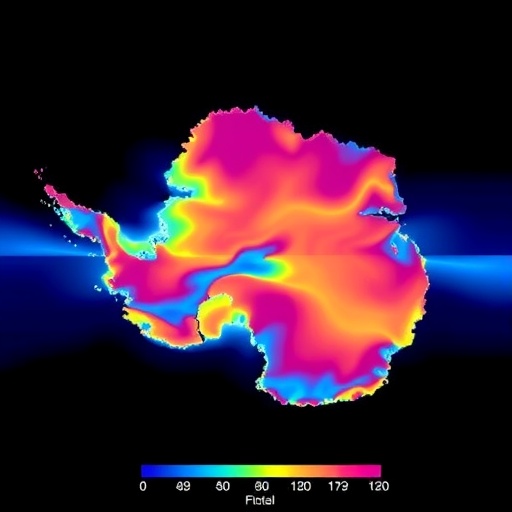
In a groundbreaking international collaboration, scientists from France, Italy, and Australia embarked on the unprecedented East Antarctic Ice Sheet Traverse (EAIIST) to study one of the planet’s driest and least understood regions. Covering an extensive 3,500-kilometer journey from Dumont d’Urville (DDU) station to the South Pole, the expedition provided an unparalleled window into the pristine atmosphere and ice characteristics of the East Antarctic Plateau. This traverse marked a critical effort to expand our understanding of how water vapor isotopes interact with temperature variations across Antarctic landscapes, shedding important light on atmospheric circulation influences on paleoclimate records found in ice cores.
The EAIIST traverse launched on November 23, 2019, from DDU station and made key stops including Concordia station (DC), Paleo, Wind Crust, and the enigmatic Megadunes area—each site offering a unique environment representative of past and present accumulation regimes. The team strategically chose the Megadunes region, believed to mirror glacial ice accumulation conditions, to extract ice cores and collect atmospheric data that could bridge gaps in knowledge about Antarctica’s climate history. Their return to DC in mid-January 2020 and the eventual arrival back at DDU by early February culminated in a meticulously planned journey that integrated fieldwork, instrumentation, and scientific inquiry.
The hazy Antarctic air carried the breath of both nature and technology throughout the traverse. The caravan consisted of five Caterpillar tractors and one Kassbohrer vehicle working in tandem to prepare and maintain the route across treacherous icy terrain. Among the array of equipment were two specially configured science laboratories housed in insulated containers: a “warm lab” for atmospheric measurements including water vapor isotope assessment and continuous flow analysis of surface snow cores, and a “cold lab” dedicated to securely storing and processing extracted ice cores. Living containers were attached to the convoy to provide shelter and workspace for the expedition crew, facilitating long stretches of intense field research in extreme conditions.
Central to the traverse’s research mission was the continuous monitoring of water vapor isotopic composition via a Picarro L2140-i instrument housed within the warm lab. Drawing atmospheric air through a 5-meter inlet positioned to limit contamination from vehicle exhaust, the system captured detailed records of isotopic values such as δ18O and δD. Careful caravan orientation ensured emissions were typically blown away from the inlet. Despite the notoriously rough terrain that could induce movement and vibration, meticulous instrument bracing and foam padding safeguarded the analyzers’ precision—a vital factor affirming the reliability of the collected data across this arduous journey.
In addition to the mobile EAIIST measurements, permanent isotope analyzers stationed at DDU and DC fortified the dataset by offering continuous baseline observations. These fixed stations, which underwent rigorous testing and calibration since the mid-2010s, provided a frame of reference for evaluating natural seasonal isotope variability and addressing the challenges posed by Antarctica’s dry winter conditions. Notably, the DC instrument operates under persistent dryness in summer but faces performance limits during the more frigid and arid winter months, underscoring inherent difficulties in long-term isotope monitoring on the continent.
Meticulous calibration exercises, essential for ensuring data integrity, were carried out both prior to the traverse at DDU and following the fieldwork at the Laboratoire des Sciences du Climat et de l’Environnement (LSCE) in France. This two-step calibration protocol, grounded in established isotope analysis procedures, involved cross-referencing the Picarro instrument’s water mixing ratio against known true values from weather stations and dew point generators. Injection of isotopic standards with known δD and δ18O values illuminated humidity dependence effects, enabling correction of raw measurements to high accuracy. To guard against potential contamination due to vehicle exhaust or snow interference, data segments exhibiting anomalously elevated water vapor concentrations were judiciously excluded, ensuring a robust, uncontaminated dataset.
Validation of instrument performance was a critical pillar underpinning the reliability of the findings. A direct co-location experiment conducted at DDU, wherein the EAIIST instrument operated side-by-side with the permanent station analyzer sharing the same inlet, revealed exceptional concordance in humidity and δ18O measurements. Across a comprehensive 14-hour window spanning the continent’s full summer humidity range, the difference between instruments was minimal, confirming a precision margin well within internationally accepted thresholds. This instrumental agreement provides confidence that observed isotopic variations reflect real atmospheric phenomena rather than measurement artifacts.
By integrating isotopic data with precipitation and surface snow sampling at multiple points, researchers unlocked complex relationships between temperature and isotopic composition at daily, seasonal, and interannual scales. At DC, snow sampling followed a standardized protocol involving spatially distributed surface samples mixed for laboratory analysis, offering high-resolution snapshots of isotopic variability. Complementary precipitation samples from DC and DDU enriched temporal analyses, enabling the construction of isotope-temperature relationships pivotal for interpreting past climate signals archived in the ice.
To conceptualize atmospheric moisture transport and isotopic fractionation processes, the team employed the framework of moist isentropic surfaces—quasi-Lagrangian pathways reflecting conserved thermodynamic states factoring in moisture content. Using the moist entropy potential temperature (θs) as a proxy, they tracked how water vapor isotopes evolve along these surfaces under Antarctic conditions. This approach generalizes classical one-dimensional Rayleigh distillation models into a two-dimensional understanding that incorporates variable initial conditions and moisture content, allowing nuanced representation of isotopic fractionation influenced by temperature and atmospheric circulation.
The evolution of isotopic ratios along moist isentropic trajectories closely follows Rayleigh distillation principles, where isotopic depletion scales with the degree of moisture removal through precipitation. By examining zonal-mean θs surfaces intersecting DC and DDU during distinct seasons, researchers derived temporal and spatial isotope-temperature slopes tethered to atmospheric transport pathways as simulated by isotope-enabled General Circulation Models (isoGCMs). This holistic strategy integrates physical atmospheric processes with isotopic behavior, emphasizing the role of circulation in modulating isotope-temperature relationships across Antarctica.
To underpin their mechanistic interpretation, the team leveraged outputs from sophisticated isotope-enabled GCMs including iCAM5, ECHAM6-wiso, and LMDZ6-iso. These models incorporate realistic climate forcings such as prescribed sea surface temperatures, greenhouse gases, and aerosols with fine-resolution dynamical nudging towards ERA5 reanalysis data. The simulations span multiple decades, enabling robust statistical characterization of atmospheric parameters relevant to the region. Model grid points nearest to field sites like DC and DDU provided essential reference values, bridging field observations with model-based insights into atmospheric dynamics and isotopic variability.
This integrative study, coupling a pioneering Antarctic traverse with advanced isotope measurement and sophisticated modeling frameworks, marks a major advancement in Antarctic paleoclimatology and atmospheric science. The delineation of isotope-temperature variability modulated by atmospheric circulation deepens our understanding of the complex interactions governing isotopic proxies in ice cores, critical for reconstructing past climate states. Moreover, the high-resolution water vapor and snow isotope records generated offer a baseline for calibrating future ice core studies and improving regional climate models.
In conclusion, the EAIIST collaborative traverse represents a milestone in polar science, providing the first near-continuous, spatially distributed suite of water vapor isotope data complemented by parallel surface snow and ice core analyses across East Antarctica’s vast and inhospitable plateau. The interdisciplinary approach demonstrates the power of combining field innovation with rigorous instrument calibration and targeted numerical simulations to unravel intricate atmospheric processes shaping isotope-temperature relationships. This work not only elevates our capacity to interpret Antarctic paleoclimate archives but also offers vital perspectives on current and future climate dynamics across the southernmost continent.
Subject of Research: Water isotope–temperature variability in Antarctica linked to atmospheric circulation and moisture transport mechanisms.
Article Title: Water isotope–temperature relationship variability across Antarctica set by atmospheric circulation.
Article References:
Casado, M., Bailey, A., Leroy-Dos Santos, C. et al. Water isotope–temperature relationship variability across Antarctica set by atmospheric circulation. Nat. Geosci. (2026). https://doi.org/10.1038/s41561-026-01961-y


