

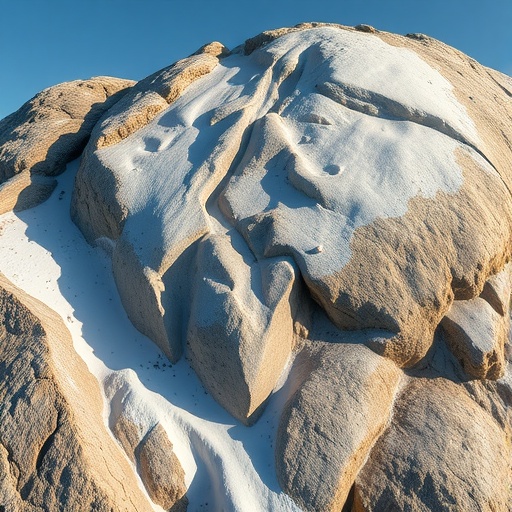
In a groundbreaking discovery that challenges long-held assumptions about Earth’s most extreme glacial episode, researchers at the University of Southampton have uncovered compelling evidence demonstrating that the Earth’s climate experienced rhythmic fluctuations even during the Snowball Earth period. This era, which spanned roughly between 720 and 635 million years ago during the Cryogenian Period, was previously thought to be a static, climatically frozen world devoid of short-term variability. The study, published in the prestigious journal Earth and Planetary Science Letters, presents an astonishing revelation: despite the near global freeze, Earth’s climate system exhibited oscillations on annual, decadal, and centennial scales strikingly analogous to modern climatic cycles.
The Cryogenian Period represents one of the most severe glaciations in Earth’s geological history, with expansive ice sheets hypothesized to have extended into tropical latitudes, effectively transforming the planet’s surface into a giant snowball. Such an extreme scenario was believed to have stifled the dynamic exchange processes between the atmosphere and oceans, rendering the climate system static and unresponsive to typical climatic drivers for millions of years. This new research upends that paradigm by leveraging exquisitely preserved geological records from the Garvellach Islands off Scotland’s west coast, revealing the presence of intricate climate rhythms during this intense freeze.
Central to this breakthrough are the varves—finely laminated sedimentary rocks—within the Port Askaig Formation that record depositional events on an annual scale. Through meticulous microscopic and statistical analyses of 2,600 distinct sediment layers, scientists discerned repeating patterns indicative of climate oscillations. These layers, each corresponding to a single year, captured environmental fluctuations spanning from seasonal freeze-thaw cycles to longer periodicities resembling solar influences and interannual oscillations akin to phenomena such as the modern El Niño. This preservation is unprecedented and offers a natural, geological “data logger” of climate variability during this extreme epoch.
These varves formed in a calm, deep-water environment beneath a thick ice cover, likely through cyclical freezing and melting processes. The researchers posit that this setting fostered delicate conditions allowing minute year-to-year changes to be recorded in remarkable detail. The data suggests that familiar modes of climate variability, long thought impossible in a world blanketed by ice, did persist. This discovery raises profound questions about the resilience and driving mechanisms of Earth’s climate system under the harshest boundary conditions known.
However, the detected climate oscillations likely represent episodic disturbances within the overarching Snowball Earth state rather than the norm. The study’s lead authors suggest that these fluctuations occurred during transient phases lasting a few thousand years, punctuating an otherwise stable and frigid global climate regime. This implies that the Snowball Earth was not an entirely monolithic climatic state but experienced intervals where the ice cover partially retreated, enabling limited ocean-atmosphere interactions and thus enhancing climate dynamism.
To further probe this hypothesis, the team employed advanced climate modeling focused on ocean-ice interactions during Snowball Earth conditions. The simulations demonstrate that a completely ice-encased ocean suppresses most modes of climate variability, effectively “switching off” oscillations driven by ocean-atmosphere feedback. Intriguingly, the models reveal that if even a modest fraction—around 15%—of the ocean surface remained ice-free, particularly in tropical regions, then modern-like climate oscillations could resurface. This finding supports the concept of “slushball Earth” or “waterbelt” states, where partial deglaciation allowed complex climate dynamics to operate intermittently.
Such models underscore the non-binary planetary climate dynamics of Snowball Earth, with the planet possibly oscillating between fully glaciated and partially thawed regimes over millennia. This nuanced understanding advances the notion that despite extreme physical constraints, Earth’s climate system demonstrates an intrinsic propensity for oscillation that can manifest given minimal favorable conditions. It further challenges existing theories that view Snowball Earth strictly as a climatic trap devoid of variability.
The Scottish varve record itself remains one of the most pristine preserved intervals from Snowball Earth epochs worldwide. Its exceptional quality allowed researchers to reconstruct climatic changes with extraordinary resolution, opening a novel window into Earth’s past. The detailed sedimentary archive from the Garvellach Islands effectively writes a climate history of a frozen planet with annual precision, thus offering unparalleled insights into planetary climate resilience and feedbacks during critical phases of Earth’s evolution.
Unraveling this ancient climate behavior has profound implications beyond just paleoclimate studies. It provides critical analogues for understanding how Earth, and other terrestrial planets, might respond to severe perturbations or global-scale climate shifts. The persistence of oscillatory behavior under extreme conditions suggests that planetary climate regimes can retain or regain dynamism after significant disruptions. This knowledge may enrich predictive capabilities concerning modern climate change and its potential tipping points.
Professor Thomas Gernon of the University of Southampton, a co-author on the study, highlights that the presence of these rhythmic climate signals during Snowball Earth exemplifies an innate oscillatory nature within climate systems. Even when subjected to stringent limits, if the slightest opportunity arises—such as marginal open water surfaces—climate modes familiar to us today can re-emerge. This realization challenges the long-standing narrative of glaciation as purely detrimental to climate variability.
Furthermore, the findings deepen our understanding of cryospheric processes and their interaction with atmospheric forcing. Seasonal freeze-thaw dynamics presumably catalyzed sediment deposition cycles, while solar cycles and ocean-atmosphere interactions contributed to longer-term variability. This intersection of geologic evidence with climate modeling paints a comprehensive picture of ancient Earth’s climate complexity during one of its most enigmatic intervals.
In summary, this research not only illuminates the dynamic character of Earth’s climate during the Cryogenian Snowball Earth but also challenges the assumption that extreme global glaciations inevitably suppress all but the most static climatic conditions. High-resolution sedimentary records combined with innovative climate models illustrate that Earth’s climate system can sustain multi-timescale oscillations under conditions once deemed too harsh. Ultimately, this breakthrough redefines our understanding of the robustness and adaptability of planetary climate systems, fostering new perspectives on Earth’s deep-time environmental evolution.
Subject of Research: Climate oscillations during the Cryogenian Snowball Earth glaciation.
Article Title: Interannual to multidecadal climate oscillations occurred during Cryogenian glaciation.
News Publication Date: 4-Feb-2026.
Web References: 10.1016/j.epsl.2026.119891
Image Credits: This file is licensed under the Creative Commons Attribution-Share Alike 4.0 International license. Attribution must be given to Pablo Carlos Budassi.
Keywords: Snowball Earth, Cryogenian Period, climate oscillations, varves, Port Askaig Formation, glaciation, climate modeling, interannual variability, El Niño-like oscillations, solar cycles, Slushball Earth, Earth paleoclimate, Garvellach Islands.


