

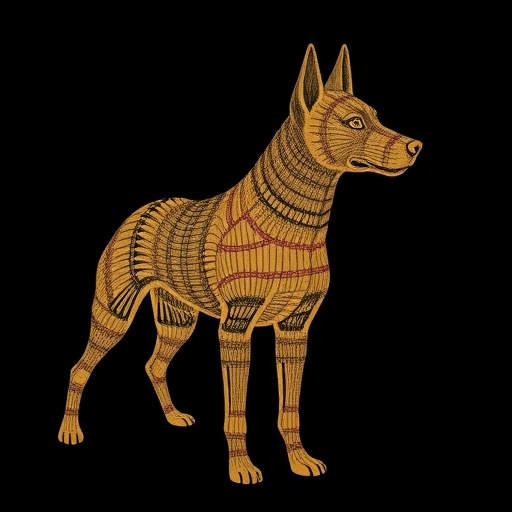
Dogs have long been humanity’s closest animal companions, but exactly when and how this bond first took shape has remained an enigma for scientists. Now, an international team of researchers has shattered previous records to demonstrate that dogs were domesticated more than 14,000 years ago, predating the advent of farming by millennia. The breakthrough comes from an extensive genomic analysis of ancient canid remains, revealing not only the early emergence of domesticated dogs but also their significant genetic continuity through European prehistory into modern times.
This landmark study analyzed DNA extracted from 216 canid skeletal samples gathered across Europe and its periphery, spanning regions from Switzerland and Germany to Türkiye and Scotland. Importantly, 181 of these samples predate the Neolithic era, providing an unprecedented window into the prehistoric canine populations that lived alongside Europe’s hunter-gatherers. Advancing beyond traditional morphological methods, which often struggle to differentiate wolves from early dogs due to overlapping physical features, the team employed cutting-edge hybridisation capture techniques. This methodological innovation enriched ancient canid DNA fragments from heavily contaminated archaeological material, greatly increasing the fidelity and scope of genetic sequencing.
The results reveal a remarkable clarity in distinguishing dogs from wolves. For the first time, two-thirds of ancient samples underwent confident genetic classification, overturning prior assumptions based solely on bone size or morphology. For example, a canid specimen from Belgium dating to approximately 13,700 years ago, once believed to be a domesticated dog due to its small stature and evidence of human interaction, was instead identified as a wild wolf. Such findings underscore the indispensability of genomic tools in reconstructing ancient canid histories accurately.
Among the most striking discoveries is the identification of a 14,200-year-old dog from the Kesslerloch cave in Switzerland, making it one of the oldest genetically confirmed dogs known to science. Intriguingly, this prehistoric European dog exhibits closer genetic affinity to present-day European dogs than to those currently found in Asia. This genomic pattern implies that domestication likely began tens of thousands of years before this specimen’s time, allowing sufficient evolutionary divergence to arise between European and Asian dog populations.
The team’s phylogenetic analyses support a nuanced narrative of dog domestication. Ancient European dogs trace their ancestry predominantly to an eastern Eurasian wolf lineage but also carry minor genomic contributions from western Eurasian wolves. This admixture highlights dog domestication as a complex process involving multiple wolf populations rather than an independent European event, opposed to earlier theories that posited separate domestication centers. Thus, the widespread common ancestry between Eurasian dog populations suggests an ancient origin somewhere in Asia, followed by migration and regional adaptation across the continent.
With the transition from foraging to farming catalyzing sweeping changes in human societies around 10,000 years ago, the researchers also explored whether this cultural revolution impacted dog genetics. They compared genetic profiles of dogs from pre-agricultural hunter-gatherer communities with those living during and after the arrival of Neolithic farmers from Southwest Asia. The findings indicate that while dog populations mirrored human demographic shifts to some extent, the agricultural transition did not completely replace pre-existing canine lineages. Instead, hunter-gatherer dog lineages contributed substantially to the genetic makeup of Neolithic and modern European dogs.
Modern European dog breeds, therefore, carry a genetic legacy that traces back directly to these ancient pre-farming populations, retaining approximately half of their ancestry from dogs that roamed Europe over 14,000 years ago. This continuity not only highlights the long-standing role of dogs in human societies but also suggests that domesticated dogs were central to human life well before the rise of sedentary agriculture.
Senior Group Leader Pontus Skoglund from the Francis Crick Institute emphasizes the broader implications of these findings. “Dogs were uniquely the first domesticated animal, emerging before the onset of farming,” Skoglund notes. “This study offers vital insights into how domestication and subsequent human cultural shifts intertwined, shaping the shared evolutionary pathways of our species and our closest animal companions.” According to Skoglund, the persistent presence and integration of dogs within farming societies underline their importance to ancient human groups.
First author Anders Bergström from the University of East Anglia underscores the pivotal role of advanced genomic techniques in enabling these discoveries. “Without sophisticated DNA capture and sequencing methods, distinguishing ancient dogs from wolves would remain nearly impossible, as morphological traits often blur between these groups.” Bergström also stresses the significance of uncovering a more comprehensive picture of dog evolution, noting the vast genetic diversity and geographic complexity captured by this extensive dataset.
Despite these revelations, key questions remain open: Where exactly in Asia were dogs first domesticated? Through which routes did dogs disperse across Europe, and how did their role evolve in tandem with human societies? As new archaeological finds and genetic data continue to emerge, researchers anticipate that these puzzles will gradually unravel, moving the field closer to a full understanding of the profound origins of humanity’s oldest domesticate.
By harnessing genomic insights from remarkably aged canid remains, this groundbreaking research not only rewrites the timeline of dog domestication but also casts fresh light on the deep and enduring partnership between dogs and humans. Their intertwined histories stretch back to the twilight of the last Ice Age, bearing witness to the origins of a relationship that remains central to human life today.
Subject of Research: Not explicitly detailed in the source, but focuses on ancient canine genomics and evolutionary biology.
Article Title: Genomic history of early dogs in Europe
News Publication Date: 25-Mar-2026
Web References: http://dx.doi.org/10.1038/s41586-026-10112-7
References: Bergström, A. et al. (2026). Genomic history of early dogs in Europe. Nature.
Keywords: Ancient DNA, Dog Domestication, Canid Genomics, Evolution, Neolithic Transition, Hunter-Gatherers, Hybridisation Capture, Prehistoric Europe


