

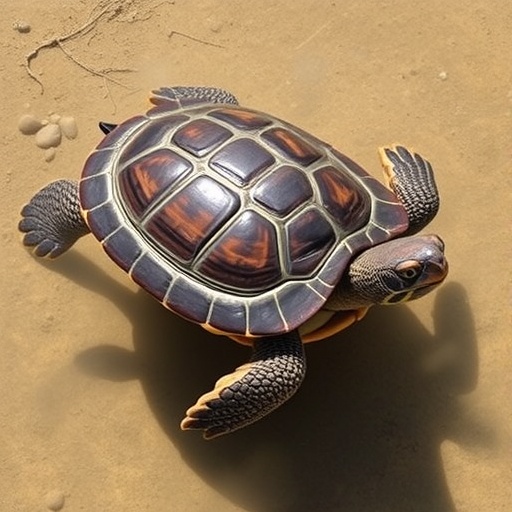
In recent years, the imprints of human activity on natural ecosystems have become increasingly evident, and nowhere is this more apparent than in the shifting dietary patterns of wildlife. A groundbreaking study published in PLOS One reveals compelling stable isotope evidence indicating that African softshell turtles (Trionychidae family) have experienced a marked disruption in their foraging behavior, driven by anthropogenic changes during the Anthropocene era. This research offers a rare glimpse into how modern-day ecological pressures significantly narrow the dietary breadth of these ancient reptiles compared to their prehistoric predecessors.
Turtles have long been recognized as ecological barometers, reflecting the health and dynamics of aquatic environments. The African softshell turtle, a species known for its wide-ranging habitat and opportunistic feeding habits, provides an ideal model for examining shifts in trophic interactions over time. Through a meticulous analysis of stable isotope ratios in turtle remains and contemporary populations, researchers have unveiled how human-induced environmental change—particularly agriculture expansion and alterations in carrion availability—has fundamentally reshaped turtle foraging strategies across millennia.
Stable isotope analysis serves as a powerful proxy in paleoecology and contemporary ecology alike, enabling scientists to reconstruct dietary preferences and habitat use with remarkable precision. By measuring variations in carbon and nitrogen isotopic compositions within turtle tissues, the study delineates shifts from a historically diverse foraging regime encompassing multiple trophic levels to a more constrained dietary niche dominated by agricultural byproducts and scavenged carrion. This isotopic evidence reflects broader ecosystem changes influenced by expanding human populations and associated land-use transformations.
Agricultural intensification, a hallmark of anthropogenic impact, emerges as a key driver reducing the complexity of turtle diets. Crop cultivation and livestock rearing modify aquatic and terrestrial food webs, indirectly funneling nutrient flows toward easily accessible, human-associated resources. Softshell turtles, adapting to these new ecological realities, increasingly rely on agricultural detritus and carrion—resources that differ significantly from natural prey species in both availability and nutritional composition. These shifts carry profound consequences for turtle physiology and population dynamics.
Carrion, traditionally sporadic in natural ecosystems, now plays an outsized role in softshell turtle diets due to human activity, including road mortalities and livestock waste. While scavenging on carrion can be a flexible survival strategy, dependence on such anthropogenic food sources can expose turtles to novel pathogens, pollutants, and fluctuating availability. Isotopic data imply that these altered foraging behaviors not only reflect an adaptive response but also signal ecological stress and habitat degradation.
Importantly, the study situates these dietary changes within a broader temporal context by incorporating archaeological and paleontological datasets. Comparing ancient turtle remains with modern specimens unveils a stark contraction in dietary diversity over centuries, mirroring the progression of agricultural landscapes and human settlement patterns in Africa. These findings underscore the deep-time ecological footprint of human civilization and emphasize the need to consider evolutionary and long-term ecological perspectives when assessing contemporary species conservation.
Moreover, the researchers highlight the critical role of interdisciplinary collaboration, combining expertise from ecology, archaeology, chemistry, and environmental sciences across multiple countries, including The Netherlands, Denmark, the U.K., Italy, the U.S., and Türkiye. Such global cooperation broadens the understanding of Anthropocene impacts on biodiversity and reinforces the value of advanced analytical techniques in conservation biology.
The study’s methodology represents an innovative fusion of isotopic analysis with stable isotope mixing models, facilitating nuanced interpretations of turtle diet composition and habitat use. These technical advancements permit researchers to disentangle complex ecological signals from varied environmental samples, providing robust evidence for the Anthropocene’s pervasive influence on food web stability and species adaptability in African freshwater ecosystems.
Findings from this research carry significant implications for aquatic conservation strategies, particularly in regions undergoing rapid agricultural expansion. Recognizing the dietary constraints imposed on softshell turtles by human-altered landscapes highlights the urgency of protecting diverse aquatic habitats and mitigating pollution and habitat fragmentation. Maintaining ecological complexity is essential for preserving the resilience and functionality of freshwater ecosystems supporting these ancient reptiles.
Furthermore, the study adds to growing evidence that anthropogenic environmental change disrupts not only the abundance and distribution of species but also fundamental behavioral and physiological traits. For the African softshell turtle, alterations in foraging patterns may affect growth rates, reproduction, and vulnerability to predators, highlighting the interconnected nature of ecosystem health and species survival. These insights advocate for integrating isotopic and ecological data into policy frameworks aimed at biodiversity conservation.
The role of carrion and agricultural byproducts in modern softshell turtle diets also raises questions about toxicological risks, as these food sources may concentrate contaminants such as pesticides, heavy metals, or pharmaceuticals. Future research directions include assessing how such exposure affects turtle health and reproductive success, which is critical for developing targeted conservation and management interventions under rapidly changing environmental conditions.
In conclusion, this landmark study unveils the subtle yet profound ways in which human activity is reshaping the very fabric of aquatic food webs. Through state-of-the-art stable isotope techniques, scientists have illuminated the Anthropocene’s footprint on African softshell turtle foraging behavior, stressing the intricate linkages between ecosystem alterations and species ecology. As human pressures continue to escalate, uncovering such ecological disruptions is vital for safeguarding biodiversity and ensuring the persistence of ancient lineages amidst modern environmental challenges.
Subject of Research: Anthropocene-driven disruption in the foraging behavior of African softshell turtles revealed through stable isotope analysis.
Article Title: Stable isotope evidence of anthropocene disruption in African softshell turtle foraging.
News Publication Date: 11 February 2026.
Web References: DOI: 10.1371/journal.pone.0339589.
Image Credits: Willemien de Kock, CC-BY 4.0.
Keywords: African softshell turtle, stable isotope analysis, Anthropocene, foraging behavior, dietary diversity, agriculture impact, carrion scavenging, freshwater ecosystems, trophic ecology, ecological disruption, biodiversity conservation.


