

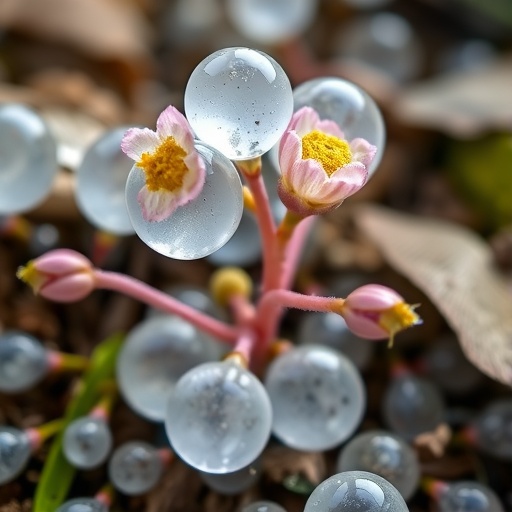
In the expansive and challenging landscapes of alpine sandy lands, where water scarcity defines the survival of vegetation, a new study sheds light on a groundbreaking approach to enhancing plant resilience under drought conditions. Researchers Yang, Guo, Pei, and their colleagues have pioneered the investigation into amphiphilic hydrogels—a novel class of water-retention materials—demonstrating their pivotal role in supporting plant growth and physiological stability amid prolonged drought stress.
Alpine sandy soils are notorious for their low water-holding capacity, sparse nutrients, and extreme temperature fluctuations, making plant establishment and growth particularly arduous. These adversities are compounded by climatic shifts that intensify drought frequency and severity, jeopardizing both native flora and agricultural productivity in these fragile ecosystems. Traditional methods, such as irrigation or organic amendments, often fall short due to logistical constraints and environmental costs. Against this backdrop, amphiphilic hydrogels emerge as a promising technological innovation by fundamentally altering soil moisture dynamics.
Amphiphilic hydrogels are uniquely characterized by their molecular architecture combining hydrophilic (water-attracting) and hydrophobic (water-repelling) segments, enabling them to absorb substantial amounts of water while controlling its release in a regulated manner. This structural duality allows these hydrogels to retain water efficiently in sandy substrates, mitigating rapid drainage and evaporation, which are significant hurdles in alpine environments. The study meticulously elaborates on how these hydrogels interface with the soil matrix and root systems to maximize moisture availability where plants need it most.
The experimental design involved manipulating hydrogel compositions and dosages within alpine sandy soil plots subjected to simulated drought conditions. Through precise physiological measurements—including stomatal conductance, photosynthetic rates, and water potential—the researchers quantified the beneficial impacts on plant function. Findings revealed that plants supplemented with amphiphilic hydrogels exhibited markedly improved water retention in rhizospheres, sustained photosynthetic efficiency, and reduced stress indicators compared to control groups.
One of the pivotal mechanisms underlying these improvements is the hydrogel’s capacity to moderate soil moisture fluctuations. By buffering rapid declines in water availability, the hydrogels create a more stable hydration environment, which is critical for sustaining cellular turgor and metabolic activities. This stability directly influences stomatal behavior, enabling optimized gas exchange and water use efficiency that correlates with enhanced biomass accumulation and root development.
Moreover, the study highlights the role of amphiphilic hydrogels in modulating root architecture. Enhanced moisture permanence encourages more extensive root proliferation and deeper rooting depths. This morphological adaptation augments the plant’s intrinsic ability to access subsurface water reserves, offering resilience against episodic drought stress. Such root dynamics also facilitate nutrient uptake, which is typically constrained in nutrient-poor sandy soils.
Beyond the physiological traits, the research underscores the potential ecological implications of integrating amphiphilic hydrogels into alpine sandy soil management. By improving plant establishment and vigor, these hydrogels can aid in ecosystem restoration efforts, combat desertification processes, and stabilize soils prone to erosion. The consequent increase in vegetation cover not only protects soils but also fosters biodiversity and carbon sequestration in vulnerable alpine landscapes.
The durability and biodegradability of amphiphilic hydrogels were also considered, addressing environmental safety concerns. The materials tested demonstrated favorable degradation profiles without accumulating harmful residues, aligning with sustainable land management practices. The research emphasizes the importance of hydrogel composition tailoring to optimize both efficacy and ecological compatibility, paving the way for large-scale applications.
Furthermore, the interdisciplinary approach adopted in this study integrates soil science, plant physiology, and materials engineering, exemplifying how collaborative efforts can yield solutions to complex environmental challenges. This holistic methodology not only advances scientific understanding but also bridges the gap between laboratory innovation and field implementation.
Critically, the study also discusses limitations, such as the need for long-term field trials to verify the persistence of beneficial effects under diverse climatic regimes. Additionally, economic analyses are necessary to assess the feasibility of widespread hydrogel application in remote alpine regions, considering both costs and potential socioeconomic benefits tied to improved vegetation health.
As drought conditions intensify globally due to climate change, the findings presented establish amphiphilic hydrogels as a transformative tool in drought mitigation strategies. Their ability to enhance water use efficiency and support plant physiological resilience opens avenues for sustainable agricultural practices and natural ecosystem preservation in harsh environments previously deemed marginal for cultivation or reforestation.
In conclusion, the comprehensive research led by Yang and colleagues pioneers a vital paradigm shift in alpine sandy land management. Through the innovative exploitation of amphiphilic hydrogels, they demonstrate a practical, scientifically grounded approach capable of bolstering plant survival and ecosystem functionality amidst escalating drought pressures. This breakthrough offers a beacon of hope for land managers, conservationists, and scientists striving to safeguard the delicate balance of alpine ecosystems under the looming threat of climatic extremes.
Subject of Research: Amphiphilic hydrogels’ effects on plant growth and physiological responses under drought stress in alpine sandy soils.
Article Title: The role of amphiphilic hydrogels on plant growth and physiology in alpine sandy land during drought stress.
Article References:
Yang, Q., Guo, F., Pei, X. et al. The role of amphiphilic hydrogels on plant growth and physiology in alpine sandy land during drought stress. Environ Earth Sci 85, 46 (2026). https://doi.org/10.1007/s12665-025-12775-3
Image Credits: AI Generated
DOI: https://doi.org/10.1007/s12665-025-12775-3


