

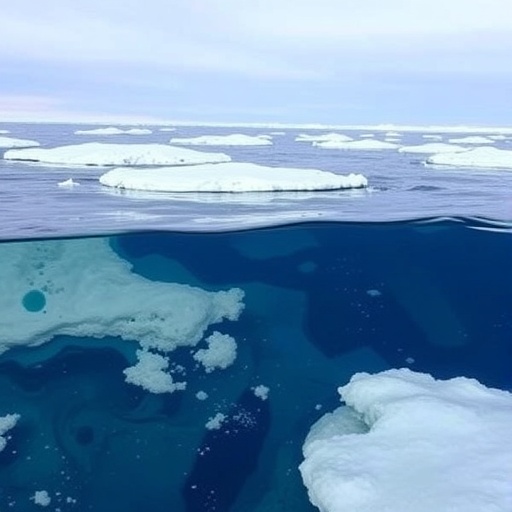
The Atlantic Meridional Overturning Circulation (AMOC) is a colossal and intricate ocean current system responsible for transporting warm waters northward and colder waters southward across the Atlantic Ocean. This conveyor belt of oceanic currents plays a vital role in regulating the Earth’s climate by distributing heat and managing the carbon cycle. Recent groundbreaking research simulated the impacts of a potential AMOC collapse triggered by freshwater influx, revealing alarming consequences for global warming and the planet’s carbon balance.
Researchers began their investigation by employing sophisticated computational climate models to simulate Earth’s climate under various atmospheric carbon dioxide (CO₂) concentrations. They then introduced an artificial input of freshwater to the Atlantic Ocean’s surface to mimic the effects of increased glacier melt or heightened rainfall, aiming to force a shutdown of the AMOC. The simulation allowed for a detailed assessment of how carbon cycling and global temperatures would respond to this sudden shift in oceanic circulation.
At pre-industrial levels of approximately 280 parts per million (ppm) CO₂, the AMOC demonstrated extraordinary resilience. Although freshwater forcing caused the circulation to temporarily collapse, it fully recovered after the freshwater input ceased. This finding underscores that under relatively low greenhouse gas concentrations, the climate system possesses inherent stability mechanisms to recover from perturbations. However, the scenario changed dramatically as atmospheric CO₂ concentrations increased.
When CO₂ levels reached 350 ppm—just shy of current atmospheric values—and remained higher, the AMOC exhibited a fundamentally altered stability regime. Instead of rebounding after a collapse, the system transited to what scientists describe as a “bistable” state. In this state, the AMOC weakened progressively over several centuries before tipping into a sustained and inactive phase. Crucially, once collapsed at these elevated CO₂ concentrations, the circulation failed to return to its former operational state within the simulated timeframes, suggesting an irreversible climatic shift.
Da Nian, lead author and climate dynamics specialist at the Potsdam Institute for Climate Impact Research (PIK), explained the significance of these findings. He highlighted that elevated atmospheric CO₂ concentrations are pivotal in destabilizing the AMOC, effectively locking it into a shut-down mode. This insight offers critical foresight into future climate trajectories, particularly as present-day CO₂ levels hover around 430 ppm, well beyond the threshold that destabilizes this essential system.
The consequences of an AMOC collapse extend far beyond regional oceanography. Across all modeled scenarios, the shutdown was accompanied by an additional global temperature rise ranging from 0.17°C to 0.27°C. Though these increments may appear modest in a global annual mean sense, they represent a substantial deviation in the tightly balanced climate system where even fractions of a degree can trigger profound environmental feedbacks.
One of the main drivers of this extra warming is a massive release of carbon from the Southern Ocean. The shutdown scenario enhances vertical mixing, causing carbon-rich deep waters to upwell to the surface and release CO₂ into the atmosphere. Matteo Willeit, a key contributor to the research at PIK, elaborated that this oceanic carbon source, once a sink absorbing human-induced emissions, effectively reverses its role. The process amplifies atmospheric greenhouse gas concentrations, exacerbating climate warming in a dangerous positive feedback loop.
The study further emphasizes that regional climatic effects could be far more drastic than the global average. At atmospheric CO₂ levels of 450 ppm—comparable to conditions last seen several million years ago when polar ice sheets were dramatically diminished—simulations revealed that Antarctic temperatures could soar by 6°C while the Arctic would experience a chilling decline reaching -7°C. This pronounced polar contrast is primarily due to disruptions in heat transport associated with the AMOC’s cessation.
This polar amplification of temperature anomalies would not only affect ice cover but also profoundly impact global ocean circulation patterns, sea levels, and ecosystems. The cooling of the Arctic juxtaposed with Antarctic warming underscores the asymmetric nature of climate responses to major ocean current alterations, thereby complicating regional climate forecasting and adaptation strategies.
From a broader perspective, the study delivers a stark warning regarding the ocean’s diminishing capacity to act as a carbon sink. Historically, oceans have absorbed roughly a quarter of anthropogenic CO₂ emissions, serving as our planet’s crucial buffer against runaway climate change. The prospect of the AMOC collapse flipping the Southern Ocean from a net carbon sink into a substantial carbon emitter dramatically reshapes the global carbon budget and accelerates climate destabilization.
Johan Rockström, the director of PIK and co-author of the study, underscored the urgency of these findings. He noted that the higher the atmospheric CO₂ levels at the time of the AMOC shutdown, the greater the amplifier effect on global warming. Essentially, continued rising emissions today not only increase direct warming but also elevate the risk of triggering oceanic processes that would compound climate change impacts in the future, locking the planet into a high-risk trajectory.
The multi-century timescale of the transition to a collapsed AMOC reveals the inherent inertia within Earth’s climate system. This lag offers a narrow window for mitigation but simultaneously paints a grim picture of delayed and potentially irreversible consequences if swift emission reductions are not implemented. The findings thus highlight the critical importance of understanding Earth system feedbacks and improving predictive capabilities surrounding ocean circulation stability.
The research utilized state-of-the-art computational simulation and climate modeling techniques, integrating ocean physics, carbon cycling processes, and atmospheric dynamics to construct a comprehensive picture of a potential future Earth’s climate. Such interdisciplinary approaches are crucial for identifying tipping points and feedback mechanisms that traditional climate models might overlook, providing policymakers and scientists with essential insights into potential climate scenarios.
These revelations about the AMOC are a clarion call for the global community to reassess climate risks, especially in light of ongoing emissions and warming trends. The collapse of one of the planet’s central oceanic circulatory systems is not just a theoretical risk but a plausible future event with far-reaching consequences. Understanding and anticipating these critical thresholds will be pivotal for informed climate action and the safeguarding of global environmental stability.
Subject of Research: Not applicable
Article Title: Collapse of the Atlantic meridional overturning circulation would lead to substantial oceanic carbon release and additional global warming
News Publication Date: 31-Mar-2026
Web References: http://dx.doi.org/10.1038/s43247-026-03427-w
References: Communications Earth & Environment
Keywords:
– Ocean circulation
– Climate stability
– Atlantic Meridional Overturning Circulation (AMOC)
– Carbon cycle
– Global warming
– Climate tipping points
– Ocean carbon release
– Computational climate modeling
– Southern Ocean
– Feedback mechanisms
– Polar temperature anomalies
– Climate mitigation


