

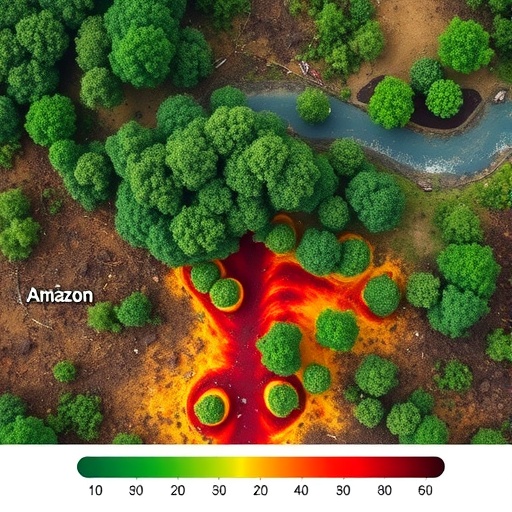
Deforestation in the Amazon rainforest is driving profound shifts in regional climate patterns, as revealed by a comprehensive study recently published in the prestigious journal Communications Earth & Environment. By analyzing satellite data, researchers quantified significant changes in surface temperature, evapotranspiration rates, and precipitation distribution between highly deforested regions and areas with dense forest cover exceeding 80%. These stark contrasts underscore the critical role intact forest ecosystems play in regulating local and regional climate dynamics.
The investigation showed that areas with forest cover below 60% exhibit climatic conditions akin to zones traditionally classified as transitional landscapes between rainforest and savanna biomes. Specifically, these degraded regions endured an average increase in surface temperatures of around 3 °C during the dry season when compared to densely forested reference areas. This temperature rise is accompanied by marked reductions in evapotranspiration and rainfall — 12% and 25% respectively. Furthermore, the analysis highlighted a notable decrease in the frequency of rainy days, with highly deforested zones experiencing approximately 11 fewer days of rain annually.
Evapotranspiration, the process by which water is transferred from the land to the atmosphere through plant transpiration and soil evaporation, is a vital component of the hydrological cycle. The removal of forested areas curtails evapotranspiration, diminishing atmospheric moisture recycling and altering rainfall patterns. Consequently, these changes intensify dry-season warming and drought stress, creating a feedback loop that predisposes the remaining forest to further degradation, increased tree mortality, and heightened vulnerability to wildfires.
Researchers posit that these dry and hot climatic shifts jeopardize the survival of species finely adapted to the humid rainforest environment. As conditions become unsuitable for these sensitive species, opportunistic native and invasive exotic species may proliferate, dramatically reshaping biodiversity composition. Such ecological transformations threaten ecosystem resilience and undermine the Amazon’s capacity to provide crucial services such as carbon sequestration, water cycling, and the regulation of regional weather systems.
The study emphasizes the imperative need to curb forest loss and to restore degraded landscapes as essential strategies for safeguarding the Amazon’s climate resilience. Beyond the intrinsic value of conserving biodiversity, healthy forest ecosystems underpin vital economic activities, including agriculture. Maintaining a minimum of 80% forest cover on rural properties, as mandated by Brazil’s Forest Code, emerges as a scientifically substantiated policy that supports both environmental stability and sustainable development.
Brazil’s Forest Code requires landowners in the Amazon biome to preserve at least 80% of native vegetation within their rural properties. This legal framework is crucial for mitigating deforestation impacts, yet enforcement challenges persist amid expanding pressures from agriculture, pastureland, and mining sectors. The Amazon region, encompassing nine Brazilian states, has seen the loss of approximately 13% of its native vegetation between 1985 and 2024, equating to an area larger than Spain. This ongoing deforestation diminishes the forest’s ability to moderate temperatures and moisture levels, exacerbating climate extremes.
Satellite data confirm that pastureland expanded from roughly 123,000 km² to over 561,000 km² during the same period, while agricultural use surged from 1,800 km² to around 79,000 km². Mining activities have also grown in prominence, notably reaching 4,440 km² by 2024. Despite some recent declines in deforestation rates, the loss of over 6,300 km² of forest cover in 2024 alone signals persistent threats to forest integrity and climate stability. Scientists warn that halting deforestation is non-negotiable for preserving the Amazon’s ecological and climatic functions.
The urgency of this issue is amplified by the broader context of global climate change. The year 2024 recorded the highest global temperatures ever measured and surpassed the critical 1.5 °C increase threshold above pre-industrial levels. Coupled with findings from the Global Carbon Budget reporting a projected 1.1% rise in fossil fuel carbon dioxide emissions in 2025, these data illustrate a compound threat to climate systems worldwide, intensifying the need for forest conservation as both a mitigation and adaptation measure.
A promising insight from the research is that restoring forest structure holds tangible benefits for reversing some of the climatic damages caused by deforestation. The recovery of ecosystem services including enhanced temperature regulation, increased water vapor recycling, and greater carbon storage capacity could contribute to improved water security, food production stability, and economic resilience across the Amazon basin. Such restoration efforts are critical components of Brazil’s broader climate strategy and align with international environmental commitments.
The methodological approach of the study involved dividing the Amazon into a systematic grid of approximately 55 by 55 kilometers to analyze varying degrees of forest cover. Scientists meticulously compared samples exhibiting three deforestation levels: less than 40%, between 40 and 60%, and 60 to 80% remaining forest cover. By including adjacent reference areas with above 80% forest cover, the researchers controlled for extraneous climatic variables, isolating the effects attributable to vegetation loss. Eleven climate variables were analyzed comprehensively, reinforcing the robustness of their conclusions.
Surface temperature, evapotranspiration, and precipitation metrics emerged as key indicators of climatic alteration directly linked to deforestation processes. Regions with forest cover under 40% experienced temperature elevations up to 4 °C during dry seasons, underscoring the considerable microclimatic disruption resultant from vegetation removal. Evapotranspiration rates in these severely deforested locales were on average 45 millimeters lower, demonstrating how vegetation plays a crucial role in modulating atmospheric moisture and temperature balance.
This groundbreaking study was facilitated by key funding from the São Paulo Research Foundation (FAPESP), which supported the lead researcher Marcus Silveira’s doctoral work and the Research Center for Greenhouse Gas Innovation. It complements other high-impact research, including related findings published in Nature Communications, which attribute over 74% of Amazon rainfall decline during dry months to deforestation, with global climate change additionally contributing to temperature increases. Together, these studies paint a multifaceted picture of the Amazon’s vulnerability under current land-use and environmental pressures.
In synthesis, scientific evidence articulates an unequivocal narrative: preserving the Amazon rainforest’s vast and intricate vegetation cover is essential for maintaining regional climate stability, biodiversity, and socio-economic livelihoods. Effective governance interventions, informed by rigorous satellite-based monitoring and ecological modeling, are critical to reversing deleterious trends. As global temperatures climb and greenhouse gas emissions rise, protecting and restoring the Amazon must remain at the forefront of international environmental strategies, securing this irreplaceable biome for future generations.
Subject of Research: Regional climate impacts of Amazon deforestation
Article Title: Observed shifts in regional climate linked to Amazon deforestation
News Publication Date: 21-Nov-2025
Web References:
- Original article DOI: 10.1038/s43247-025-02900-2
- Related FAPESP article: agencia.fapesp.br/55762
- FAO report: Climate and Ecosystem Service Benefits of Forests and Trees for Agriculture
- MapBiomas Amazon data: Amazônia, Coleção 10 do MapBiomas
References:
- Silveira, M.V.F., et al. (2025). Observed shifts in regional climate linked to Amazon deforestation. Communications Earth & Environment. doi:10.1038/s43247-025-02900-2
- Nature Communications (2024). Impact of vegetation loss and climate change on Amazon precipitation and temperature.
Keywords: Rainforests, Deforestation, Climate change, Rain


