

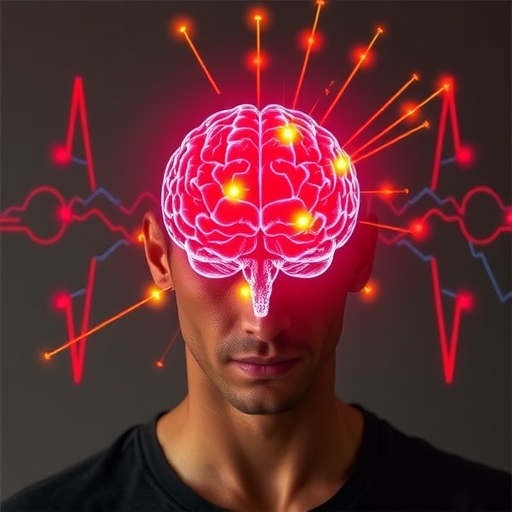
In a groundbreaking study set to redefine our understanding of brainwave dynamics, researchers Maaz, Waroquier, Dia, and their colleagues have unveiled compelling evidence that alpha power—the brain’s signature rhythm associated with relaxation and cognitive inhibition—increases spontaneously during neurofeedback sessions. Published in Communications Psychology in 2026, their findings challenge conventional assumptions about neurofeedback as a purely volitional process and open intriguing avenues for both clinical applications and cognitive enhancement strategies.
Alpha oscillations, typically ranging from 8 to 12 Hz, have long been recognized as critical indicators of the brain’s resting state and attentional processes. Traditionally, neurofeedback protocols aim to train individuals to consciously enhance these rhythms, resulting in improved cognitive performance, reduced anxiety, and beneficial effects on various neurological conditions. What sets this study apart is the demonstration that alpha power can amplify spontaneously, even without explicit instructions or strategic efforts from participants, hinting at endogenous regulatory mechanisms at play.
The experimental design involved participants undergoing standard neurofeedback sessions where real-time electroencephalographic (EEG) signals were monitored and fed back visually. Interestingly, the researchers observed a consistent trend: alpha wave enhancement occurred naturally over the course of the sessions, irrespective of whether participants were directed to modulate their brain activity or simply allowed to passively engage with the feedback loop. This observation suggests intrinsic neural adaptation processes that operate alongside, or possibly independently of, conscious control efforts.
Delving deeper, the team employed advanced time-frequency analysis and spectral decomposition methods to discern the specific temporal dynamics underlying the alpha power increase. The results indicate that the spontaneous elevation is not a fleeting artifact but a slowly building process that consolidates over repeated neurofeedback trials. The sustained nature of this increase hints at neuroplastic changes, potentially mediated through synaptic modulations within thalamo-cortical circuits known to generate alpha rhythms.
These insights hold profound implications for the field of neurofeedback therapy, which has historically grappled with inconsistent efficacy across individuals. Understanding that alpha power can augment autonomously suggests that neurofeedback protocols could be optimized to harness these innate oscillatory plasticity mechanisms, possibly reducing the cognitive load on participants and improving overall treatment outcomes. This opens a new vista wherein neurofeedback becomes a blend of active training and passive neurological facilitation.
Moreover, the spontaneous dynamics of alpha waves elucidated by Maaz and colleagues dovetail with emerging theories about the brain’s intrinsic activity patterns during rest and task engagement. Alpha oscillations have been implicated in functional inhibition, gating of sensory input, and modulation of attentional focus. The natural propensity for these rhythms to enhance under neurofeedback may reflect a fundamental homeostatic process aimed at balancing cortical excitability and maintaining optimal information processing states.
From a neurophysiological perspective, the findings raise intriguing questions about the loci of alpha wave generation during neurofeedback. The authors speculate on the involvement of distributed neural networks, including parietal and occipital regions, interacting with deep thalamic nuclei and cortical layer-specific circuits. These complex interactions could facilitate a feedback loop where initial minor fluctuations in oscillatory power get amplified through recurrent connectivity and synaptic potentiation, culminating in the observed spontaneous increase.
Clinically, the study’s revelations may translate into significant advancements for disorders linked to dysregulated alpha activity, such as anxiety, depression, and attention-deficit/hyperactivity disorder (ADHD). Harnessing spontaneous alpha increases might offer therapeutic windows where minimal intervention suffices to recalibrate dysfunctional brain rhythms, marking a paradigm shift from effort-intensive biofeedback training to subtler, perhaps even subconscious, modulation techniques.
In cognitive neuroscience, the implications extend to enhancing human performance and creativity. Given alpha waves’ association with states of relaxed alertness and creative ideation, the discovery that alpha power can grow naturally during neurofeedback suggests that mental states conducive to innovation might be more accessible than previously thought. This could pave the way for non-invasive methods to foster cognitive flexibility, problem-solving skills, and stress resilience without taxing mental resources.
Importantly, the study also underscores methodological considerations for future neurofeedback research. The spontaneous alpha increase phenomenon necessitates refined experimental controls to disambiguate volitional from automatic neural enhancements. Consequently, the authors advocate for integrative approaches combining behavioral measures, subjective reports, and electrophysiological data to capture the nuanced interplay between conscious effort and automatic brain dynamics.
The team employed rigorous statistical modeling, including mixed-effects designs, to validate the robustness of their observations across diverse participant samples and session parameters. This methodological rigor provides strong confidence that the spontaneous alpha power increase is a replicable and generalizable phenomenon, not merely an idiosyncratic finding or statistical anomaly.
From a mechanistic perspective, the researchers propose that spontaneous alpha power enhancement might stem from intrinsic brain rhythms’ resonance properties. Neural circuits could be entering an optimized state by leveraging feedback-induced plasticity, whereby neurofeedback acts not just as an external signal, but as a catalyst for endogenous rhythmic stabilization. This reframing positions neurofeedback less as a ‘training’ paradigm and more as a facilitatory context for intrinsic brain self-organization.
The broader scientific community is already taking notice, with experts heralding the study as a pivotal contribution that bridges cognitive neuroscience, clinical neuropsychology, and neuroengineering. As neurofeedback devices become more accessible through advances in wearable technology and artificial intelligence, insights into spontaneous alpha dynamics are expected to guide the development of next-generation brain-computer interfaces.
Ethical considerations also emerge in this context, especially regarding passive neurofeedback-induced brain state changes. The unintentional modulation of brain waves could raise questions about autonomy and informed consent, particularly if deployed in commercial wellness products or augmentative devices. The authors emphasize the importance of transparency and rigorous ethical frameworks accompanying neurofeedback technology deployment.
Future research directions outlined by Maaz and colleagues will explore the boundary conditions fostering spontaneous alpha upregulation, including individual differences in baseline alpha power, neurochemical modulators like GABA and acetylcholine, and interaction effects with environmental factors such as sensory input and cognitive load. Longitudinal studies will be critical to assess whether spontaneous increases translate into durable cognitive and emotional benefits.
Finally, this seminal work enriches our fundamental understanding of the brain’s capacity for self-regulation and dynamic adaptation. By revealing that alpha power enhancement is not solely a product of volitional control but also an innate neurophysiological process, the study invites us to reconsider how mental states can be cultivated and optimized, potentially heralding a new era of brain health interventions grounded in the brain’s own spontaneous rhythms.
Subject of Research: Neural dynamics of alpha oscillations during neurofeedback sessions
Article Title: Alpha power increases spontaneously during a neurofeedback session
Article References: Maaz, J., Waroquier, L., Dia, A. et al. Alpha power increases spontaneously during a neurofeedback session. Commun Psychol (2026). https://doi.org/10.1038/s44271-026-00431-w
Image Credits: AI Generated


