

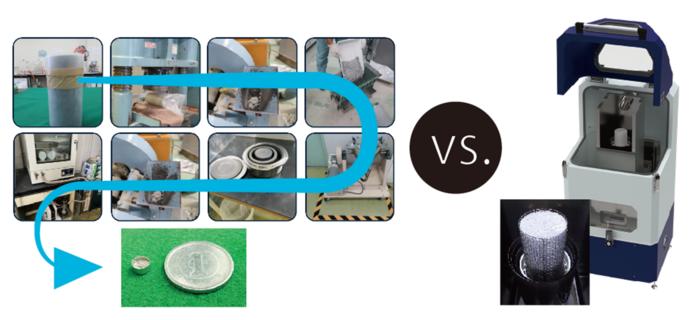
A new device can measure carbon dioxide captured in concrete more simply and in a third of the time of current methods. Researchers at the University of Tokyo worked with engineers in industry to create the boxlike device called the concrete thermal gravimetry and gas analyzer. The device heats concrete samples to almost 1,000 degrees Celsius, causing the CO2 within to be released so it can be measured. Compared to the current technique, which involves a time-consuming and complicated process of crushing concrete samples into powder for sampling, this new method is simpler, more accurate and user-friendly. The researchers hope it will contribute to CO2 trading in the future, as the concrete and cement industry work towards offsetting their emissions as part of global targets to manage greenhouse gases.

Credit: 2024 I. Maruyama, K. Noritake, Y. Hosoi, and H. Takahashi
A new device can measure carbon dioxide captured in concrete more simply and in a third of the time of current methods. Researchers at the University of Tokyo worked with engineers in industry to create the boxlike device called the concrete thermal gravimetry and gas analyzer. The device heats concrete samples to almost 1,000 degrees Celsius, causing the CO2 within to be released so it can be measured. Compared to the current technique, which involves a time-consuming and complicated process of crushing concrete samples into powder for sampling, this new method is simpler, more accurate and user-friendly. The researchers hope it will contribute to CO2 trading in the future, as the concrete and cement industry work towards offsetting their emissions as part of global targets to manage greenhouse gases.
Concrete is everywhere. We live in it, walk on it, even make movies and write songs about it. Ubiquitous in modern life and even way back in ancient Rome, this sturdy and durable material is a staple for construction projects around the world. But, it is a mixed bag. On the one hand, the process of making concrete and one of its key ingredients, cement, emits a considerable amount of greenhouse gases. It is estimated that 5-8% of all CO2 emissions from human activities to date are from cement production alone. However, concrete can now be used to store CO2, through methods of carbon capture, utilization and storage.
Achieving “net zero,” whereby the amount of CO2 taken out of the atmosphere is equal to the amount released, has become a cornerstone of international policies to tackle global warming. But to do this, we need to know what creates greenhouse gases and at what levels, and how much can be removed through different techniques.
Until now, finding out how much CO2 has been successfully captured in concrete was an extensive process. A cylinder block, about 10 centimeters in diameter and 20 cm high, would be taken and crushed in a way that it couldn’t react with the air (which would affect the results). Then a complicated and long process followed to turn it into a fine, uniform powder from which a small sample was taken for chemical analysis
A new device, developed by researchers at the University of Tokyo with engineers in industry, can skip this time-consuming process. “We developed a new machine which can measure how much CO2 is fixed in concrete or cementitious material without having to crush it,” said Professor Ippei Maruyama from the Department of Architecture at the University of Tokyo Graduate School of Engineering. “Until now, there wasn’t a simple method to measure the amount of CO2 fixed in concrete, but with this device, we can shorten the time it takes to measure CO2 and increase the accuracy of the measurement.”
A specimen block is placed inside the device and then heated to 980 degrees Celsius. As the block heats up, gases including CO2 are released from the block, which can then be measured. This new process takes about one-third of the time of current methods, limiting the time the concrete can react with the air. Results showed that an accurate measurement could be taken even when CO2 was not uniformly distributed within the block.
Researchers at the University of Tokyo envisioned the concept and parts required for the device, while engineers at Rigaku Corp. then developed it. It was then verified by researchers at the University of Tokyo and Taiheiyo Consultants Co., Ltd.
“This device requires a suitably large space and special safety considerations, so for now, there are some limitations to its application,” said Maruyama. “However, after further tests, we hope to make this device commercially available, so that it can contribute to sound emissions trading in the concrete sector and support global efforts to reach carbon neutrality.”
#####
Paper: Ippei Maruyama, Koichiro Noritake, Yoshinobu Hosoi, and Haruka Takahashi. Development of a large-scale thermogravimetry and gas analyzer for determining carbon in concrete. Journal of Advanced Concrete Technology. June 24th 2024. DOI: 10.3151/jact.22.383
Funding:
This study was based on the results obtained from a project (JPNP21023) commissioned by the New Energy and Industrial Technology Development Organization (NEDO).
Declaration / conflicts of interest
N/A
Useful Links
Graduate School of Engineering: https://www.t.u-tokyo.ac.jp/en/soe
Building Material Engineering Lab: https://bme.t.u-tokyo.ac.jp/en/
Research Contact:
Professor Ippei Maruyama
Department of Architecture, The University of Tokyo
Hongo 7-3-1, Bunkyo-ku, Tokyo 113-8656
Tel: 03-5841-6796
Email: i.maruyama@bme.arch.t.u-tokyo.ac.jp
Press contact:
Mrs. Nicola Burghall (she/her)
Public Relations Group, The University of Tokyo,
7-3-1 Hongo, Bunkyo-ku, Tokyo 113-8654, Japan
press-releases.adm@gs.mail.u-tokyo.ac.jp
About the University of Tokyo
The University of Tokyo is Japan’s leading university and one of the world’s top research universities. The vast research output of some 6,000 researchers is published in the world’s top journals across the arts and sciences. Our vibrant student body of around 15,000 undergraduate and 15,000 graduate students includes over 4,000 international students. Find out more at www.u-tokyo.ac.jp/en/ or follow us on X (formerly Twitter) at @UTokyo_News_en.
Journal
Journal of Advanced Concrete Technology
Method of Research
Experimental study
Subject of Research
Not applicable
Article Title
Development of a large-scale thermogravimetry and gas analyzer for determining carbon in concrete
Article Publication Date
24-Jun-2024

