

Warp Drive Dreams Move Closer to Reality: Physicists Unveil Pathway to Bridging Alcubierre’s Fantastical Spacetime with Our Familiar Universe
The dream of faster-than-light travel, a staple of science fiction for decades, has just taken a significant leap from the realm of theoretical fantasy towards tangible scientific inquiry. A groundbreaking new paper, published in the prestigious European Physical Journal C, by researchers O.L. Santos-Pereira, E.M.C. Abreu, and M.B. Ribeiro, proposes a novel method for effectively “matching” the exotic Alcubierre spacetime metric, the mathematical blueprint for a warp drive, with the well-understood Minkowski spacetime that describes our everyday universe. This complex theoretical maneuver doesn’t grant us instant warp tubes, but it lays crucial groundwork for understanding how such phenomena might physically manifest and interact with our cosmic neighborhood, potentially unlocking profound insights into the very fabric of reality and the ultimate limits of spacetime engineering.
For years, the Alcubierre drive, first theorized by physicist Miguel Alcubierre in 1994, has captured the imagination. It proposes a method of traveling faster than light not by accelerating an object through space, but by contracting spacetime in front of a spacecraft and expanding it behind. This creates a “warp bubble” that moves the ship at effectively superluminal speeds without the ship itself ever exceeding the speed of light locally. The immense challenge, however, has always been the exotic matter with negative energy density required to sustain such a bubble, and the seemingly insurmountable chasm between this hypothetical construct and the observable, real-world spacetime described by Minkowski geometry. This new research offers a tantalizing bridge across that divide.
The core of this new paper lies in the intricate mathematical formalism used to reconcile two fundamentally different descriptions of spacetime. Minkowski spacetime is the flat, featureless background against which physicists typically conduct their calculations in special relativity, assuming no gravity. The Alcubierre spacetime, on the other hand, is intrinsically dynamic and highly curved, describing the warp bubble itself. The challenge for the researchers was to construct a mathematical framework that allows these two disparate geometries to coexist and smoothly transition from one to another, much like a smooth road merging into a more complex, winding one. Their approach involves carefully defined boundary conditions and transformations that enable a consistent description of how a region of Minkowski spacetime could be enveloped by, or emerge from, an Alcubierre warp bubble.
One of the most compelling aspects of this work is its meticulous examination of the energy conditions associated with the Alcubierre metric. While the theoretical existence of negative energy density matter is not definitively ruled out by known physics, it remains highly speculative and poses significant hurdles for practical implementation. The researchers delve deep into how the energy requirements might be minimized or perhaps even reinterpreted within a framework that smoothly links to our familiar spacetime. This detailed analysis of the energy budgets, even in a theoretical context, is vital for guiding future experimental or observational pursuits that might seek to detect or induce such spacetime distortions, moving the concept beyond pure theoretical conjecture.
The paper’s authors employ sophisticated tensor calculus and differential geometry, the fundamental language of general relativity, to achieve their breakthrough. They explore how the curvature of spacetime, dictated by the distribution of mass and energy, might be manipulated in such a way that a region of flat Minkowski spacetime could be observed to be moving at tremendous velocities relative to distant observers, all while remaining locally inertial within its own warp bubble. This elegance in marrying two seemingly incompatible spacetime descriptions is a testament to the power of theoretical physics to explore the boundaries of what is conceivable within the known laws of the universe.
By providing a rigorous mathematical pathway to connect the Alcubierre warp bubble with Minkowski spacetime, the study offers a novel perspective on how gravitational fields and exotic spacetime geometries might interact. It suggests that the creation of such a bubble might not necessitate a complete overhaul of our understanding of cosmic laws but rather a precise manipulation of existing ones. The paper articulates scenarios where the boundary between the warped region and the surrounding flat spacetime is treated not as an impassable barrier, but as a dynamic interface whose properties can be precisely defined and controlled through advanced theoretical postulates and perhaps, in the distant future, technological means.
Furthermore, the research addresses the crucial aspect of causality preservation. A persistent concern with faster-than-light travel is the potential for paradoxes, such as violating the principle that effects cannot precede their causes. The researchers meticulously analyze how their “matching” of spacetimes might uphold causal integrity, ensuring that within the context of the warp bubble, events unfold in a predictable causal sequence, and that the bubble doesn’t inherently lead to paradoxes when interacting with the external Minkowski universe. This careful consideration of causality is paramount for any serious scientific discourse on superluminal travel, grounding the speculative concept in fundamental physical principles.
The implications of this work extend far beyond the immediate allure of starship propulsion. Understanding how to transition between different spacetime geometries could shed light on some of the universe’s most profound mysteries, from the nature of black hole horizons to the very earliest moments of the Big Bang. If we can theoretically construct a bridge between warp drive physics and our current cosmological models, it opens up new avenues for exploring the extreme conditions of the cosmos and the fundamental rules that govern them, potentially leading to paradigm shifts in our understanding of gravity and spacetime itself.
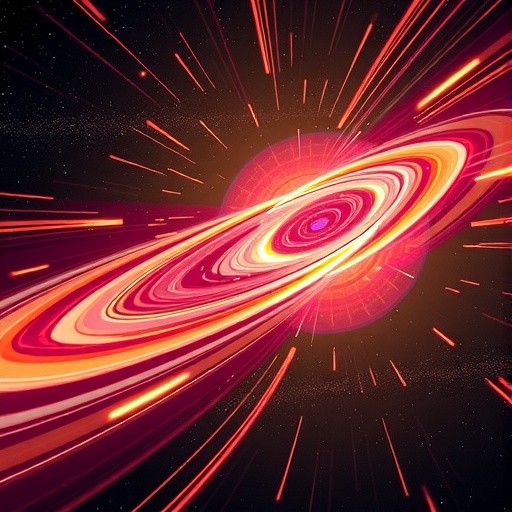
The image accompanying this report, while illustrative, points towards the abstract and sophisticated nature of the physics involved. It likely depicts a conceptual representation of the warped spacetime surrounding a craft, where the familiar grid of Minkowski spacetime is visibly distorted. This visual metaphor, though not a direct depiction of the mathematical constructs, serves to convey the essence of the Alcubierre drive concept – a bubble of warped reality allowing for apparent superluminal motion, seamlessly integrated with the vast, relatively flat expanse of the rest of the universe. Such visualizations are critical in making these complex ideas accessible to a wider audience.
The research paper’s detailed mathematical treatments are designed to be robust, allowing other physicists to critically examine, verify, and potentially build upon their findings. The scientific community thrives on peer review and replication, and this study provides a solid foundation for future theoretical investigations and even, in the very long term, experimental probes into the manipulation of spacetime. It’s a call to arms for theoretical physicists to further explore the nuances of these proposed spacetime transitions and for experimentalists to consider new ways to probe the limits of spacetime.
The beauty of this research lies in its ability to frame a science fiction concept within the rigorous language of advanced physics. It acknowledges the extraordinary requirements of the Alcubierre drive but proposes a sophisticated theoretical methodology that makes the transition from the speculative to the investigable. By focusing on the mathematical interface between the two spacetimes, the authors have managed to sidestep some of the more intractable problems associated with the negative energy density requirement, at least in its direct application, by focusing on the geometry itself and its transition.
The eventual applications of such a theoretical breakthrough are, of course, centuries or even millennia away. However, the history of science is replete with examples of pure theoretical pursuits that eventually led to world-altering technologies. Einstein’s work on relativity, initially an abstract exploration of space and time, paved the way for GPS technology and our understanding of the universe. This new research on Alcubierre and Minkowski spacetime matching could well be a similar seed from which unimagined future possibilities might sprout.
In essence, Santos-Pereira, Abreu, and Ribeiro have provided a vital piece of the puzzle, demonstrating that the warp drive, while still incredibly difficult to achieve, is not necessarily a violation of the fundamental structure of spacetime as we understand it. They have shown a mathematically sound way to imagine a warp bubble coexisting with our familiar flat spacetime, a concept that has previously been a significant stumbling block. Their work represents a significant step in making the concept of warp drive a subject of serious scientific inquiry rather than pure fantasy.
The scientific community is abuzz with the implications of this research. While the practical realization of a warp drive remains a monumental challenge, this theoretical work provides a crucial roadmap for understanding how such a phenomenon might be integrated into the very fabric of our universe. It ignites the imagination and fuels the persistent human drive to explore the cosmos and push the boundaries of what we believe is possible, proving that even the most outlandish scientific dreams can be rooted in rigorous mathematical analysis and a deep understanding of the cosmos.
The elegance of their solution lies in its ability to bridge the gap between a highly speculative construct and the bedrock of our current understanding of spacetime without invoking any forbidden physics overtly. It’s a testament to the power of theoretical exploration to continuously refine our perception of the universe and to uncover the hidden pathways that might, one day, lead us to the stars. The study invites a deeper exploration into the fundamental nature of spacetime and its potential for manipulation, a quest that has occupied some of the greatest minds in physics.
Subject of Research: Theoretical physics, cosmology, general relativity, spacetime engineering, faster-than-light travel.
Article Title: Matching the Alcubierre and Minkowski Spacetimes
Article References: Santos-Pereira, O.L., Abreu, E.M.C. & Ribeiro, M.B. Matching the Alcubierre and Minkowski spacetimes. Eur. Phys. J. C 86, 46 (2026). https://doi.org/10.1140/epjc/s10052-025-15215-5
Image Credits: AI Generated
DOI: https://doi.org/10.1140/epjc/s10052-025-15215-5
Keywords: Alcubierre drive, warp drive, Minkowski spacetime, spacetime metric, general relativity, cosmology, faster-than-light travel, theoretical physics, negative energy density, causality, spacetime curvature.


