

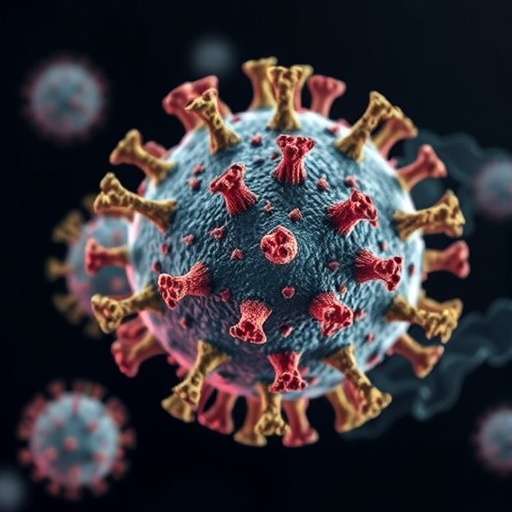
In a groundbreaking study that bridges the fields of environmental science, virology, and artificial intelligence, researchers have unveiled critical insights into how air pollution impacts susceptibility to SARS-CoV-2 infection. Leveraging state-of-the-art AI-driven multi-omics analysis, the team led by Feng, Dong, and Ke has identified the Niemann-Pick disease type C1 (NPC1) protein as a crucial mediator in increasing vulnerability to COVID-19 among individuals exposed to fine particulate matter (PM2.5). This discovery not only deepens our understanding of the molecular mechanisms underpinning viral infection in polluted environments but also highlights potential therapeutic targets for mitigating risk in vulnerable populations.
The study’s methodology employed a sophisticated artificial intelligence framework that integrated multi-layered omics data including genomics, transcriptomics, proteomics, and epigenomics. By processing and cross-referencing vast datasets from populations exposed to varying levels of PM2.5, the AI model pinpointed NPC1 as a pivotal factor influencing how SARS-CoV-2 interacts with host cells. This multi-omics approach allowed for a nuanced interrogation of the cellular landscape, revealing the complex interplay between environmental pollutants and host genetic factors that dictate susceptibility.
Atmospheric particulate matter with diameters smaller than 2.5 micrometers, commonly referred to as PM2.5, is a notorious pollutant linked to a broad array of respiratory and cardiovascular ailments. Its tiny size enables deep lung penetration and systemic circulation, where it can incite inflammation and immune dysregulation. The team’s findings suggest that PM2.5 exposure modulates NPC1 expression and function within lung epithelial cells, thereby altering the dynamics of SARS-CoV-2 entry and replication. This interconnection provides a molecular explanation for the epidemiological observations of higher COVID-19 morbidity and mortality rates in highly polluted regions.
NPC1 is an intracellular cholesterol transporter traditionally implicated in Niemann-Pick disease, a lysosomal storage disorder. The protein resides primarily in the membranes of late endosomes and lysosomes, organelles integral to intracellular trafficking and pathogen processing. The new research reveals NPC1’s unsuspected role as a facilitator of viral entry and infection. Mechanistically, elevated PM2.5 exposure recalibrates cellular lipid metabolism pathways, augmenting NPC1 activity, which in turn enhances SARS-CoV-2’s ability to hijack endosomal pathways to enter host cells more effectively.
The AI model developed utilized advanced deep learning algorithms, enabling it to sift through the complex non-linear relationships within the multi-omics data. This allowed for the identification of NPC1 not just as an isolated factor, but as part of a broader regulatory network altered by PM2.5 exposure. Through this systems biology lens, researchers could delineate key signaling cascades and transcriptional programs modified by environmental pollution, providing an integrated picture of how external pollutants rewire cellular infrastructure to favor viral infection.
Importantly, the study also explored how modulation of NPC1 expression impacts viral replication post-entry. Using in vitro cell culture models treated with PM2.5 extracts, the researchers demonstrated that cells with upregulated NPC1 exhibited significantly increased viral load, underscoring the protein’s functional relevance beyond mere viral docking. Moreover, pharmacological inhibition of NPC1 resulted in reduced viral replication, invoking the potential for repurposed drugs targeting NPC1 as adjunct therapies for COVID-19, particularly in polluted urban settings.
The environmental aspect of the study underscores the public health implications of chronic PM2.5 exposure. By elucidating the molecular pathways linking pollution to infectious disease susceptibility, the research shifts the narrative from solely focusing on direct viral mitigation strategies to incorporating environmental remediation as an equally vital component. This could catalyze policy reforms aiming to reduce ambient air pollution as a means of curbing pandemic severity and enhancing population resilience against respiratory viruses.
One of the study’s novel contributions is its demonstration of how AI can accelerate discovery in complex biological systems influenced by environmental factors. Traditional methods of dissecting such multifaceted interactions are often time-consuming and limited by the scale of data. Here, AI-driven multi-omics fusion enabled rapid hypothesis generation and testing, illustrating the vast potential for computational approaches in future epidemiological and mechanistic viral pathogenesis research.
Beyond SARS-CoV-2, the mechanistic insights into NPC1’s role within pollutant-exposed cells may have wider implications for understanding host-pathogen interactions in various infectious diseases. Given NPC1’s involvement in cholesterol trafficking—a process critical for many viral life cycles—this protein could serve as a universal nodal point that environmental stressors exploit to exacerbate infectious disease risk, warranting broader investigation across virology.
The researchers also provided a comprehensive analysis of cellular transcriptomic shifts upon PM2.5 exposure, noting upregulation of inflammatory cytokines and dysregulation of interferon signaling pathways. These changes further exacerbate host susceptibility by compromising innate immune defenses and may synergize with NPC1’s facilitation of viral entry. This multilayered immune modulation underscores the complex biological disruption caused by pollution, which extends beyond just mechanical obstruction to active biochemical reprogramming.
In terms of translational applications, the study opens new avenues for developing diagnostic tools that incorporate environmental exposure profiles and NPC1 expression status to predict COVID-19 risk. Such precision medicine approaches could inform targeted interventions and prioritize resource allocation in high-risk communities, embodying a shift toward more holistic pandemic management models that integrate environmental, molecular, and clinical data streams.
Moreover, the findings stimulate a re-examination of existing treatment paradigms. Traditionally, antiviral strategies have focused primarily on viral proteins or host receptors such as ACE2. This study spotlights intracellular trafficking regulators like NPC1 as additional viable targets. Future pharmacological development could focus on small molecules or biologics that modulate NPC1’s activity or expression, potentially serving as adjuncts that reduce viral load and improve clinical outcomes, especially in populations burdened by environmental pollution.
The study also highlighted the spatial heterogeneity of PM2.5 effects on lung tissue, detailing how localized alterations in NPC1 expression can create microenvironments permissive to viral proliferation. This granularity points to the importance of considering tissue-specific responses in both research and clinical intervention design, acknowledging that exposure does not uniformly affect all regions of the respiratory tract.
Harnessing AI’s power, the researchers developed predictive modeling frameworks that anticipate future outbreak severity based on pollution trends and population genetic susceptibility patterns involving NPC1 polymorphisms. These predictive tools could greatly enhance public health preparedness, enabling preemptive measures such as targeted vaccination campaigns or pollution control efforts timed according to predicted risk windows.
The cross-disciplinary approach championed by Feng and colleagues exemplifies the next frontier in infectious disease research, where integration of cutting-edge AI analytics, molecular biology, and environmental health converge to unravel hidden layers of disease vulnerability. This paradigm not only broadens scientific understanding but also empowers policymakers, clinicians, and researchers to craft more effective and equitable health interventions.
In summary, the revelation that NPC1 modulates SARS-CoV-2 susceptibility under PM2.5 exposure is a pivotal advancement, exposing previously unrecognized molecular crosstalk between environmental pollutants and viral infection mechanisms. This knowledge spotlights the urgent need for interdisciplinary strategies to combat pandemics, emphasizing environmental health as a cornerstone of infectious disease prevention and control in our increasingly industrialized and polluted world.
Subject of Research:
Investigating the role of NPC1 protein in modulating susceptibility to SARS-CoV-2 infection under exposure to fine particulate matter (PM2.5) using AI-guided multi-omics analysis.
Article Title:
AI-guided multi-omics analysis identifies NPC1-modulated susceptibility to SARS-CoV-2 infection under PM2.5 exposure.
Article References:
Feng, G., Dong, Z., Ke, L. et al. AI-guided multi-omics analysis identifies NPC1-modulated susceptibility to SARS-CoV-2 infection under PM2.5 exposure. Nat Commun (2026). https://doi.org/10.1038/s41467-026-71196-3
Image Credits: AI Generated


