

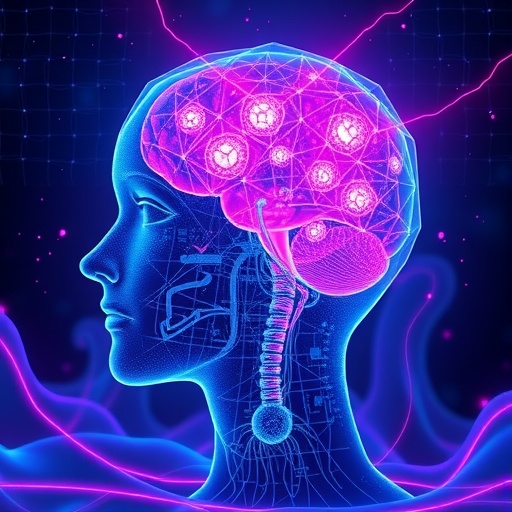
In the ever-evolving landscape of mental health research, an innovative confluence of artificial intelligence and psychedelic science has emerged, promising to reshape therapeutic practices and digital experiences alike. A recent breakthrough detailed in a 2026 publication in Nature Mental Health sheds light on the unprecedented potential of AI-generated virtual psychedelics—sophisticated, computer-crafted simulations designed to replicate and expand upon the psychoactive effects of traditional psychedelics. This pioneering approach marks a significant departure from both classical pharmacological interventions and existing virtual reality therapies, bridging digital innovation with profound mental health applications.
The essence of these AI-generated virtual psychedelics lies in their capacity to simulate the rich, multifaceted perceptual and cognitive effects typical of substances like psilocybin, LSD, or DMT, yet entirely within a controlled digital environment. Employing advanced machine learning algorithms and generative models, researchers have crafted immersive experiences capable of modulating users’ sensory inputs, emotional states, and neural dynamics in ways that mirror psychedelic phenomenology. This technological feat taps into the intricate architecture of human consciousness, leveraging AI’s pattern-recognition strengths to curate experiences that resonate deeply on subjective and neurological levels.
Fundamentally, the creation process involves training AI systems on large datasets encompassing neuroimaging, psychophysical responses, and subjective reports associated with psychedelic use. Through this data amalgamation, the models learn to synthesize virtual environments and sensory stimuli that mimic the altered states induced by chemical psychedelics. Virtual reality (VR) and augmented reality (AR) platforms act as the delivery interfaces, with precisely programmed visuals, sounds, and haptic feedback eliciting effects akin to those experienced during classic psychedelic sessions. The intricate orchestration of these stimuli by AI ensures that the induced mental states are both scientifically grounded and therapeutically relevant.
Notably, these AI-generated virtual psychedelics circumvent many challenges inherent in traditional psychedelic therapy. The legal and regulatory complexities surrounding psychoactive substances often limit accessibility and application scope. By replacing pharmacological agents with digitally engineered experiences, the approach opens avenues for legally compliant, scalable mental health interventions. Additionally, the digital format permits real-time customization tailored to individual patient profiles, optimizing therapeutic outcomes while minimizing risks such as adverse psychological reactions or physical harm.
Neurologically, virtual psychedelics engage brain networks implicated in perception, emotion, and self-referential processing, including the default mode network (DMN) and sensory cortices. Functional connectivity analyses have revealed patterns of neural activity during virtual psychedelic sessions that resemble those observed in pharmacological psychedelic states, suggesting a convergence of mechanism despite the absence of chemical agents. This fidelity is vital not only for therapeutic efficacy but also for elucidating the underpinnings of consciousness and its modulation through non-invasive means.
This paradigm also holds transformative potential for mental health conditions that have historically been refractory to conventional therapies. Depression, anxiety, PTSD, and addiction—ailments often marked by rigid cognitive patterns and emotional dysregulation—may benefit from the neuroplasticity enhancements and perceptual flexibility engendered by virtual psychedelic experiences. Early clinical trials exhibit promising results, with patients reporting sustained mood improvements, reduced symptom severity, and enhanced introspective insight following AI-facilitated sessions, all without ingesting psychoactive compounds.
Beyond clinical applications, AI-generated virtual psychedelics represent a frontier for experimental neuroscience and psychology. Researchers can systematically manipulate experiential parameters, dissecting the components of psychedelic states with unprecedented granularity and ethical oversight. This capacity propels fundamental understanding of altered consciousness, offering a sandbox for probing reality perception, ego dissolution, and mystical-type experiences without the confounding variables implicit in drug metabolism or adherence.
Furthermore, the integration of biofeedback and neurofeedback systems offers exciting prospects for dynamic, closed-loop virtual psychedelic experiences. By monitoring physiological and neural markers, AI can adapt the virtual environment in real time, enhancing therapeutic precision and fostering greater user agency. Such adaptive environments herald a future where mental health interventions are not static protocols but living systems responsive to the evolving internal state of the participant.
Ethical considerations shadow this emergent technology as well. Ensuring user safety, informed consent, and psychological readiness is paramount, especially given the immersive and potentially disorienting nature of virtual psychedelics. The research community advocates for rigorous guidelines and multidisciplinary oversight to balance innovation with responsibility. Transparent reporting of outcomes, adverse events, and long-term effects will be essential to maintain public trust and clinical viability.
On the technological frontier, the development of AI models capable of faithfully reproducing the phenomenological richness of psychedelics demands continual refinement. Advances in neural network architectures, unsupervised learning, and multimodal data integration will enhance simulation fidelity and robustness. Simultaneously, enhancements in VR/AR hardware, including higher resolution displays, spatial audio, and tactile feedback, will deepen immersion and therapeutic impact.
The potential for democratizing access to psychedelic therapy via AI-generated virtual psychedelics also signals a societal shift. Remote deployment through consumer-grade VR devices can transcend geographic and economic barriers, bringing advanced mental health tools into underserved communities. This accessibility could alleviate systemic burdens by providing scalable support options complementary to traditional services, thus broadening the mental health landscape’s inclusivity.
Commercial interests are rapidly converging on this space, with startups and established tech companies investing heavily in AI-driven psychedelic simulations. These ventures promise novel wellness products, therapeutic services, and entertainment experiences, creating a multifaceted ecosystem where clinical rigor intersects with consumer innovation. However, this dynamic also necessitates robust regulatory frameworks to safeguard scientific integrity and prevent exploitative practices.
In sum, the advent of AI-generated virtual psychedelics is more than a technological novelty; it is a pivot toward reimagining mental health care and altered states research. It harmonizes digital sophistication with human psychology, shaping a future where consciousness modulation is accessible, customizable, and integrated within ethical and therapeutic frameworks. As ongoing studies unravel long-term efficacy, neural mechanisms, and best practice protocols, this approach stands as a beacon of digital therapeutics and cognitive exploration.
In conclusion, the fusion of artificial intelligence, virtual reality, and psychedelic science illuminates a path forward, addressing unmet clinical needs while deepening our grasp of human consciousness. AI-generated virtual psychedelics herald an era of innovative digital psychedelia, poised to transform mental health treatment paradigms and expand horizons in neuroscience, psychology, and beyond. The ripple effects of this technology will undoubtedly catalyze new dialogues and discoveries at the intersection of technology and mind.
Subject of Research: The use of AI-generated virtual psychedelics to simulate psychedelic experiences and their therapeutic application in mental health.
Article Title: AI-generated virtual psychedelics bridge digital and therapeutic frontiers in mental health research.
Article References:
Riva, G., Brizzi, G., Rastelli, C. et al. AI-generated virtual psychedelics bridge digital and therapeutic frontiers in mental health research. Nat. Mental Health (2026). https://doi.org/10.1038/s44220-025-00576-3
Image Credits: AI Generated


