

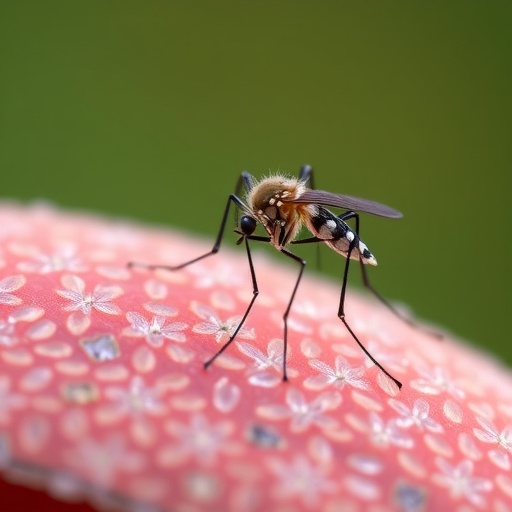
In the ongoing battle against vector-borne diseases like malaria, dengue, chikungunya, and ZIKA, early and accurate surveillance of mosquito populations remains a critical cornerstone for effective public health interventions. These diseases claim hundreds of thousands of lives annually and affect millions more worldwide, underscoring the urgent need for innovative monitoring technologies that operate in real time and with high precision. One promising frontier in mosquito surveillance leverages the acoustics of mosquito flight – a method centered on capturing and interpreting the faint wingbeat sounds emitted by these tiny, yet deadly, insects.
Mosquitoes produce sound when they flap their wings, creating a frequency that varies according to several biological and environmental factors. The essence of this method lies in the fact that the wingbeat frequency differs among mosquito species, providing a acoustic signature that can theoretically be used for precise species identification. This is particularly valuable because public health efforts often need to focus on detecting only a handful of species known to be effective vectors of disease or invasive threats. Harnessing these sound signatures, advanced AI algorithms can potentially deliver automated, continuous surveillance, revolutionizing how vector populations are tracked.
Recent advances in artificial intelligence, particularly deep learning models, have demonstrated impressive success in classifying mosquito species based on their flight sounds. Some AI models have achieved accuracy levels as high as 97% in controlled settings. However, this encouraging performance often deteriorates when the number of species expands, primarily due to significant variability in mosquito sounds driven by natural environmental and biological factors. In addition, most existing training datasets used to develop these models are limited, lacking wide representation of species, environmental conditions, and individual characteristics, thereby challenging the reliability of AI species recognition in varied field conditions.
A groundbreaking study conducted collaboratively by researchers from the HUN-REN Centre for Ecological Research, ELTE University, and the University of Szeged in Hungary has delved deeply into this challenge. The scientists sought to unravel how much mosquito wingbeat sounds vary not only between species but also between individual mosquitoes and under different environmental conditions. By examining these variables in detail, the team aimed to shed light on the acoustic complexity that must be accounted for to enhance AI-driven mosquito surveillance systems.
The researchers embarked on an extensive experimental study involving the capture and sound recording of hundreds of mosquitoes representing the ten most abundant species in Hungary. Recordings were captured using a sophisticated setup that included a 4-channel microphone array delicately positioned around mosquito cages to maximize the chances of recording the faint wingbeat sounds. Despite performing the experiments inside a soundproof box, the team faced the technical challenge that mosquito wingbeat frequencies are inherently faint, making reliable data collection particularly difficult without multi-microphone approaches.
In analyzing the collected data, the team found that while the acoustic signals related to specific species remained relatively consistent, controlling for environmental and biological variability significantly improved the reliability of species-specific signatures. This finding suggests that mosquito flight sounds do maintain distinguishing features but that natural variability must be integrated into AI recognition systems for these tools to perform well outside the lab. Addressing this variability requires incorporating factors such as temperature, humidity, mosquito sex, age, and size, all of which the researchers studied in detail.
One of the most influential parameters affecting mosquito sound was sex. Female mosquitoes generally exhibited lower-frequency wingbeat sounds compared to males, a result that aligns with their typical larger body size. This difference is critical because it indicates that sex-based acoustic variations must be embedded in AI training data if classification models are to achieve robust accuracy. Neglecting such intra-species acoustic variability risks misidentification and reduced surveillance efficiency.
Temperature emerged as another significant driver of sound variability among mosquitoes. The team observed that higher temperatures tend to increase wingbeat frequency, likely due to the physiological effect of temperature on insect metabolism and muscle activity. Mosquito muscles beat wings faster as ambient temperature rises, boosting wingbeat frequency and hence the sound pitch. However, this relationship was not uniform; different species exhibited distinct sensitivities to temperature changes, reflecting their evolutionary adaptations to different climatic niches and host preferences.
In particular, species originating from temperate zones reacted differently to temperature shifts compared to those from subtropical regions. This variability may also connect to the typical blood temperature of their preferred host animals, such as hotter mammal blood versus cooler bird blood. The differential response means that a universal temperature correction algorithm for sound frequency cannot be applied across species. Instead, precise, species-specific models must be developed to accurately calibrate acoustic data according to ambient environmental conditions.
Julie Augustin, the first author and a leading expert from the HUN-REN Centre, stressed the importance of embracing natural acoustic variability for building next-generation AI classifiers. According to Augustin, “Our data demonstrates that we cannot ignore intra-specific and intra-individual variability for AI-based acoustic classification. Better integration of this natural variance would require training data that comprehensively represents environmental and biological diversity, a goal currently limited by the scarcity of complete ecological sound databases.”
Building such detailed and expansive databases is no trivial task. It involves painstaking collection, recording, and annotation of mosquito sounds across multiple species, regions, seasons, and environmental scenarios. Yet without this level of representation, AI models risk being trained on narrow datasets, causing them to underperform in the field where conditions are dynamic and unpredictable. Augmenting training datasets to mirror real-world variability thus represents a critical research priority for ecoacoustics and vector surveillance.
An alternative or complementary approach involves embedding environmental metadata directly into classification algorithms. By incorporating temperature, humidity, and other factors as inputs alongside acoustic features, AI systems can adjust their predictions dynamically, improving accuracy. While some efforts along these lines exist, the comprehensive understanding necessary to implement such context-aware algorithms across multiple mosquito species is not fully developed, indicating a fertile area for future research.
Ultimately, the study highlights the nuanced landscape of mosquito acoustic signals and the significant challenges in deploying effective AI-based monitoring tools. To transform passive acoustic surveillance into a dependable public health asset, research must continue toward integrating natural variability, expanding ecological datasets, and enhancing algorithmic sophistication. Such advances could enable real-time detection of vector species, providing early warnings to mitigate outbreaks and potentially saving countless lives.
This research not only paves the way for improved AI applications in vector ecology but also exemplifies the broader intersection of biology, environmental science, and cutting-edge computational techniques. By harnessing the faint buzz of a mosquito’s wings, scientists edge closer to novel, scalable, and non-invasive solutions to global health challenges, revealing how even the subtlest sounds can carry profound insights.
Subject of Research: Animals
Article Title: Proximate determinants of the frequency of mosquito sounds: separating species-specific effects from environmentally driven variations – implications for AI species recognition
News Publication Date: 4-Mar-2026
Image Credits: Augustin, Julie
Keywords: mosquito acoustics, vector-borne diseases, AI classification, wingbeat frequency, species recognition, environmental variability, biological variability, temperature effects, passive acoustic monitoring, mosquito surveillance, deep learning, entomology


