

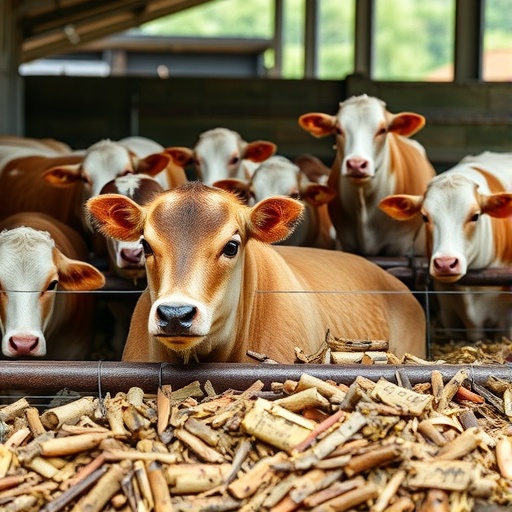
In a groundbreaking advancement for sustainable agriculture and environmental management, researchers have unveiled a sophisticated machine learning framework capable of optimizing the hydrothermal treatment of livestock manure. This novel approach not only enhances the conversion efficiency of biowaste into valuable resources but also predicts the dynamic behavior of phosphorus— a critical yet finite nutrient—within both the solid hydrochar and liquid effluents generated during treatment. The findings promise transformative implications for waste valorization, nutrient recovery, and pollution mitigation on a global scale.
Hydrothermal treatment stands out as a cutting-edge biowaste processing technology that circumvents the necessity for prior drying, operating effectively across a broad spectrum of temperature regimes. This process thermochemically converts wet biomass, such as livestock manure, into hydrochar—a carbon-rich, stable solid—and a phase enriched with solubilized nutrients. Unlike conventional drying and pyrolysis methods, hydrothermal treatment offers significant energy savings and enhanced nutrient retention, particularly of phosphorus, whose misallocation in ecosystems frequently precipitates eutrophication and ecological degradation.
Phosphorus plays an indispensable role in plant metabolism and crop yield optimization, yet its natural reserves are geopolitically concentrated and rapidly depleting. The diffuse dispersal of phosphorus in agricultural waste streams, especially from livestock manure, presents a dual challenge: environmental contamination when unmanaged, and loss of a vital fertility input when unrecovered. Addressing this challenge, the research spearheaded by Xiaofei Ge and colleagues integrates advanced machine learning techniques to precisely model and predict phosphorus partitioning during hydrothermal treatment, thereby illuminating pathways for maximizing nutrient recycling.
Machine learning models such as XGBoost, Decision Trees, and Random Forests were methodically trained and validated using extensive experimental datasets to capture the multifactorial influences governing phosphorus fate. Notably, the XGBoost algorithm emerged as the superior predictive tool, demonstrating remarkable concordance with empirical observations. This high-fidelity modeling provides nuanced insights into how key operational parameters, including reaction time, pH levels, and the presence of metal ions such as calcium and iron, modulate phosphorus speciation and distribution.
The interaction of calcium and iron ions with phosphorus compounds during treatment was elucidated as a pivotal factor enhancing phosphorus immobilization within hydrochar. This biochemical complexation reduces phosphorus solubility and mitigates its risk of leaching into water bodies, thereby offering a safer fertilizer product. Increasing treatment severity was found to progressively stabilize phosphorus forms, promoting uniformity and durability in hydrochar, which is critical for its agronomic efficacy and environmental compatibility.
Operational variables such as alkaline or acidic pH conditions and extended reaction times were systematically analyzed for their impact on phosphorus recovery efficiencies. The study revealed that manipulating these parameters enables precise tuning of phosphorus partitioning, empowering practitioners to optimize hydrochar quality or nutrient-rich liquid compositions depending on targeted end-use applications, ranging from soil amendment to liquid fertilizer formulations.
Beyond the intrinsic scientific merit, the integration of artificial intelligence with traditional environmental engineering methods represents a paradigm shift in how biowaste treatment is conceptualized and implemented. By providing actionable predictive models, this research equips waste managers and policymakers with a robust decision-support tool capable of tailoring hydrothermal processes to local resource constraints, environmental regulations, and sustainability goals.
Moreover, the implications of this research extend into global sustainability frameworks, intersecting with carbon neutrality ambitions and circular economy principles. Enhanced nutrient recovery from livestock manure reduces dependence on mined phosphorus fertilizers and curtails greenhouse gas emissions associated with raw material extraction and fertilizer production. Concurrently, improved hydrochar quality contributes to soil carbon sequestration and fertility, fostering climate resilience in agroecosystems.
Sabry M. Shaheen, co-corresponding author, emphasizes the interdisciplinary potential of this approach, spotlighting its applications not only in agriculture but also in water resource management and environmental protection. By unlocking the complex interdependencies inherent in biowaste processing through machine learning, the study lays foundational groundwork for scalable innovations in waste valorization.
The research published in the esteemed journal Biochar signifies a critical stride towards intelligent and sustainable biowaste management. As the agriculture sector grapples with mounting pressures from environmental regulations and resource scarcity, the integration of predictive analytics into treatment technologies offers a promising route to reconcile productivity and ecological stewardship.
Looking ahead, the research team advocates for expanded experimental datasets and the inclusion of additional variables such as microbial activity and mixed waste compositions to further refine model accuracy. Such advancements will support the development of next-generation hydrothermal reactors equipped with real-time monitoring and adaptive control systems powered by artificial intelligence, revolutionizing the bioeconomy.
In summary, this research exemplifies the synthesis of machine learning and environmental science to tackle pressing challenges in phosphorus management and waste treatment. Through optimized hydrothermal processing guided by predictive modeling, it heralds a future where agricultural wastes are no longer pollutants but integral components of sustainable nutrient cycles, driving both economic and environmental resilience worldwide.
Subject of Research: Not applicable
Article Title: Optimizing the conditions of biowastes hydrothermal treatment and predicting phosphorus fate in the hydrochar and liquid phase using machine learning
News Publication Date: 25-Aug-2025
Web References: http://dx.doi.org/10.1007/s42773-025-00485-9
References:
Ge, X., Zhang, T., Mukherjee, S. et al. Optimizing the conditions of biowastes hydrothermal treatment and predicting phosphorus fate in the hydrochar and liquid phase using machine learning. Biochar 7, 96 (2025).
Image Credits: Xiaofei Ge, Tao Zhang, Santanu Mukherjee, Yundan Chen, Xiaonan Wang, Xingyu Chen, Mingxin Liu, Esmat F. Ali, Jörg Rinklebe, Sang Soo Lee & Sabry M. Shaheen
Keywords
Chemical engineering, Machine learning, Waste management, Wastewater treatment


