

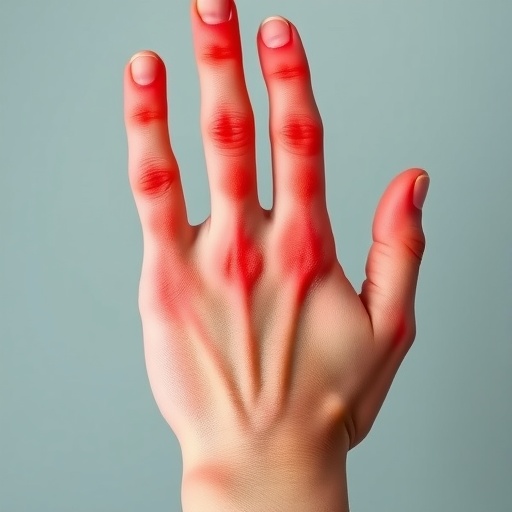
A revolutionary advancement in medical diagnostics has been achieved by a team of researchers from Kobe University, who have developed an artificial intelligence (AI) system capable of identifying acromegaly—a rare and often underdiagnosed endocrine disorder—exclusively through analysis of images of the back of the hand and clenched fist. This breakthrough not only promises enhanced diagnostic accuracy but also addresses critical concerns related to patient privacy, potentially transforming how this intractable disease is detected and managed in clinical and regional healthcare settings worldwide.
Acromegaly is characterized by excessive growth hormone production, typically manifesting in middle-aged individuals. It causes significant enlargement of the hands and feet, distinctive changes in facial features, and abnormal growth affecting bones and internal organs. Due to its gradual onset and rarity, diagnosis is frequently delayed by up to a decade, resulting in severe health consequences including reduced life expectancy by an average of ten years if untreated. Current diagnostic pathways are complex and resource-intensive, often making early detection elusive, especially in non-specialist environments.
The Kobe University research group recognized the need for a non-invasive, privacy-conscious tool that could facilitate early acromegaly detection without relying on facial imaging, which poses substantial privacy and consent challenges. Prior AI attempts predominantly utilized facial photographs, limiting their clinical applicability due to ethical and legal restrictions. Responding to this, the team strategically focused on hand images, given that physical changes in this region are well-recognized clinical markers of the disease, routinely assessed by endocrinologists during examinations.
To ensure robustness and generalizability, the researchers compiled an extensive multicenter dataset comprising over 11,000 images gathered from 725 patients spanning 15 medical institutions across Japan. These images exclusively captured the dorsal aspects of the hand and the clenched fist posture, intentionally avoiding palm line patterns that could compromise individual privacy. This comprehensive dataset enabled the training and validation of a sophisticated deep learning model designed to discern subtle morphological alterations indicative of acromegaly.
Published in the Journal of Clinical Endocrinology & Metabolism, their findings revealed the AI’s exceptional diagnostic performance, achieving remarkably high sensitivity and specificity. The system consistently outperformed experienced endocrinologists tasked with evaluating the same hand images, a testament to the AI’s capability to detect nuanced visual biomarkers beyond human perception. This validation underscores the feasibility of deploying such technology as a practical preliminary screening tool that circumvents privacy concerns linked to facial recognition.
Technically, the AI employs convolutional neural networks (CNNs), which are highly effective at image classification tasks. The CNN architecture was meticulously optimized to extract discriminative features from hand images, focusing on morphometric changes that are subtle yet diagnostically relevant. Rigorous cross-validation strategies and multicenter participation bolstered the model’s reliability and reduced the risk of overfitting, paving the way for clinical translation in diverse patient populations.
Looking beyond acromegaly, the research team envisions expanding the model’s scope to identify other hand-associated pathologies such as rheumatoid arthritis, anemia, and digital clubbing—conditions that also manifest distinctive physical changes in hand morphology. This strategic extension could significantly broaden the utility of AI-driven imaging analytics in routine healthcare settings, enabling early disease detection across a spectrum of disorders through simple photographic data.
Importantly, the researchers emphasize that the AI tool is intended to augment, not replace, clinical judgment. In real-world practice, diagnosis integrates multifaceted data including clinical history, laboratory results, and imaging studies. The AI model complements this approach by reducing diagnostic oversight and facilitating timely referrals to specialists, a critical factor in improving patient outcomes for slowly progressive and underdiagnosed conditions.
Furthermore, the technology could substantially alleviate healthcare disparities. By empowering non-specialist physicians with advanced diagnostic capabilities during comprehensive health check-ups, particularly in rural or underserved areas, the system can bridge gaps in specialist access. This aligns with global efforts to democratize healthcare through innovative digital solutions that enhance early intervention and streamline referral pathways.
The implications of this AI innovation extend beyond clinical workflows. By preserving patient anonymity through exclusive use of hand images, it obviates major ethical hurdles associated with AI in medical imaging. Such privacy-conscious design is essential to secure patient trust and regulatory approval, setting a precedent for responsible AI application in medical diagnostics.
The research was financially supported by the Hyogo Foundation for Science Technology and conducted collaboratively with multiple prestigious institutions including Fukuoka University, Hyogo Medical University, Nagoya University, and others. This multicenter collaboration ensured diverse clinical input and reinforced the study’s scientific rigor.
Kobe University, a premier national research institution founded in 1902, has once again demonstrated its leadership in pioneering interdisciplinary innovation by combining medical expertise and artificial intelligence. With a commitment to addressing complex societal challenges, the university’s groundbreaking work exemplifies the transformative potential of AI technology to reshaping the landscape of rare disease diagnosis and healthcare delivery.
As the AI model progresses toward wider clinical adoption, ongoing research will focus on integrating additional data modalities and refining algorithms for enhanced accuracy and scalability. This pioneering study lays a robust foundation for the future of automated, privacy-aware medical diagnostics, heralding a new era of precision health that begins at the level of simple, non-invasive imaging.
Subject of Research: People
Article Title: Automatic Acromegaly Detection Using Deep Learning on Hand Images: A Multicenter Observational Study
News Publication Date: 27-Feb-2026
Web References: http://dx.doi.org/10.1210/clinem/dgag027
References: The Journal of Clinical Endocrinology & Metabolism
Image Credits: Kobe University
Keywords: Acromegaly, Deep Learning, Artificial Intelligence, Diagnostic AI, Hand Imaging, Privacy-Preserving AI, Endocrinology, Rare Diseases, Medical Imaging, Healthcare Disparities, Clinical Decision Support, Multicenter Study


