

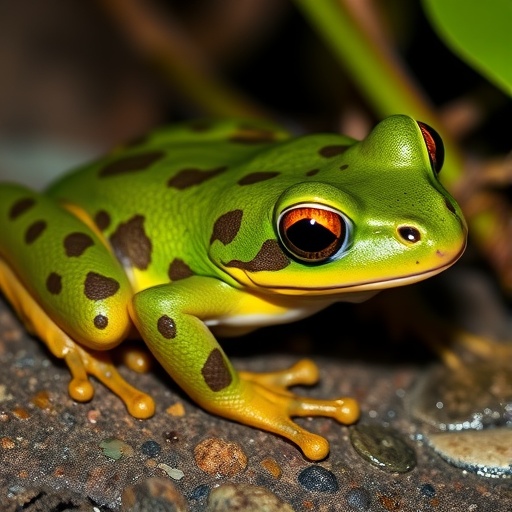
In the heart of Central Africa, amidst one of the planet’s richest troves of biodiversity, lies a captivating mystery: why do frogs display significant variation in diversity across different parts of the region’s vast rainforests? While one might instinctively point to present-day environmental factors such as temperature or precipitation, recent groundbreaking research suggests that the cause reaches far deeper into Earth’s climatic past. A global cooling event that concluded approximately 12,000 years ago during the last ice age continues to shape the diversity and distribution of frogs more than a millennium later.
This remarkable revelation emerged from an extensive study led by Gregory Jongsma, acting curator of Zoology at the New Brunswick Museum, along with collaborators at the Florida Museum of Natural History. Their work, published in Ecology and Evolution, focuses on the Lower Guinean Forests—also known as the Guineo-Congolian rainforest—which stretch across Central Africa close to the equator. Here, the interplay between historical climate shifts and the dynamic ecosystems of this humid jungle has forged unique biological patterns that persist into modern times.
Jongsma’s intrigue with this area began early, inspired by the legendary conservationist Mike Fay’s epic “mega transect” journey—an arduous 2,000-mile trek through the trailless jungles of Gabon and neighboring countries. Fay’s meticulous collection of ecological data laid the groundwork for understanding the complexity of Central African biodiversity, but until recently, the impact of historical climate events on such diversity remained elusive.
Central to Jongsma’s research are the Afrobatrachian frogs, a group representing roughly half of Africa’s frog species. Unlike other amphibians thought to have disparate origins, molecular and evolutionary studies confirm that Afrobatrachians form a cohesive clade endemic to Africa. This group is astonishingly diverse: it includes species adapted to canopy life, burrowing subspecies, and frogs exhibiting advanced reproductive strategies such as direct development, bypassing the tadpole stage altogether. Their distribution offers a window into the environmental forces that shape biodiversity in tropical ecosystems.
Conventional ecological theory posits that species diversity reflects equilibrium with contemporary environmental conditions. High rainfall, temperature, and primary productivity are expected to promote higher biodiversity. Yet, field observations confound this expectation. Some lowland forests, despite appearing climatically ideal, harbor fewer frog species and fewer endemic frogs than comparable regions. Contemporary climate patterns alone fail to reconcile these disparities.
To address this paradox, the research team adopted an evolutionary lens, testing the hypothesis that historical climatic conditions exert a dominant influence on present-day diversity patterns. Reconstructing the past environment over the Pleistocene epoch—a period spanning nearly three million years and culminating in the last ice age—required integrating paleoclimatic data gleaned from ice cores, sedimentary pollen and spores, and marine oxygen isotope records. These proxies enabled researchers to model the spatial dynamics of forest habitats in Central Africa during periods of climatic oscillation.
The team discovered that while the Congo rainforest largely remained a continuous expanse, pockets of forested refuge—termed “refugia”—persisted amid expanses of encroaching savannah during colder, drier glacial intervals. Species, including frogs, congregated in these stable refugia where habitat conditions remained viable. This historical pattern is still legible today, with frog species diversity and endemism strongly concentrated within these former refugia zones.
Such refugia act as evolutionary cradles. Isolation within these stable enclaves fosters genetic divergence, resulting in speciation over time. The phenomenon explains why some endemic species have narrow, localized distributions and why endemic-rich refugia persist as biodiversity hotspots long after climatic conditions stabilize. Moreover, dispersal from these refugia has been slow, creating lasting spatial heterogeneity in species distributions—a temporal lag driven by the protracted timescales of evolution and migration.
To robustly link climatic history with frog diversity, Jongsma’s team constructed niche models incorporating ten widespread frog species outside Afrobatrachia to parameterize species-environment relationships. These models calibrated environmental preferences based on modern occurrence data, then projected backward in time onto reconstructed paleoclimatic surfaces. This allowed the researchers to estimate historical suitable habitat distributions for Afrobatrachian frogs during glacial and interglacial periods, capturing how climate-driven habitat shifts shaped diversity dynamics.
The findings bear profound ecological and conservation implications. They underscore the critical importance of incorporating historical perspective into biodiversity assessments and protected area design. Many Central African countries are engaged in ambitious conservation initiatives, notably the “30X30” goal aiming to safeguard 30% of terrestrial habitats by 2030. Prioritizing areas with a legacy of ecological stability—ancient refugia—could optimize conservation outcomes by preserving evolutionary reservoirs that underpin regional biodiversity.
Beyond frogs, this research exemplifies how integrating paleoclimate science, evolutionary biology, and ecological modeling can unravel the deep-time forces shaping modern ecosystems. It challenges purely ecological assumptions and emphasizes the enduring impact of Ice Age climates on tropical forest fauna, inviting re-examination of diversity patterns in other taxa with similar histories.
As forests continue to face threats from deforestation and climate change, understanding the historical context of biodiversity becomes not only a scientific endeavor but a pragmatic necessity. The lessons drawn from Africa’s frogs spotlight the intertwined fate of life and climate and the need to preserve evolutionary legacies locked in these ancient forests.
Subject of Research: Pleistocene forest stability and its influence on frog diversity patterns in Central Africa
Article Title: Pleistocene Forest Stability Predicts Patterns of Frog Diversity in Central Africa
News Publication Date: 11-Mar-2026
Web References: https://doi.org/10.1002/ece3.73207
Image Credits: Image by Gregory Jongsma
Keywords: Frogs, Africa, Ice ages, Pleistocene epoch, Refugia, Biodiversity, Endemic species


