

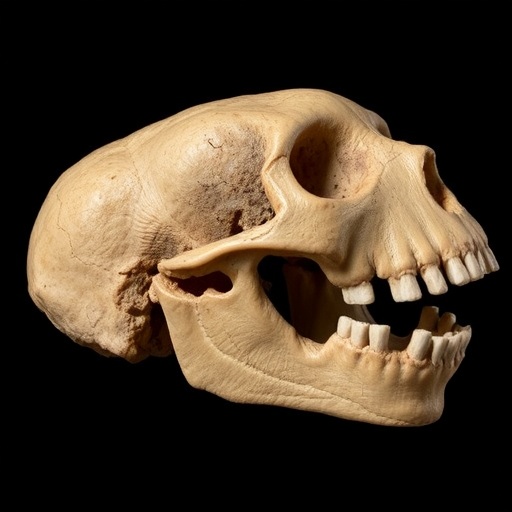
In a groundbreaking discovery that has the potential to reshape our understanding of early hominin evolution, paleoanthropologists have unearthed a partial mandible of the genus Paranthropus in the Afar depression of northeastern Ethiopia. This region, long celebrated as a cradle of human evolution, preserves an unparalleled six-million-year record of fossils and artifacts that narrate the complex story of our ancestors’ development. The newfound fossil, dated between 2.5 and 2.9 million years ago, offers a rare and compelling glimpse into the geographic distribution and ecological adaptability of Paranthropus, a genus previously absent from this pivotal study area.
The Afar depression, characterized by its dynamic tectonic and volcanic activity, has yielded a rich tapestry of hominin fossils over the decades, including some of the earliest representatives of Australopithecus and early Homo. However, the conspicuous absence of Paranthropus fossils here has long posed questions about the evolutionary narrative of this robust genus known for its distinctive cranio-dental morphology. The new specimen bridges this gap, providing concrete anatomical evidence that Paranthropus occupied a broader ecological and geographic range than formerly recognized, suggesting a much more versatile and successful genus than traditional models have portrayed.
Detailed morphological analysis of the mandible reveals key characteristics consistent with Paranthropus, including the robust nature of the jaw and dental features indicating a powerful masticatory apparatus optimized for heavy chewing. These traits have historically led researchers to classify Paranthropus as a dietary specialist, adapted primarily to tough, fibrous plant matter found in specific, relatively closed habitats. Nevertheless, the depositional context for this mandible attests to a range of diverse, and even open, environments within the Mille-Logya research area, implying that Paranthropus could thrive across varied ecological landscapes, countering the long-held perception of its dietary narrowness.
Isotopic dietary evidence and associated faunal assemblages further endorse the inference that Paranthropus demonstrated significant ecological plasticity. This ability to exploit diverse resources may reflect an evolutionary advantage facilitating its wider dispersal. It is particularly notable that the Paranthropus specimen overlaps temporally with the emergence and early persistence of the Homo lineage, a period marked by critical evolutionary experimentation and divergence among hominin groups. These findings hint at complex interspecies dynamics, competition, and niche partitioning that directed human ancestry’s adaptive pathways.
The dating of the fossil relies on stratigraphically controlled sedimentary sequences, volcanic ash layers (tuffs), and radiometric techniques, securing its age firmly within the late Pliocene to early Pleistocene epoch. This chronological anchoring is vital, as it situates the Paranthropus individual within a critical evolutionary window when multiple hominin forms emerged and diversified amid fluctuating climatic and environmental pressures. Consequently, this discovery enriches the empirical framework for reconstructing hominin evolutionary trajectories during a time of major geological, ecological, and biological transitions.
The Mille-Logya research area, where the fossil was excavated, has emerged as a prime locus for unearthing fossils dating from between 2.5 and 3 million years ago, filling a key geographic and chronological void in paleoanthropological research. This fresh evidence not only challenges previous assumptions about hominin biogeography but also emphasizes the region’s significance in understanding how hominin genera adapted to an ever-changing mosaic of environments, including savannahs, riverine woodlands, and open grasslands.
The broader implications of the discovery extend to debates about the evolutionary pressures that shaped the robust dental and cranial features seen in Paranthropus. Researchers now posit that these adaptations might not only have served as specialized dietary tools but potentially as multifunctional strategies usable across varying habitats with different food availabilities. This adaptability may explain the genus’s success and geographic dispersal despite competing hominins occupying similar temporal ranges.
Moreover, the newfound presence of Paranthropus in Afar provides an invaluable reference point for future paleoanthropological investigations. It invites a reexamination of other fossil assemblages within eastern Africa and signals the possibility that elusive Paranthropus fossils may yet be uncovered in other understudied regions, thereby refining the hominin fossil record’s completeness and resolution.
This discovery also enriches the multidimensional dialogue about early hominin ecology, behavior, and evolutionary strategies. It nuances the simplistic categorization of hominins into narrowly defined niches and supports a complex, interconnected web of adaptive responses to environmental challenges. As the dating and stratigraphic context of the fossil are well-understood, it opens doors for comparative studies with contemporaneous hominin fossils, facilitating more detailed phylogenetic analyses and evolutionary modeling.
Paranthropus’s newly identified presence in a region that has been a historic focal point for paleoanthropological finds underlines the dynamic nature of scientific knowledge. It also spotlights the importance of continuous fieldwork and methodological innovation. Using cutting-edge dating techniques, detailed morphometrics, and paleoenvironmental reconstruction, researchers are piecing together a vivid, multifaceted picture of human evolutionary origins.
In sum, this remarkable discovery reshapes prevailing paradigms about hominin distribution and adaptability. It suggests a genus far more ecologically versatile and broadly spread than earlier models allowed, emphasizing the role of environmental variability in hominin evolutionary success. By filling a critical geographical and temporal gap, this find enhances our grasp of the intricate processes that undergirded the emergence of our genus and underscores the vast potential for future revelations in the Afar depression and beyond.
The implications of this research resonate profoundly within the paleoanthropological community, promising to catalyze new hypotheses and invigorate field expeditions aimed at decoding the complexities of early hominin life. As we continue to confront the enigmatic chapters of human origins, discoveries like the Paranthropus mandible from Afar remind us that our evolutionary story is far from fully told—and that the fossil record still holds many transformative secrets.
Subject of Research: Human Evolution and Paleontological Discoveries in the Afar Region, Ethiopia
Article Title: Afar Fossil Shows Broad Distribution and Versatility of Paranthropus
Article References:
Alemseged, Z., Spoor, F., Reed, D. et al. Afar fossil shows broad distribution and versatility of Paranthropus. Nature (2026). https://doi.org/10.1038/s41586-025-09826-x
Image Credits: AI Generated


