

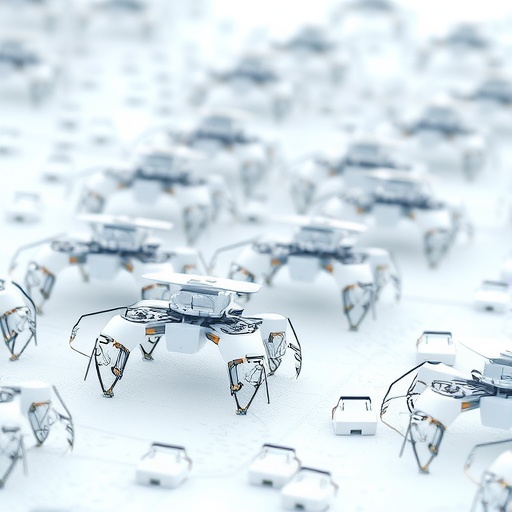
In recent years, the field of robotics has witnessed remarkable innovations, particularly in the realm of reconfigurable robot swarms. These swarms have the potential to revolutionize how robotic systems tackle complex environments. The research conducted by Yi and colleagues offers a deep dive into the design and application of these swarms, focusing specifically on the mechanisms that allow them to traverse varied terrains. Their work emphasizes the importance of passive coupling mechanisms, which enhance the swarms’ adaptability and efficiency.
Reconfigurable robot swarms are designed to operate collectively as cohesive units, intelligently adapting their configuration based on the challenges presented by the terrain. This adaptability is critical as it enables the robotic units to perform tasks that are either impossible or too dangerous for humans. The innovation stems from an intricate understanding of the dynamics involved when these robots interact with each other and their environment.
One of the cornerstones of this research is the introduction of passive coupling mechanisms. Unlike active coupling methods that require constant power and control signals, passive mechanisms enable robots to automatically connect and disconnect based on environmental conditions. This significantly reduces energy consumption and enhances the efficiency of the swarm. Researchers have extensively modeled these mechanisms to ensure that swarms maintain structural integrity while navigating challenging landscapes.
Yi et al.’s study also delves into the various applications for these reconfigurable swarms. In disaster response scenarios, for instance, these robots could efficiently navigate rubble and debris, effectively communicating and coordinating to locate victims or assess structural weaknesses. They could be deployed in search and rescue missions, where traditional methods may fail or pose risks to human life. The versatility of these swarms in unpredictable environments positions them as essential tools in emergency management.
The research highlights the significance of simulation testing, asserting how it validates the efficacy of the proposed models and designs. Through extensive simulations, the team demonstrated that the passive coupling mechanisms function seamlessly under diverse conditions, including uneven terrains and obstacles. These simulations are not only crucial for developing the robots but also serve as a testament to their potential resilience in real-world applications.
Moreover, the findings presented in this research could pave the way for advancements in the field of environmental monitoring. By utilizing these robot swarms, researchers could deploy a fleet that monitors ecological conditions, assesses vegetation health, or even tracks wildlife movements. The ability to collect data over extensive areas without disturbing the ecosystems presents a tremendous advantage for environmental scientists and conservationists.
A particularly intriguing aspect of Yi et al.’s research is the potential for collaborative learning among the swarm. Each robot can gather data and share its findings with others in real-time, allowing for collective intelligence. This feature not only enhances their operational efficiency but also suggests pathways for future advancements in autonomous learning systems within robotics. The collaborative nature of these systems mirrors natural phenomena observed in ant colonies and other animal swarms, compelling researchers to look to the natural world for inspiration.
Security and safety considerations remain paramount in the discussion of deploying swarms. The authors address potential security concerns surrounding the use of robotic swarms, especially in sensitive environments. Ensuring that these robots cannot be hacked or manipulated is of utmost importance. The research outlines potential strategies for securing communication channels and safeguarding the integrity of operations in hostile or sensitive spaces.
In considering the societal implications of such technological advancements, Yi et al. call for a thorough examination of ethical considerations. As these robots become integral to disaster response and environmental monitoring, discussions around privacy, data collection, and human-robot interaction are critical. It is crucial to establish guidelines that govern the deployment of autonomous systems to protect individual rights and freedoms while leveraging their significant advantages.
The article also reflects on future research directions, noting the need for further exploration in enhancing the coordination mechanisms among the robots. Effective communication strategies within the swarm will be significant for optimizing performance and decision-making processes. As researchers uncover more about the dynamics of collective robotic behavior, the promise of fully autonomous swarms becomes increasingly tangible.
As advancements in materials science continue, the physical characteristics of these robotic units can evolve to meet more demanding requirements. Lightweight, durable materials could allow for faster movement across difficult terrains, pushing the boundaries of what is possible in swarm robotics even further. The convergence of materials science and robotics will undoubtedly yield innovations with far-reaching implications.
With their pioneering work, Yi and colleagues have opened avenues for both academic inquiry and practical applications. Their findings serve as a robust foundation upon which future studies can build, encouraging interdisciplinary collaboration and innovation in swarm robotics. The marriage of engineering, biology, and computer science is reshaping the landscape of robotic applications, offering solutions that could significantly impact various sectors.
The future of reconfigurable robot swarms is undoubtedly promising, but it requires ongoing research, development, and ethical considerations. As we stand on the brink of potentially transformative technologies, it is essential to approach these advancements with a mindset that balances innovation with responsibility. By doing so, we can harness the power of robotic swarms to create a safer, more efficient world for all.
In conclusion, the exploration of reconfigurable robot swarms by Yi et al. signals an exciting chapter in the field of robotics. Their emphasis on passive coupling mechanisms, robust design, and diverse applications showcases the potential of these systems to address complex challenges in various domains. This research paves the way for a future where robot swarms not only assist in human endeavors but collaborate seamlessly with us, enhancing our capabilities and resilience in the face of adversity.
Subject of Research: Reconfigurable robot swarms for terrain traversal with passive coupling mechanisms
Article Title: Reconfigurable robot swarms for terrain traversal with passive coupling mechanisms
Article References:
Yi, S., Singh, S., Seo, A. et al. Reconfigurable robot swarms for terrain traversal with passive coupling mechanisms.
Auton Robot 49, 20 (2025). https://doi.org/10.1007/s10514-025-10205-8
Image Credits: AI Generated
DOI: https://doi.org/10.1007/s10514-025-10205-8
Keywords: Reconfigurable robot swarms, passive coupling mechanisms, terrain traversal, robotics, autonomy, collaborative learning, environmental monitoring, security, ethics, materials science.


