

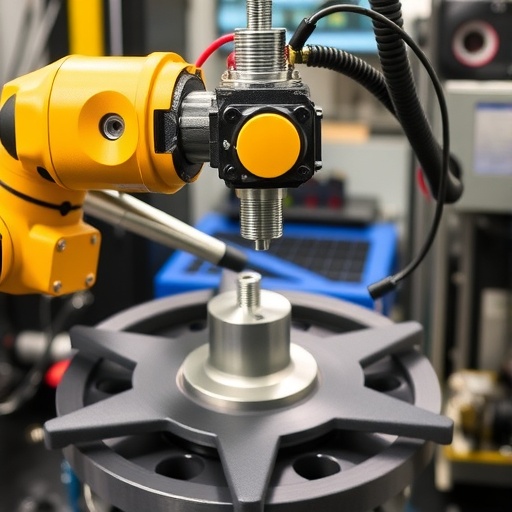
In the constantly evolving landscape of robotics, the pursuit of precision and adaptability has led researchers to explore innovative control mechanisms for industrial applications. One of the most compelling advancements comes from a remarkable study conducted by Wei et al. that presents an adaptive variable impedance hybrid force-position control method specifically designed for hub-spoke grinding robots. This groundbreaking research, set for publication in Scientific Reports in 2026, addresses critical challenges faced in precision grinding operations and promises to revolutionize the field.
The study identifies the inherent complexities involved in the grinding process, particularly when dealing with varying material properties and geometrical complexities. Traditional control methods often lack the flexibility required to adapt to these dynamic environments, leading to inefficiencies and reduced surface quality in finished products. Wei and his team have sought to bridge this gap by developing a novel control strategy that integrates force control with position control, thus allowing for a more nuanced approach to handling the variabilities present in grinding tasks.
At the core of this research lies the concept of variable impedance control, which allows robots to modify their compliance based on real-time feedback from the workpiece. This feature is particularly crucial in grinding applications, where the contact force must be carefully regulated to prevent damage to both the robot and the workpiece. The authors have meticulously detailed how their adaptive control framework utilizes sensory data to adjust the impedance characteristics, thus enabling the robot to adapt its behaviors dynamically throughout the grinding cycle.
In their experiments, Wei et al. used a sophisticated setup that included high-fidelity sensors and advanced algorithms to capture essential feedback. By processing this data, their hybrid control system demonstrates an ability to optimize both the force exerted and the positioning of the grinding head. This becomes particularly significant in complex machining contexts where precision is paramount, and even small deviations can result in subpar outcomes. The study emphasizes that their method not only enhances the effectiveness of the grinding process but also extends the lifespan of the robotic systems by minimizing wear and tear.
Furthermore, this research highlights the importance of collaboration between mechanical engineers and software developers. The development of effective control algorithms necessitates a deep understanding of both the physical principles underlying robotic motion and the computational techniques required to implement these concepts. Wei and his team have drawn upon interdisciplinary knowledge to forge a path that not only boosts efficiency but also sets the stage for more intelligent robotic systems capable of learning and self-improvement.
When assessing the implications of this research, we must also consider the broader impacts on the manufacturing industry. The introduction of adaptable robotics is set to lead to a paradigm shift in how industrial processes are executed. By implementing a control strategy that can adjust in real time, manufacturers could achieve greater consistency in product quality, lower operational costs, and increased competitiveness in the global market. The implications of such advancements could reverberate across various sectors, from automotive to aerospace, where precision grinding plays a critical role.
As robots become more integrated into our manufacturing workflows, the ethical considerations surrounding their deployment become essential. Concerns regarding job displacement, skills gaps, and the need for new training programs are often at the forefront of discussions about automation. However, the work presented by Wei et al. illustrates that the future of robotics is not solely about replacing human labor but enhancing it. By deploying sophisticated machines alongside human workers, companies can capitalize on the strengths of both, leading to an optimized manufacturing environment where precision and efficiency reign supreme.
Moreover, there is potential for this research to spark further innovations in related fields. The principles of adaptive variable impedance control could inspire advancements in other robotic applications, including those in extraction, assembly, and disruption scenarios where varying levels of force are necessary. As researchers delve deeper into this paradigm, we may witness new solutions that tackle existing limitations while opening avenues for entirely new robotic applications.
The study by Wei and colleagues is rich in practical implications, not just for engineers and scientists but also for policymakers and industry leaders. As we transition into an era characterized by increasingly intelligent machines, it is vital that stakeholders understand both the benefits and responsibilities that come with these technologies. The integration of adaptive control methods paves the way for a sustainable future where human creativity and robotic efficiency coalesce, propelling industries forward in unprecedented ways.
The research presented is particularly timely, aligning with global trends towards smart manufacturing and Industry 4.0. As industries worldwide seek to modernize their processes, the findings from this study reinforce the necessity for innovative approaches to automation. The adaptive variable impedance hybrid control method encapsulates a futuristic vision where machines not only respond to inputs but anticipate and adapt proactively, thus marking a significant advancement in robotic capabilities.
In conclusion, the adaptive variable impedance hybrid force-position control method developed by Wei et al. stands as a beacon of innovation in the realm of robotic grinding applications. The comprehensive exploration of its capabilities offers profound insights into the future of manufacturing technologies. By harnessing the power of advanced control strategies, industries can enhance operational efficiencies, mitigate risks, and ultimately drive progress towards a new era of intelligent manufacturing. As more studies build upon these findings, the horizon looks promising for the next generation of robotic systems that will redefine what is possible in precision tasks.
As the field of robotics continues to advance, it is crucial that researchers remain committed to addressing the challenges inherent in these technologies. Wei et al.’s work exemplifies a proactive approach that not only seeks immediate improvement but lays the groundwork for continuous evolution. The adaptability showcased in their hybrid control system is indicative of the future trajectory of robotics—one that prioritizes versatility, efficiency, and an unwavering commitment to quality.
In closing, as we await the wide dissemination of the findings from Wei et al., it is evident that this research will resonate deeply within technological and manufacturing circles. The implications of their work extend far beyond mere academic achievement; they serve as a catalyst for change in a world where adaptability and precision are crucial for survival and growth in an ever-competitive marketplace.
Subject of Research: Adaptive variable impedance hybrid force-position control method for hub-spoke grinding robots
Article Title: Adaptive variable impedance hybrid force-position control method for hub-spoke grinding robots
Article References: Wei, S., Ze-jian, Z., Hao-yu, Y. et al. Adaptive variable impedance hybrid force-position control method for hub-spoke grinding robots. Sci Rep (2026). https://doi.org/10.1038/s41598-025-34249-z
Image Credits: AI Generated
DOI:
Keywords: Adaptive control, robotics, grinding, impedance control, hybrid systems, manufacturing innovation, Industry 4.0.


