

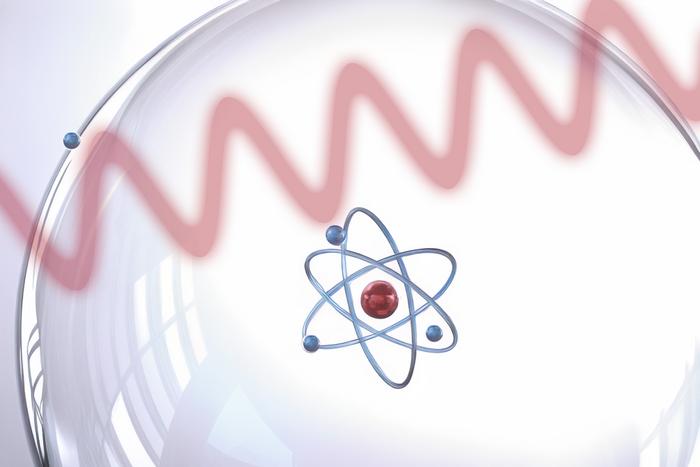
A crystal is an arrangement of atoms that repeats itself in space, in regular intervals: At every point, the crystal looks exactly the same. In 2012, Nobel Prize winner Frank Wilczek raised the question: Could there also be a time crystal – an object that repeats itself not in space but in time? And could it be possible that a periodic rhythm emerges, even though no specific rhythm is imposed on the system and the interaction between the particles is completely independent of time?

Credit: TU Wien
A crystal is an arrangement of atoms that repeats itself in space, in regular intervals: At every point, the crystal looks exactly the same. In 2012, Nobel Prize winner Frank Wilczek raised the question: Could there also be a time crystal – an object that repeats itself not in space but in time? And could it be possible that a periodic rhythm emerges, even though no specific rhythm is imposed on the system and the interaction between the particles is completely independent of time?
For years, Frank Wilczek’s idea has caused much controversy. Some considered time crystals to be impossible in principle, while others tried to find loopholes and realise time crystals under certain special conditions. Now, a particularly spectacular kind of time crystal has successfully been created at Tsinghua University in China, with the support from TU Wien in Austria. The team used laser light and very special types of atoms, namely Rydberg atoms, with a diameter that is several hundred times larger than normal. The results have now been published in the journal “Nature Physics”.
Spontaneous symmetry breaking
The ticking of a clock is also an example of a temporally periodic movement. However, it does not happen by itself: Someone must have wound the clock and started it at a certain time. This starting time then determined the timing of the ticks. It is different with a time crystal: according to Wilczek’s idea, a periodicity should arise spontaneously, although there is actually no physical difference between different points in time.
“The tick frequency is predetermined by the physical properties of the system, but the times at which the tick occurs are completely random; this is known as spontaneous symmetry breaking,” explains Prof Thomas Pohl from the Institute of Theoretical Physics at TU Wien.
Thomas Pohl was in charge of the theoretical part of the research work that has now led to the discovery of a time crystal at Tsinghua University in China: Laser light was shone into a glass container filled with a gas of rubidium atoms. The strength of the light signal that arrived at the other end of the container was measured.
“This is actually a static experiment in which no specific rhythm is imposed on the system,” says Thomas Pohl. “The interactions between light and atoms are always the same, the laser beam has a constant intensity. But surprisingly, it turned out that the intensity that arrives at the other end of the glass cell begins to oscillate in highly regular patterns.”
Giant atoms
The key to the experiment was to prepare the atoms in a special way: The electrons of an atom can orbit the nucleus on different paths, depending on how much energy they have. If energy is added to the outermost electron of an atom, its distance from the atomic nucleus can become very large. In extreme cases, it can be several hundred times further away from the nucleus than usual. In this way, atoms with a giant electron shell are created – so-called Rydberg atoms.
“If the atoms in our glass container are prepared in such Rydberg states and their diameter becomes huge, then the forces between these atoms also become very large,” explains Thomas Pohl. “And that in turn changes the way they interact with the laser. If you choose laser light in such a way that it can excite two different Rydberg states in each atom at the same time, then a feedback loop is generated that causes spontaneous oscillations between the two atomic states. This in turn also leads to oscillating light absorption.” All by themselves, the giant atoms stumble into a regular beat, and this beat is translated into the rhythm of the light intensity that arrives at the end of the glass container.
“We have created a new system here that provides a powerful platform for deepening our understanding of the time crystal phenomenon in a way that comes very close to Frank Wilczek’s original idea,” says Thomas Pohl. “Precise, selfsustained oscillations could be used for sensors, for example. Giant atoms with Rydberg states have already been successfully used for such techniques in other contexts.”
Journal
Nature Physics
Method of Research
Experimental study
Subject of Research
Not applicable
Article Title
Dissipative time crystal in a strongly interacting Rydberg gas
Article Publication Date
2-Jul-2024

