
Saturday, March 21, 2026
Science
No Result
View All Result
  • Login
  • HOME
  • SCIENCE NEWS
  • CONTACT US
  • HOME
  • SCIENCE NEWS
  • CONTACT US
No Result
View All Result
Scienmag
No Result
View All Result
Home Science News Cancer

A new mechanical transducer was revealed

May 10, 2024
in Cancer
Reading Time: 3 mins read
0
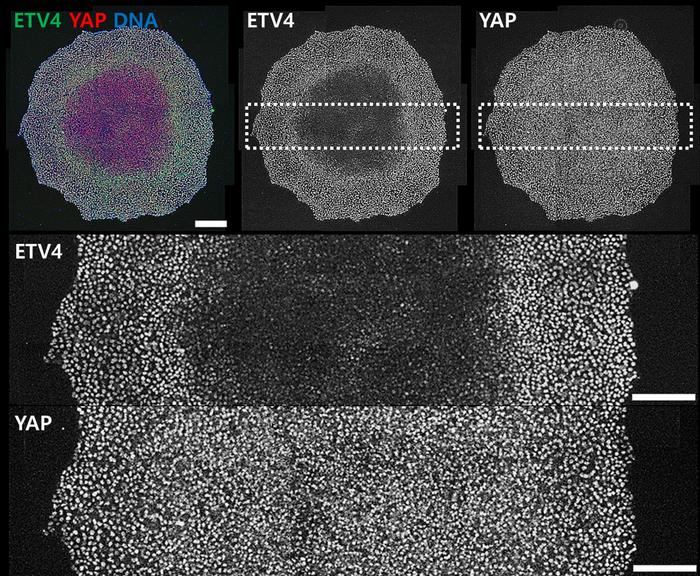
Microscopic depiction showcasing ETV4 expression dynamics in human embryonic stem cells influenced by variations in cell density
68
SHARES
620
VIEWS
Share on FacebookShare on Twitter
ADVERTISEMENT

Professor Jiwon Jang and Seungbok Yang, a PhD candidate, from the Department of Life Sciences at Pohang University of Science and Technology (POSTECH), and Dr. Mahdi Golkaram from the Department of Mechanical Engineering at University of California Santa Barbara (UCSB) have uncovered a novel regulator governing how cells respond to mechanical cues. Their findings were published on May 3 in the online edition of Nature Cell Biology, an international journal in the field of cell biology.

Microscopic depiction showcasing ETV4 expression dynamics in human embryonic stem cells influenced by variations in cell density

Credit: POSTECH

Professor Jiwon Jang and Seungbok Yang, a PhD candidate, from the Department of Life Sciences at Pohang University of Science and Technology (POSTECH), and Dr. Mahdi Golkaram from the Department of Mechanical Engineering at University of California Santa Barbara (UCSB) have uncovered a novel regulator governing how cells respond to mechanical cues. Their findings were published on May 3 in the online edition of Nature Cell Biology, an international journal in the field of cell biology.


Much research in cell biology has traditionally centered on understanding how cells react to chemical signals such as diffusible signaling molecules. However, cells also respond to mechanical stimuli such as cell density, size, and substrate stiffness by expressing specific genes. Yet, the mechanisms by which mechanical regulators perceive mechanical stimuli have remained largely unexplored.


In this research, human embryonic stem cells (hESCs) were employed by the researchers to delve into how cells detect and react to mechanical signals. Through an examination of the transcriptome of hESCs cultivated under different cell densities, the researchers pinpointed a key player known as “ETV4”, responsible for mediating variations in stem cell density and controlling differentiation.


Furthermore, the team deciphered the intricate mechanism through which ETV4 perceives mechanical cues. Initially, integrin receptors1) recognize alterations in cell density, subsequently modulating the endocytosis of a cell surface receptor, namely the Fibroblast Growth Factor Receptor (FGFR). Mechanical regulation of FGFR endocytosis determines the protein stability of ETV4 by ERK signaling.


During the differentiation process of stem cells, ETV4 plays a role in directing the formation of mesendoderm in regions characterized by low cell density while promoting neuroectoderm development in areas of high cell density. The researchers discovered that a new mechanotransducer ETV4 bridges cell density dynamics to stem cell differentiation.


POSTECH Professor Jiwon Jang who led the research stated, “We’ve uncovered the importance of mechanical cues in regulating stem cell differentiation along with the pivotal involvement of ETV4.” He expressed optimism by saying, “Given ETV4’s substantial implications as a critical oncogene, we envision leveraging this insight to devise technologies aimed at controlling cancer cells through mechanical cues.”


The research was conducted with support from the Biomedical Technology Development Program, the Basic Research Program for Individuals, the Group Research and Basic Research Lab Program, and the Smart Specialization Infrastructure Project of the National Research Foundation of Korea.The research was conducted with support from the Biomedical Technology Development Program, the Basic Research Program for Individuals, the Group Research and Basic Research Lab Program, and the Smart Specialization Infrastructure Project of the National Research Foundation of Korea.


Journal

Nature Cell Biology

DOI

10.1038/s41556-024-01415-w

Article Title

ETV4 is a mechanical transducer linking cell crowding dynamics to lineage specification

Article Publication Date

3-May-2024

Share27Tweet17
Previous Post

Metabolism of autism reveals developmental origins

Next Post

Developing an efficient host-vector system for a model archaeon by solving CRISPR-based host-plasmid conflict

Related Posts

blank
Cancer

Dr. Chun Li Honored with SNMMI Mars Shot Research Fund Award

March 20, 2026
blank
Cancer

Pre-Chemotherapy Exercise Demonstrates Potential to Alleviate Cancer-Related Fatigue

March 20, 2026
blank
Cancer

New Questionnaire Developed for Accurate Assessment of Cancer Patients’ Anxiety

March 20, 2026
blank
Cancer

MSK Research Highlights: Breakthroughs Unveiled – March 20, 2026

March 20, 2026
blank
Cancer

Link Between Tobacco Smoking and Lung Cancer Risk Following Negative Initial Low-Dose CT Scan Results

March 20, 2026
blank
Cancer

Nivolumab Combo Shrinks Esophageal Cancer Pre-Surgery

March 20, 2026
Next Post
Developing an efficient host-vector system for a model archaeon by solving CRISPR-based host-plasmid conflict

Developing an efficient host-vector system for a model archaeon by solving CRISPR-based host-plasmid conflict

  • Mothers who receive childcare support from maternal grandparents show more parental warmth, finds NTU Singapore study

    Mothers who receive childcare support from maternal grandparents show more parental warmth, finds NTU Singapore study

    27626 shares
    Share 11047 Tweet 6904
  • University of Seville Breaks 120-Year-Old Mystery, Revises a Key Einstein Concept

    1029 shares
    Share 412 Tweet 257
  • Bee body mass, pathogens and local climate influence heat tolerance

    671 shares
    Share 268 Tweet 168
  • Researchers record first-ever images and data of a shark experiencing a boat strike

    535 shares
    Share 214 Tweet 134
  • Groundbreaking Clinical Trial Reveals Lubiprostone Enhances Kidney Function

    520 shares
    Share 208 Tweet 130
Science

Embark on a thrilling journey of discovery with Scienmag.com—your ultimate source for cutting-edge breakthroughs. Immerse yourself in a world where curiosity knows no limits and tomorrow’s possibilities become today’s reality!

RECENT NEWS

  • TCF4 Repeat Expansion Alters Fuchs Corneal Proteome
  • Breastfeeding’s Impact on Neonatal Antibiotic Resistance
  • Sublethal DNA Damage Halts B Cell Effector Functions
  • Intraoperative MAP Targets and Elderly Hypertension Risks

Categories

  • Agriculture
  • Anthropology
  • Archaeology
  • Athmospheric
  • Biology
  • Biotechnology
  • Blog
  • Bussines
  • Cancer
  • Chemistry
  • Climate
  • Earth Science
  • Editorial Policy
  • Marine
  • Mathematics
  • Medicine
  • Pediatry
  • Policy
  • Psychology & Psychiatry
  • Science Education
  • Social Science
  • Space
  • Technology and Engineering

Subscribe to Blog via Email

Enter your email address to subscribe to this blog and receive notifications of new posts by email.

Join 5,191 other subscribers

© 2025 Scienmag - Science Magazine

Welcome Back!

Login to your account below

Forgotten Password?

Retrieve your password

Please enter your username or email address to reset your password.

Log In
No Result
View All Result
  • HOME
  • SCIENCE NEWS
  • CONTACT US

© 2025 Scienmag - Science Magazine

Discover more from Science

Subscribe now to keep reading and get access to the full archive.

Continue reading