

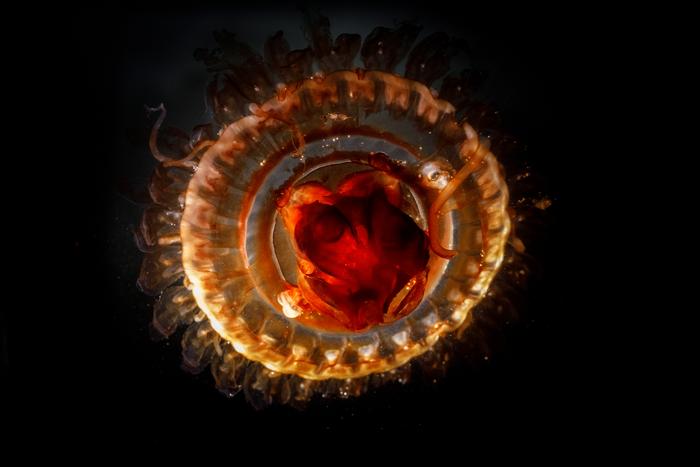
For a long time, scientists assumed that jellyfish were a dead-end food source for predatory fish. However, a team from the Alfred Wegener Institute together with the Thünen Institute has now discovered that fish in Greenland waters do indeed feed on jellyfish. In two of the analyzed species, they even made up the majority of the food, as the researchers describe in a study published in the journal Royal Society Open Science. The results suggest that the role of jellyfish as prey in marine food webs should be reconsidered, especially in regards to the fact that they could be profiting from climate change and spreading farther and farther north.

Credit: Alfred Wegener Institute / Mario Hoppmann
For a long time, scientists assumed that jellyfish were a dead-end food source for predatory fish. However, a team from the Alfred Wegener Institute together with the Thünen Institute has now discovered that fish in Greenland waters do indeed feed on jellyfish. In two of the analyzed species, they even made up the majority of the food, as the researchers describe in a study published in the journal Royal Society Open Science. The results suggest that the role of jellyfish as prey in marine food webs should be reconsidered, especially in regards to the fact that they could be profiting from climate change and spreading farther and farther north.
Jellyfish are found in all oceans, from polar to tropical regions. In the future, gelatinous zooplankton could spread even further, as it is generally one of the winners of climate change: unlike other species, jellyfish are able to better cope with the fact that the global oceans are becoming warmer and more acidic. “Therefore, it is important that we rethink and understand how jellyfish and gelatinous zooplankton generally fit into marine food webs,” says Dr Charlotte Havermans, head of the ARJEL junior research group at the Alfred Wegener Institute, Helmholtz Centre for Polar and Marine Research (AWI). In a new study, she and her team have therefore investigated the role of gelatinous zooplankton as prey of fish in Greenlandic waters.
Greenlandic waters are home to large quantities of various types of gelatinous zooplankton. However, whether and to what extent jellyfish and co. are on the menu of the fish that live here was previously unclear. “We analyzed the stomach contents of seven fish species, including commercially used species such as Atlantic cod, haddock and redfish,” says Charlotte Havermans. “With the help of DNA metabarcoding, we were able to determine very precisely what the animals fed on.”
The results were surprising: “We found DNA of jelly in the stomachs of all examined fish species, albeit in varying quantities,” says Annkathrin Dischereit, first author of the study and doctoral student in ARJEL. For two species, the greater silver smelt and the northern wolffish, they even made up the largest proportion of the food. This is despite the fact that gelatinous zooplankton is widely considered a trophic dead end and emergency food for some fish species at best. “This assumption is based on the fact that their tissue is quickly digested by predator fish and jellyfish are therefore rarely recorded as prey in studies,” explains Annkathrin Dischereit.
Modern method shows that the role of jellyfish is greater than previously thought
DNA metabarcoding provided a solution to this situation: Using this state-of-the-art method, researchers were able to detect short gene fragments in the stomachs, compare them with genetic reference databases and thus identify those prey species to which the fragments belonged. “We were able to see that every species we analyzed fed on jellyfish or other gelatinous zooplankton,” explains Annkathrin Dischereit. “We detected up to 59 species of gelatinous invertebrates in the stomachs of the fish. This clearly shows that they play a significant but previously overlooked role in the subarctic food web.” The stomach contents of some of these species had never been analyzed before in this area.
The study shows that we need to rethink our view of the role of jellyfish and co. in marine food webs. Gelatinous zooplankton is more than just stop-gap food. It is regular prey for predator fish higher up the food chain. “Our results raise the question of why fish seem to eat jellyfish surprisingly frequently,” says Charlotte Havermans. Despite their low energy density, their contribution to the energy budget of predator fish could be more significant than previously assumed: They could be digested more quickly, are easier to hunt, are increasingly common and provide energy-rich components thanks to their diet. “There is still a need for research here,” says Annkathrin Dischereit. “Our study provides a snapshot in time that only takes into account recently digested prey. We need to collect continuous samples throughout the year and link these to how the gelatinous zooplankton communities change over this period of time. Only then can we understand the trophic links between fish and gelatinous zooplankton.”
This is absolutely necessary, as Charlotte Havermans says: “Only trophic insights can provide information on why jellyfish are important for fish and other organisms.” So far, no proper trophic studies have yet been carried out on several species, such as redfish. “The results of our current study raise doubts about how well we understand subpolar ecosystems and how the recently observed increase in gelatinous zooplankton might affect them.”
Journal
Royal Society Open Science
Method of Research
Observational study
Subject of Research
Animals
Article Title
A belly full of jelly? DNA metabarcoding shows evidence for gelatinous zooplankton predation by several fish species in Greenland waters
Article Publication Date
14-Aug-2024

