


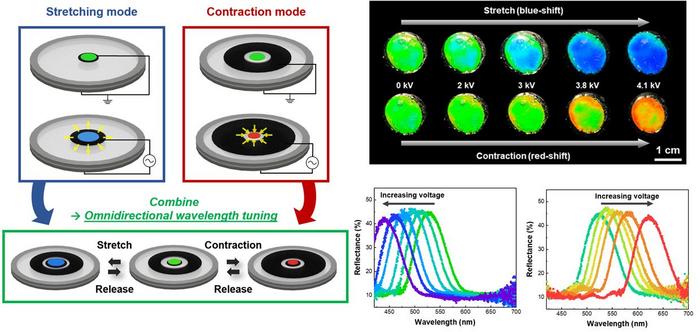
A team at Pohang University of Science and Technology (POSTECH), spearheaded by Professor Su Seok Choi and Ph.D. candidate Seungmin Nam from the Department of Electrical Engineering, has developed a novel stretchable photonic device that can control light wavelengths in all directions. This pioneering study was published in Light: Science & Applications on May 22.

Credit: POSTECH
A team at Pohang University of Science and Technology (POSTECH), spearheaded by Professor Su Seok Choi and Ph.D. candidate Seungmin Nam from the Department of Electrical Engineering, has developed a novel stretchable photonic device that can control light wavelengths in all directions. This pioneering study was published in Light: Science & Applications on May 22.
Structural colors are produced through the interaction of light with microscopic nanostructures, creating vibrant hues without relying on traditional color mixing methods. Conventional displays and image sensors blend the three primary colors (red, green, and blue), while structural color technology leverages the inherent wavelengths of light, resulting in more vivid and diverse color displays. This innovative approach is gaining recognition as a promising technology in the nano-optics and photonics industries.
Traditional color mixing techniques, which use dyes or luminescent materials, are limited to passive and fixed color representation. In contrast, tunable color technology dynamically controls nanostructures corresponding to specific light wavelengths, allowing for the free adjustment of pure colors. Previous research has primarily been limited to unidirectional color tuning, typically shifting colors from red to blue. Reversing this shift—from blue to red, which has a longer wavelength—has been a significant challenge. Current technology only allows adjustments towards shorter wavelengths, making it difficult to achieve diverse color representation in the ideal free wavelength direction. Therefore, a new optical device capable of bidirectional and omnidirectional wavelength adjustment is needed to maximize the utilization of wavelength control technology.
Professor Choi’s team addressed these challenges by integrating chiral liquid crystal elastomers (CLCEs) with dielectric elastomer actuators (DEAs). CLCEs are flexible materials capable of structural color changes, while DEAs induce flexible deformation of dielectrics in response to electrical stimuli. The team optimized the actuator structure to allow both expansion and contraction, combining it with CLCEs, and developed a highly adaptable stretchable device. This device can freely adjust the wavelength position across the visible spectrum, from shorter to longer wavelengths and vice versa.
In their experiments, the researchers demonstrated that their CLCE-based photonic device could control structural colors over a broad range of visible wavelengths (from blue at 450nm to red at 650nm) using electrical stimuli. This represents a significant advancement over previous technologies, which were limited to unidirectional wavelength tuning.
This research not only establishes a foundational technology for advanced photonic devices but also highlights its potential for various industrial applications.
Professor Choi remarked, “This technology can be applied in displays, optical sensors, optical camouflage, direct optical analogue encryption, biomimetic sensors, and smart wearable devices, among many other applications involving light, color, and further broadband electromagnetic waves beyond visible band. We aim to expand its application scope through ongoing research.”
The study was supported by the Samsung Research Funding & Incubation Center of Samsung Electronics and the Technology Innovation Program (Flexible Intelligent Variable Information Display) of the Korea Planning & Evaluation Institute of Industrial Technology.
Journal
Light Science & Applications
Article Title
Omnidirectional color wavelength tuning of stretchable chiral liquid crystal elastomers
Article Publication Date
22-May-2024
Cite Scienmag News
Bethany Barker. (June 3, 2024). Development of revolutionary color-tunable photonic devices. Scienmag. https://scienmag.com/development-of-revolutionary-color-tunable-photonic-devices/
Bethany Barker. "Development of revolutionary color-tunable photonic devices." Scienmag, 3 June 2024, https://scienmag.com/development-of-revolutionary-color-tunable-photonic-devices/. Accessed 3 September 2026.
Bethany Barker. "Development of revolutionary color-tunable photonic devices." Scienmag. June 3, 2024. https://scienmag.com/development-of-revolutionary-color-tunable-photonic-devices/

