


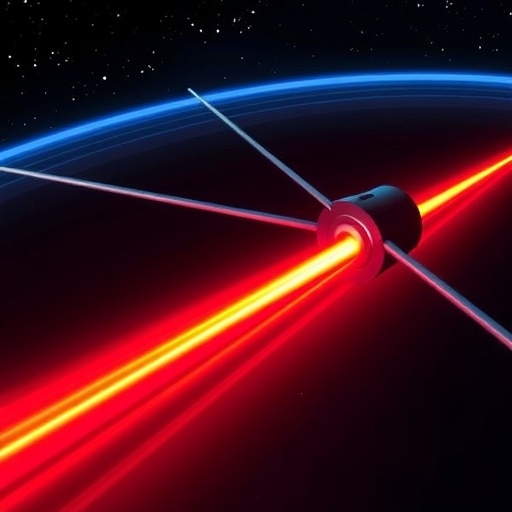
In a groundbreaking study published in Living Reviews in Relativity, the LISA Consortium Waveform Working Group has unveiled a critical advancement in the modeling of gravitational waveforms for the Laser Interferometer Space Antenna (LISA). This innovative research is not merely an incremental improvement; it represents a monumental leap forward in our ability to detect and interpret gravitational waves, which are ripples in spacetime caused by some of the universe’s most violent events. As we stand on the brink of a new era in astrophysics, the implications of this work reach far beyond traditional astrophysic studies and could redefine our understanding of the cosmos itself.
The primary objective of this research was to create precise waveform models for LISA that can aid in the identification and analysis of gravitational waves originating from astronomical sources. Gravitational waves carry with them a wealth of information about their origins and the physical phenomena that produced them. However, for scientists to interpret these faint signals amid the noise of cosmic radiation, they require a reliable framework that can accurately predict what these waveforms should look like. This research thus provides an essential tool for astrophysicists and cosmologists alike.
The study focuses on the mechanics of gravitational wave emissions from various astrophysical sources, including merging black holes and neutron stars. Each of these cosmic events creates unique wave signatures, which can be modeled using advanced mathematical formulas that capture the complex interactions involved. The complexity of these interactions necessitates a highly sophisticated approach, and the researchers employed cutting-edge computational techniques to devise models that are not only accurate but also computationally efficient. This efficiency is vital for future data analysis, allowing real-time processing of gravitational wave signals as they are detected.
In addition to modeling the waveforms themselves, the study discusses the statistical methods employed to assess the accuracy and reliability of these models. A significant portion of the research was devoted to understanding how variations in the parameters of the models can affect the resulting waveforms. By establishing a robust statistical framework, the authors ensure that their findings can withstand the scrutiny of peer review and practical application in observational astronomy.
Another critical aspect of this research is its collaboration between various theoretical physicists and numerical analysts. The interdisciplinary nature of the project highlights the importance of collective expertise in modern scientific endeavors. By facilitating communication and collaboration among researchers with diverse skill sets, the LISA Consortium has set a new benchmark for future collaborative projects across the field of astrophysics.
The implications of this work go far beyond the immediate benefits of improved waveform modeling. As LISA gears up for its planned launch in the coming years, this research serves as a foundational step toward unlocking a treasure trove of cosmic information. The scientific community eagerly awaits the mission’s findings, anticipating a wealth of data that could answer some of the most profound questions about the universe, such as the nature of black holes, the mechanics of stellar evolution, and the mysteries surrounding dark matter and dark energy.
One fascinating angle explored in the paper is the connection between the waveform characteristics and the fundamental properties of the sources, such as mass and spin. This provides a direct method for astronomers to measure and analyze these properties through gravitational wave signatures. With advancements in waveform modeling, we are positioned to not only witness these cosmic events but to also extract precise measurements that contribute to a deeper understanding of the underlying physics.
Furthermore, the research emphasizes the importance of efficient algorithms in future gravitational wave data analysis. The growing volume of data produced by gravitational wave detectors demands rapid processing capabilities to ensure that no significant event goes unnoticed. The algorithms developed in this study are designed to be scalable, permitting their application to data sets of varying sizes, from small-scale laboratory experiments to large astrophysical observations.
In addition to the scientific advancements, the paper advocates for educational initiatives aimed at training the next generation of researchers in gravitational wave astronomy. As the field expands, there exists a great need for skilled scientists who are conversant with both the theoretical groundwork and the computational techniques necessary for waveform modeling. By fostering educational programs and supporting mentorship frameworks, the LISA Consortium can cultivate a new wave of talent that is prepared to tackle the next set of challenges in gravitational wave astronomy.
Concluding this research, the authors highlight several future directions for their work. They propose ongoing refinement of the waveform models to incorporate new data from LISA and other gravitational wave observatories, including ground-based detectors. This iterative process of refining and recalibrating models will be crucial as new gravitational wave events are detected, allowing scientists to continuously update their theoretical frameworks in line with observational data.
As we look ahead to the future of gravitational wave astronomy, the contributions made by the LISA Consortium Waveform Working Group stand out as a pivotal moment in the field. The groundwork established through this study not only enhances our ability to understand the most energetic and fundamentally interesting processes in the universe but also serves as a catalyst for further innovation and exploration.
In summary, the release of this vital research marks a significant milestone for the LISA mission and for the broader cosmic community. By providing a more accurate and user-friendly method to model gravitational waveforms, researchers now possess an invaluable resource that will amplify our capacity to investigate the universe’s most mysterious phenomena. As we delve deeper into the secrets held by gravitational waves, the potential for new discoveries and insights into the fabric of spacetime itself becomes increasingly profound.
The work of the LISA Consortium is nothing short of revolutionary, and as we approach the launch of the LISA observatory, the anticipation in the scientific community is palpable. With each passing day, we edge closer to a new era of cosmic exploration, armed with the tools and knowledge essential for unveiling the mysteries of our universe.
LISA Consortium Waveform Working Group., Afshordi, N., Akçay, S. et al. Waveform modelling for the Laser Interferometer Space Antenna.
Living Rev Relativ 28, 9 (2025). https://doi.org/10.1007/s41114-025-00056-1
Cite Scienmag News
Wesley B. (October 30, 2025). Modeling Waveforms for Space-Based Laser Interferometers. Scienmag. https://scienmag.com/modeling-waveforms-for-space-based-laser-interferometers/
Wesley B. "Modeling Waveforms for Space-Based Laser Interferometers." Scienmag, 30 October 2025, https://scienmag.com/modeling-waveforms-for-space-based-laser-interferometers/. Accessed 28 August 2026.
Wesley B. "Modeling Waveforms for Space-Based Laser Interferometers." Scienmag. October 30, 2025. https://scienmag.com/modeling-waveforms-for-space-based-laser-interferometers/


