


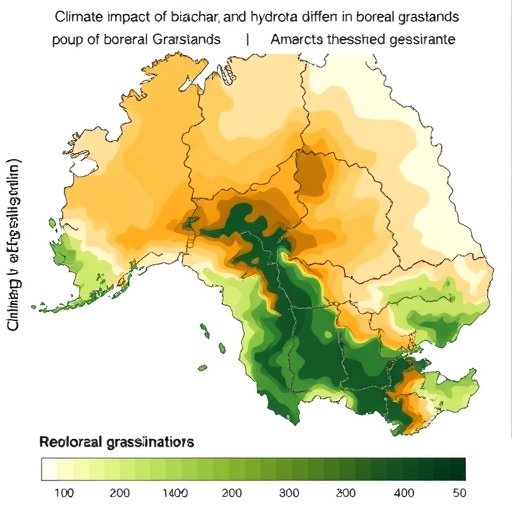
Recent advances in soil science have spotlighted the potential of carbon-rich amendments such as biochar and hydrochar to mitigate climate change by altering greenhouse gas dynamics in agricultural soils. However, a groundbreaking new study from Finland’s Natural Resources Institute (Luke) and partnering universities reveals that the choice between these two carbonaceous materials profoundly influences their environmental outcomes. This research elucidates contrasting effects of biochar and hydrochar on soil greenhouse gas emissions, organic carbon storage, and plant productivity within boreal legume grasslands.
The investigation centered on experimental plots cultivating a typical boreal grass-legume mixture of timothy grass and red clover. Over a controlled three-month period, emissions of three key greenhouse gases—carbon dioxide (CO2), nitrous oxide (N2O), and methane (CH4)—were meticulously measured following the incorporation of biochar or hydrochar, both with and without supplemental nitrogen fertilizer. This systematic approach allowed researchers to decipher nuanced soil-atmosphere exchange mechanisms influenced by each form of char.
Biochar and hydrochar, while chemically related as carbonaceous soil amendments, originate from distinct manufacturing processes, imparting divergent properties and ecological effects. Biochar is derived through high-temperature pyrolysis of birch wood, whereas hydrochar results from lower-temperature hydrothermal carbonization of birch bark. These processes modify the chars’ surface chemistry, porosity, and nutrient profiles, attributes that inherently shape their interaction with soil microbial communities and subsequent greenhouse gas fluxes.
Intriguingly, results demonstrated diametrically opposed effects on nitrous oxide fluxes between the two chars. Biochar amendment consistently elevated emissions of N2O, a greenhouse gas with over 200 times the global warming potential of CO2, particularly under nitrogen fertilization regimes. This enhancement suggests biochar may stimulate microbial pathways such as nitrification and denitrification responsible for N2O production, possibly by altering soil aeration or providing labile carbon substrates.
Conversely, hydrochar application markedly suppressed nitrous oxide emissions, in some instances turning soils into minor sinks for this potent greenhouse gas. The study attributes this mitigation to hydrochar’s facilitation of microbial communities that consume N2O or to its capacity for modulating soil redox conditions unfavorable for N2O generation. Enhanced microbial biomass carbon observed under hydrochar treatments further substantiates its role in promoting a more dynamic and potentially N2O-consuming soil microbiome.
Despite these divergent impacts on nitrous oxide, both biochar and hydrochar amendments significantly boosted particulate organic carbon in soils, indicating their shared capacity to contribute to soil organic matter accrual. This increase in particulate carbon implies long-term sequestration potential, beneficial for soil fertility and carbon storage. However, neither char variant significantly altered overall fluxes of carbon dioxide or methane during the experimental timeframe, nor did they substantially affect the biomass yield of the grass-clover mixture.
Interestingly, biochar combined with nitrogen fertilization exhibited a slight reduction in timothy grass biomass, signaling possible antagonistic effects on nitrogen availability or uptake pathways. This phenomenon suggests biochar may, under certain pedoclimatic conditions, interfere with nutrient cycling or root function, a consideration critical for agronomic applications seeking yield optimization alongside environmental benefits.
The complex interplay revealed between char type, nitrogen management, microbial ecology, and plant productivity underscores the necessity for tailored approaches when integrating carbon amendments into boreal agricultural systems. Lead author Hem Raj Bhattarai emphasizes the importance of selecting appropriate char materials that align with specific soil and crop characteristics to maximize greenhouse gas mitigation and soil health improvements.
Complementing the laboratory and controlled field assessments, the researchers advocate for larger-scale studies across diverse soil types and environmental contexts to refine guidelines for sustainable biochar and hydrochar utilization. Such investigations could uncover key variables influencing char efficacy and broaden the applicability of these materials in climate-smart agriculture, especially in northern latitudes facing unique ecological constraints.
This study presents a compelling narrative for the heterogeneous effects of biochar and hydrochar, challenging the common perception of biochar as a uniformly beneficial soil amendment. By revealing hydrochar’s superior capacity to diminish nitrous oxide emissions and promote microbial biomass, the findings offer a pathway towards more nuanced and effective soil carbon-enhancement strategies.
Moreover, the research contributes critical insights to the broader discourse on soil carbon management and greenhouse gas mitigation, highlighting the intricacy of soil biogeochemical processes and the pivotal role of microbial communities in regulating gas fluxes. These findings will resonate within the environmental chemistry and earth sciences communities focused on advancing sustainable land-use practices.
In summary, the Finnish-led study sheds light on the distinct mechanistic actions of biochar and hydrochar in modulating greenhouse gas emissions and soil organic carbon dynamics in boreal grasslands. It underscores the importance of precision in selecting soil amendments to align with ecological and agricultural goals, signaling a paradigm shift in how carbon-rich chars are integrated into climate mitigation strategies in agroecosystems.
News Publication Date: 28-Sep-2025
References: Bhattarai, H.R., Honkanen, E., Ruhanen, H. et al. Effects of biochar, hydrochar and nitrogen fertilization on greenhouse gas fluxes, soil organic carbon pools, and biomass yield of a boreal legume grassland. Biochar 7, 114 (2025). DOI: 10.1007/s42773-025-00496-6
Keywords
Biogeochemistry, Geochemistry, Carbon cycle, Soil chemistry, Microbiology, Soil science, Environmental chemistry, Environmental sciences
Cite Scienmag News
Bethany Barker. (October 27, 2025). Climate impacts of biochar and hydrochar differ in boreal grasslands. Scienmag. https://scienmag.com/climate-impacts-of-biochar-and-hydrochar-differ-in-boreal-grasslands/
Bethany Barker. "Climate impacts of biochar and hydrochar differ in boreal grasslands." Scienmag, 27 October 2025, https://scienmag.com/climate-impacts-of-biochar-and-hydrochar-differ-in-boreal-grasslands/. Accessed 1 September 2026.
Bethany Barker. "Climate impacts of biochar and hydrochar differ in boreal grasslands." Scienmag. October 27, 2025. https://scienmag.com/climate-impacts-of-biochar-and-hydrochar-differ-in-boreal-grasslands/


