


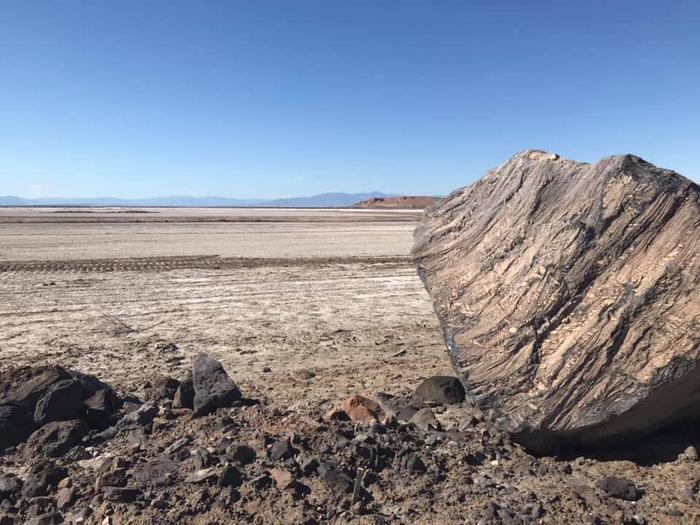
When desert winds stir up dust from the Salton Sea’s exposed lakebed, nearby communities suffer from increased air pollution. The deterioration coincides with reduced flows into California’s largest lake, a new research paper in the American Journal of Agricultural Economics finds.

Credit: Emily C. Dooley, UC Davis
When desert winds stir up dust from the Salton Sea’s exposed lakebed, nearby communities suffer from increased air pollution. The deterioration coincides with reduced flows into California’s largest lake, a new research paper in the American Journal of Agricultural Economics finds.
Disadvantaged communities have been affected more than others in the areas near the Salton Sea, which has been shrinking for years, said the paper’s co-leading author Eric Edwards. He is an assistant professor of agricultural economics at University of California, Davis, who did the research while at North Carolina State University.
“We have a dusty area, and any time there is wind, it’s going to pick up dust and move it around,” Edwards said. “We think this new dust is increasing the amount of pollution faced by disadvantaged communities in the region surrounding the lake.”
An overflowing river
The Salton Sea formed in 1905 after the Colorado River overflowed its banks and the floodwaters settled into what was known as the Salton Sink. It was primarily fed by water runoff from agricultural operations for almost a century. As the southern part of California struggled to meet growing water demand, the Imperial Irrigation District agreed to send water to San Diego for urban use.
Imperial, which supplies water to vast desert farms as well as seven towns and two special districts, is the largest user of Colorado River water. The agreement with San Diego required agricultural water users to increase efficiency and reduce their water consumption, which reduced water running into the Salton Sea, Edwards said.
The reductions increased the lake’s salt content, which is higher than in the Pacific Ocean. This also harmed wildlife habitats and created localized air pollution. The area is the subject of many environmental restoration projects.
Studying implications
Edwards and others used a particle transport model to study the effects of changing water diversions on particulate pollution.
They found that the paths of fine particulate matter — which can cause asthma, heart and respiratory issues when inhaled — were associated with higher air pollution readings after Imperial began reducing runoff water to the Salton Sea around 2011 in order to transfer it to San Diego, a practice that continues today.
Researchers modeled lakebed exposure by dividing the lake’s shoreline into 1-square-kilometer grids and collected air pollution data daily for over 20 years, from 1998 to 2018. They added data about the exposed lakebed, or playa, and used a sophisticated physics model called HYSPLIT to factor in wind levels and particle size to track the movement of dust over time. State health screening information available by ZIP code added more to the story by pinpointing disadvantaged areas, asthma rates and other vulnerabilities.
Lake levels were higher in 1998 before the transfers, so the change was not evident until later years, when the lakebed became more exposed.
“We show that during that post-2011, there is an increase in particles going through disadvantaged communities relative to non-disadvantaged communities, which are farther away from the sea,” Edwards said.
In the paper, the pollution paths are depicted on a map of the state. The Salton Sea is marked with a black dot, and red lines radiate from there to distances of 100 miles or more.
“From every exposed grid cell you have these paths predicting where the particles are going based on physics,” Edwards said. “That’s the path of emissions.”
Prior research suggests that dust particles from newly exposed playa are more susceptible to wind erosion.
“There’s lots of evidence that playa is particularly emissive in terms of dust,” Edwards said. “If it’s dry, those particles get picked up readily by the wind and create dust — and at rates higher than areas that have been exposed to the wind over long periods of time.”
Informing decision makers
Edwards said policymakers and regulators should consider the health and environmental impacts of water diversions in their decision making.
“The drying up of the Salton Sea has serious health consequences that have generally fallen on more disadvantaged populations, who may not be well equipped to advocate for policies that improve their health,” he said. “Policymakers need to think about how to facilitate the movement of water via market transactions, which are essential, while also accounting for potential negative effects on the environment.”
Ryan Abman from San Diego State University and Dana Hernandez-Cortes from Arizona State University contributed equally with Edwards to the research and journal article.
The U.S. Department of Agriculture’s National Institute of Food and Agriculture supported this research.
Journal
American Journal of Agricultural Economics
Article Title
Water, dust, and environmental justice: The case of agricultural water diversions
Article Publication Date
29-May-2024
Cite Scienmag News
Denise Maddox. (May 29, 2024). A drying Salton Sea pollutes neighboring communities. Scienmag. https://scienmag.com/a-drying-salton-sea-pollutes-neighboring-communities/
Denise Maddox. "A drying Salton Sea pollutes neighboring communities." Scienmag, 29 May 2024, https://scienmag.com/a-drying-salton-sea-pollutes-neighboring-communities/. Accessed 3 September 2026.
Denise Maddox. "A drying Salton Sea pollutes neighboring communities." Scienmag. May 29, 2024. https://scienmag.com/a-drying-salton-sea-pollutes-neighboring-communities/

