


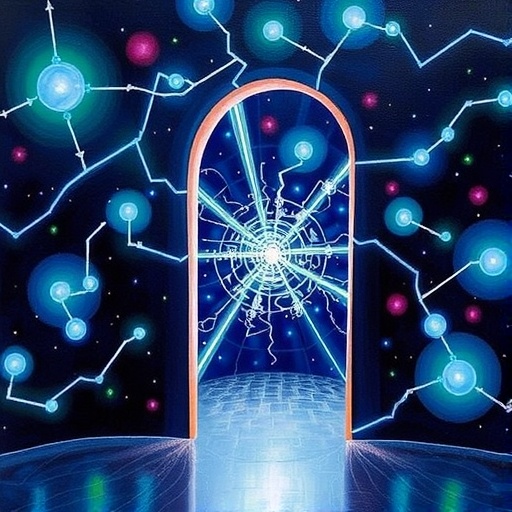
Imagine a scenario where a frog is trapped inside a box that has a large opening at a certain height. The question seems straightforward: can the frog escape? Intuition suggests that if the frog has enough energy to jump higher than the height of the opening, it should be able to leap out. However, the reality is more complex. The frog’s success depends not just on its ability to jump high but also on its capacity to land precisely on or through the opening. If it misjudges or misses the doorway, the frog remains trapped, despite having sufficient energy.
This deceptively simple analogy captures a long-standing puzzle in condensed matter physics concerning electrons inside solids. When materials are bombarded with electrons, these interactions can transfer energy, enabling some electrons within the solid to acquire enough energy to escape. Although the fundamental mechanism of electron escape — known as secondary electron emission — has been extensively studied and exploited in various technologies, accurately predicting which electrons will manage to exit has remained elusive. This scientific conundrum has now been addressed by a pioneering collaborative effort at the Vienna University of Technology (TU Wien), revealing the critical role of “doorway states” — specific quantum states acting as gateways for electrons to leave a solid.
Within a material, electrons occupy discrete energy levels determined by the solid’s electronic structure. These electrons remain confined as long as their energy is below a characteristic threshold. Upon absorption of additional energy, some electrons exceed this ionization energy and theoretically gain freedom to escape into the vacuum or adjacent materials. Conventional models have assumed a direct relationship between electron energy and emission probability, positing that electrons with energies surpassing this threshold should readily emit from the material’s surface.
However, experimental data routinely contradicted these assumptions. Materials with nearly identical electronic band structures, such as graphene samples differing only in the number of layers, sometimes exhibited stark differences in their secondary electron emission profiles. This discrepancy indicated that electron energy alone does not dictate emission. Herein lies the crux: some electrons, while energetically free, linger within the solid because they fail to match states that efficiently connect the internal electron levels to those outside the material.
Professor Richard Wilhelm and colleagues identified that certain electrons populate what are termed “doorway states.” Unlike ordinary energy states, these quantum resonance states mediate the coupling between bound electron states and the continuum of free electron states outside the solid. An electron occupying a doorway state effectively finds the “open door” through which it can exit. Thus, passing the energy threshold is necessary but not sufficient — the electron’s spatial and momentum characteristics, shaped by the doorway states’ quantum nature, are equally vital.
This nuanced understanding resolves longstanding discrepancies in experimental observations. The existence of doorway states clarifies why materials exhibiting similar energy spectra can behave very differently in secondary electron emission experiments. Doorway states depend sensitively on the atomic layering and structural attributes of the material. For instance, these states may only emerge once a threshold number of atomic layers is stacked, explaining why five or more layers of a material are often necessary for certain emission behaviors to manifest.
The implications of these findings are profound. Not only do they deepen our fundamental knowledge about electron dynamics in condensed matter systems, but they also open new avenues for technological innovation. By tailoring the structure and layering of materials, researchers can engineer the presence or absence of specific doorway states. This ability offers precise control over electron emission characteristics, pivotal in applications ranging from electron microscopy to semiconductor device engineering and energy harvesting technologies.
Furthermore, the research showcases a compelling example of how advanced experimental techniques combined with theoretical modeling can uncover hidden aspects of quantum behavior that are not apparent from energy considerations alone. The identification of doorway states required intricate measurements and analysis, bridging empirical findings with quantum mechanical simulations to visualize the complex electron landscape inside the material.
This insight into electronic doorway states may also influence fields beyond solid-state physics, such as surface science and catalysis, where electron transfer processes at interfaces are critical. Understanding and manipulating doorway states could lead to enhanced efficiency in electron-driven reactions or sensing technologies that rely on surface electron interactions.
Moreover, the analogy of the frog and the box elegantly encapsulates the subtlety of quantum escape phenomena, reminding us that energy availability does not guarantee transition or release. Instead, the pathway, resonances, and coupling to external states collectively determine whether an electron—or any quantum particle—successfully departs its initial environment.
Ultimately, this research elevates the discourse on secondary electron emission from a simple energy picture to a detailed quantum mechanical framework. It reveals how electron release is governed by a complex interplay of material structure and quantum resonance states, offering a richer, more predictive understanding that can inspire future experimental designs and technological breakthroughs.
The unraveling of the doorway state mystery represents a landmark achievement in condensed matter physics, highlighting the intricate quantum choreography that governs electron behavior in layered materials. As we continue to refine our grasp of these processes, the prospect of designing materials with customized electron emission profiles becomes ever more tangible, promising to revolutionize various scientific and industrial domains.
News Publication Date: 16-Oct-2025
Web References: DOI: 10.1103/qls7-tr4v
Keywords
Materials science, Physics, Applied physics, Condensed matter physics, Energy, Experimental physics, Solid state physics
Cite Scienmag News
Katie Riggs. (October 20, 2025). The Quantum Doorway Puzzle: Electrons Struggling to Find Their Exit. Scienmag. https://scienmag.com/the-quantum-doorway-puzzle-electrons-struggling-to-find-their-exit/
Katie Riggs. "The Quantum Doorway Puzzle: Electrons Struggling to Find Their Exit." Scienmag, 20 October 2025, https://scienmag.com/the-quantum-doorway-puzzle-electrons-struggling-to-find-their-exit/. Accessed 4 September 2026.
Katie Riggs. "The Quantum Doorway Puzzle: Electrons Struggling to Find Their Exit." Scienmag. October 20, 2025. https://scienmag.com/the-quantum-doorway-puzzle-electrons-struggling-to-find-their-exit/


