

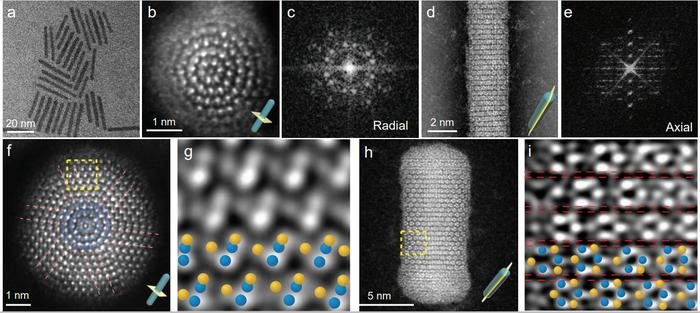
Crystal symmetry is a fundamental concept in materials science, playing a crucial role in determining the structure-property relationships. Typically, a crystal is a solid composed of structural units that periodically repeat in three-dimensional space, forming a system that exhibits both translational and rotational symmetry. When specific forms of symmetry within the system are disrupted due to spontaneous processes or external influences, novel physical phenomena and chemical properties often emerge. However, extensive effort in designing and regulating atomic configurations in materials have primarily focused on manipulating geometric shapes, chemical doping, and local environments, the new types of symmetrical materials are rarely reported.

Credit: ©Science China Press
Crystal symmetry is a fundamental concept in materials science, playing a crucial role in determining the structure-property relationships. Typically, a crystal is a solid composed of structural units that periodically repeat in three-dimensional space, forming a system that exhibits both translational and rotational symmetry. When specific forms of symmetry within the system are disrupted due to spontaneous processes or external influences, novel physical phenomena and chemical properties often emerge. However, extensive effort in designing and regulating atomic configurations in materials have primarily focused on manipulating geometric shapes, chemical doping, and local environments, the new types of symmetrical materials are rarely reported.
Addressing this gap, a research team composed of Professor Lin Guo from Beihang University, Professor Renchao Che from Fudan University, Professor Lin Gu from Tsinghua University, and Professor Er-Jia Guo from the Institute of Physics, Chinese Academy of Sciences, has reported a NiS ultrafine nanorod featuring a novel symmetry distribution. The atomic arrangement of this nanorod exhibits both radial rotational symmetry and axial translational symmetry. This is the first demonstration of direction-related symmetry separation within a single nanostructure, which goes beyond the traditional descriptions of material structures in known three-dimensional space groups and point groups, surpassing the conventional definitions of crystallography. Due to its unique crystal structure, the nanorod simultaneously displays combined magnetic properties of striped and vortex magnetic domains in different directions. This related research was published in the National Science Review (NSR), with Jianxin Kang, Qi Hu, Zhongning Huang from Beihang University, Ruixuan Zhang from Fudan University, and Ang Gao from Tsinghua University as co-first authors.
Detailed structural characterization revealed that the cross-sectional profile of NiS nanorods distinctly displays regular five-ring atomic patterns rather than traditional periodic lattices. Radially, NiS nanorods exhibit rotational symmetry but lack translational symmetry. In contrast, when observed from the side, the NiS nanorods show regular translational periodicity. However, the presence of only horizontal stripes and a disordered atomic structure at the atomic scale indicates that the radial projection periodicity of the atoms is disordered, and the radial symmetry is disrupted. Experimental results demonstrate that NiS nanorods only exhibit traditional crystal-like rotational and translational symmetry once they grow to a certain diameter.
Furthermore, the research team used Lorentz microscopy to measure the magnetic distribution of NiS nanorods at the nanoscale. The results indicate that NiS nanorods possess axially antiparallel striped magnetic domains and radially arranged vortex domains, suggesting that the electron spin arrangement follows the inherent atomic arrangement. Along the long axis, the long-range ordered atomic arrangement produces aligned spins and magnetic moments, forming domain walls. In the radial direction, the circular arrangement of atoms restricts the alignment consistency of the spins, causing the magnetic moments to form a closed loop.
To short end, the observed symmetry separation in NiS nanorods demonstrates the integration of multiple magnetic orders, a phenomenon not previously seen in traditional crystals, quasicrystals, and amorphous materials. This intrinsic magnetic configuration induced by unique crystal symmetry offers new materials and design concepts for discovering new magnetic coupling and promoting high-density non-volatile magnetic recording media.
###
See the article:
NiS ultrafine nanorod with translational and rotational symmetry
Journal
National Science Review

