


Researchers at the School of Engineering of the Hong Kong University of Science and Technology (HKUST) have developed a sustainable and controllable strategy to manipulate interfacial heat transfer, paving the way for improving the performance of eco-friendly cooling in various applications such as electronics, buildings and solar panels.

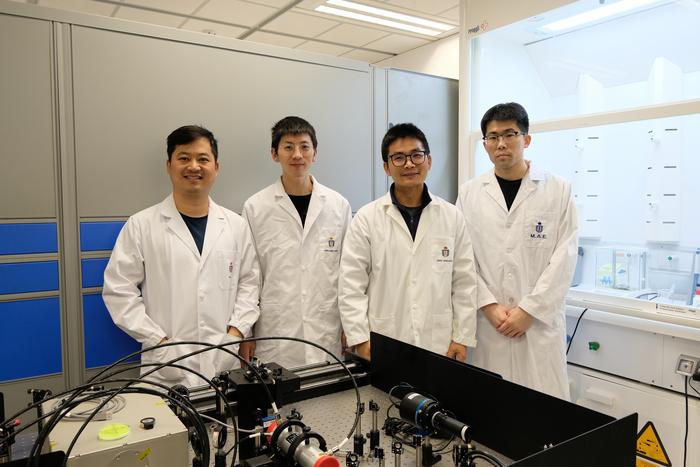
Credit: HKUST
Researchers at the School of Engineering of the Hong Kong University of Science and Technology (HKUST) have developed a sustainable and controllable strategy to manipulate interfacial heat transfer, paving the way for improving the performance of eco-friendly cooling in various applications such as electronics, buildings and solar panels.
As demand for effective cooling solutions continues to grow due to the rising global temperature, scientists worldwide have been actively exploring energy-saving cooling technologies that are more effective. Compared to active cooling, which entirely depends on energy consumption to operate, passive cooling relies on natural processes and design principles to reduce heat and maintain a comfortable temperature with low or no energy consumption. This approach has therefore generated wide interest among researchers due to its eco-friendly nature and zero-electricity characteristic.
One emerging field of study is passive cooling using metal-organic frameworks (MOFs), which are porous materials that can capture water vapor from the air and be used to increase energy efficiency in room temperature space cooling applications. However, MOFs typically exhibit low thermal conductivity, making them poor thermal conductors. Moreover, the presence of adsorbed water molecules in MOFs further reduces their effective thermal conductivity. This limitation leaves little room for manipulating the intrinsic thermal transport properties of MOFs to enhance their cooling performance.
To address the issue, researchers worldwide have turned their attention to the interfacial heat dissipation between MOFs and the materials they come into contact with. Various approaches, including the use of adhesion layers, nanostructures, chemical modification, and self-assembled monolayers, have been employed to enhance the interfacial thermal conductance (ITC). However, synthesizing or fabricating buffer layers with precise atomic control is a challenging task, limiting the potential applications of these methods.
In their pioneering work, the research team led by Prof. ZHOU Yanguang from the Department of Mechanical and Aerospace Engineering at HKUST introduced a sustainable and controllable strategy to manipulate interfacial heat transfer between the contacted substrate and typical MOFs by utilizing a water adsorption process. Through comprehensive frequency-domain thermoreflectance (FDTR) measurements and molecular dynamics (MD) simulations, they have demonstrated a remarkable improvement in ITC between the contacted substrate and MOFs. The ITC was increased from 5.3 MW/m2K to 37.5 MW/m2K, representing an enhancement of approximately 7.1 times. Effective enhancements are also observed in other Au/MOF systems.
The research team attributes this improvement to the formation of dense water channels facilitated by the adsorbed water molecules within MOFs. These channels serve as additional thermal pathways, significantly enhancing thermal energy transfer across the interfaces. Further analysis using the frequency domain direct decomposition method developed by the team found that the adsorbed water not only activates the high-frequency vibrations, but also increases the overlap of vibrational density of states between the substrate and MOF which enhances the thermal energy dissipation from the substrate to MOF, highlighting the bridge effect of the adsorbed water molecules.
“This innovative study not only provides new insights into thermal transport across MOFs and other materials, but also holds great promise for enhancing the performance of cooling applications involving MOFs. By leveraging the water adsorption process, our team has achieved a breakthrough in manipulating interfacial heat transfer, paving the way for more efficient cooling technologies,” said Prof. Zhou.
Their research work, titled “Direct Observation of Tunable Thermal Conductance at Solid/Porous Cystalline Solid Interfaces Induced by Water Adsorbates”, was recently published in first-rate multidisciplinary journal Nature Communications. Led by Prof. Zhou, the team included his PhD students WANG Guang, FAN Hongzhao, and LI Jiawang, as well as Associate Head of the Department of Mechanical and Aerospace Engineering at HKUST Prof. LI Zhigang.
Journal
Nature Communications
Method of Research
Experimental study
Subject of Research
Not applicable
Article Title
Direct observation of tunable thermal conductance at solid/porous crystalline solid interfaces induced by water adsorbates
Article Publication Date
14-Mar-2024
Cite Scienmag News
Denise Maddox. (May 28, 2024). HKUST researchers enhance performance of eco-friendly cooling applications by developing sustainable strategy to manipulate interfacial heat transfer. Scienmag. https://scienmag.com/hkust-researchers-enhance-performance-of-eco-friendly-cooling-applications-by-developing-sustainable-strategy-to-manipulate-interfacial-heat-transfer/
Denise Maddox. "HKUST researchers enhance performance of eco-friendly cooling applications by developing sustainable strategy to manipulate interfacial heat transfer." Scienmag, 28 May 2024, https://scienmag.com/hkust-researchers-enhance-performance-of-eco-friendly-cooling-applications-by-developing-sustainable-strategy-to-manipulate-interfacial-heat-transfer/. Accessed 4 September 2026.
Denise Maddox. "HKUST researchers enhance performance of eco-friendly cooling applications by developing sustainable strategy to manipulate interfacial heat transfer." Scienmag. May 28, 2024. https://scienmag.com/hkust-researchers-enhance-performance-of-eco-friendly-cooling-applications-by-developing-sustainable-strategy-to-manipulate-interfacial-heat-transfer/

