


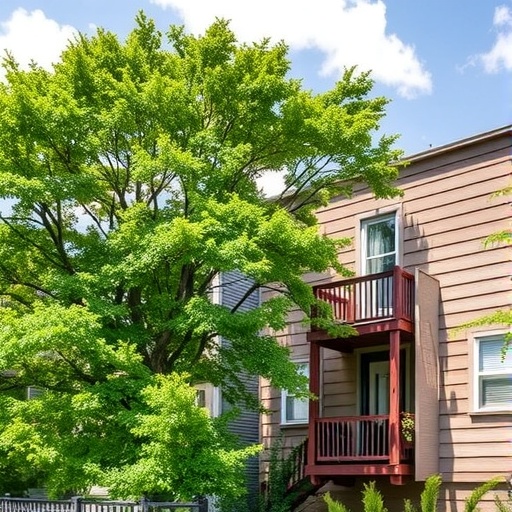
In urban environments, the interplay between thermal comfort and air quality has emerged as a critical focus for researchers and city planners alike. A recent study published in the journal Environmental Science and Pollution Research delves into this complex relationship, presenting a multi-objective optimization approach to balance the benefits of urban greenery with building configurations. This innovative research highlights how trees can act as vital assets in improving both thermal comfort and reducing air pollutants in densely populated street canyons.
As urbanization continues to accelerate globally, cities are increasingly vying for sustainable and livable environments. The research conducted by Li, Jareemit, and Liu investigates the essential systems in urban landscapes, particularly within street canyons—narrow, typically deep corridors flanked by tall buildings. These canyons often experience unique microclimatic conditions that can amplify pollution levels while concurrently affecting thermal comfort for inhabitants. The study emphasizes that amidst the rising temperatures attributed to climate change, the necessity for effective strategies has become imperative.
One of the chief findings of the research is the role that urban trees play in mitigating thermal discomfort typically experienced in street canyons. The authors provide comprehensive details on how strategically placed trees can provide shade, reduce the urban heat island effect, and ultimately help regulate temperatures. Trees not only provide immediate relief through their cooling properties but also enhance the aesthetic beauty of an area, thereby encouraging outdoor activities and enhancing quality of life for city dwellers.
The multi-objective optimization model proposed in this study is groundbreaking. By employing advanced computational techniques, the authors effectively assess various combinations of building configurations and tree placements. The optimization process helps to identify the most effective arrangements that can maximize comfort and minimize pollution. This approach paves the way for data-driven decision-making, potentially guiding urban development towards sustainable outcomes that cater to both environmental restoration and human comfort.
Furthermore, the research provides valuable insights into air quality improvements that can be achieved through vegetation integration. Trees act as natural air filters, trapping toxic pollutants and particulate matter, thus contributing positively to urban air quality. The study presents evidence suggesting that specific tree species are more efficient in pollutant absorption, and their placement can significantly influence the air quality within a street canyon.
City planners and environmental scientists are increasingly recognizing the significance of incorporating ecological principles into urban design. Li, Jareemit, and Liu’s study urges stakeholders to take into account the dual benefits of trees in urban planning practices. The authors argue for integrating natural solutions not as an afterthought but as fundamental components of urban infrastructure, thereby creating symbiotic relationships between green spaces and built environments.
The researchers conducted a series of simulations to validate their optimization model. These simulations consider various factors, including climatic conditions and urban density, providing a robust framework for understanding how tree and building structures interact. Their findings indicate that a carefully calibrated design can lead to a marked improvement in both thermal comfort and air quality, providing compelling evidence for the adoption of such strategies in urban planning frameworks.
Notably, the implications of this research extend beyond ecological and comfort metrics; they touch on public health as well. Improved air quality is linked to significant reductions in respiratory ailments and other health issues associated with pollution exposure. By addressing thermal comfort through green infrastructure, city planners stand to enhance not just environmental but public health outcomes, thus reinforcing the interconnected nature of urban ecosystems.
In essence, the research advocates for a paradigm shift in how cities view greenery, urging stakeholders to embrace the multifaceted benefits of trees. As urban centers evolve, incorporating nature into the built environment can lead to a more sustainable and resilient future, effectively confronting challenges posed by climate change and urban heat.
In conclusion, Li, Jareemit, and Liu’s innovative work stands as a testament to the potential of interdisciplinary research aimed at enriching urban life. Their approach links environmental science with urban planning, presenting a roadmap for cities aspiring to harmonize human comfort with ecological health. As cities grapple with rising temperatures and pollution, such findings emphasize the urgency of adopting holistic solutions that prioritize both people and the planet.
This study exemplifies how forward-thinking research can not only inform policy but also inspire a new generation of urban designers to foster cities that are not only habitable but thriving ecosystems where both people and nature coexist harmoniously.
Ultimately, the integration of appropriate tree species and thoughtful building configurations could lead to a new standard in urban planning. By addressing urban heat and pollution simultaneously, cities can work towards not just surviving but flourishing in an era marked by climate uncertainties. The findings from this research may well serve as a beacon for future studies aimed at unearthing innovative solutions to urban challenges.
As we move into an increasingly urban-centric future, the implications of the work conducted by Li and colleagues are profound. The quest to balance thermal comfort and pollutant mitigation through smart, green infrastructure is not just an opportunity; it is a necessity for building resilient cities capable of adapting to the demands of the 21st century.
This research serves as a reminder that the path to sustainable urban living may lie in our ability to look to nature for solutions, fostering a design ethos that values environmental stewardship while enhancing human experience. The hope is that this foundational study will spark further exploration into urban ecological dynamics, inspiring practical applications that engage communities in the shared goal of creating cleaner, healthier, and more livable urban spaces.
Li, X., Jareemit, D., Liu, J. et al. Balancing thermal comfort and pollutant mitigation in street canyons: a multi-objective optimization of tree and building configurations.
Environ Sci Pollut Res (2025). https://doi.org/10.1007/s11356-025-37085-w
Cite Scienmag News
Violet Maxwell. (October 15, 2025). Optimizing Trees and Buildings for Comfort and Clean Air. Scienmag. https://scienmag.com/optimizing-trees-and-buildings-for-comfort-and-clean-air/
Violet Maxwell. "Optimizing Trees and Buildings for Comfort and Clean Air." Scienmag, 15 October 2025, https://scienmag.com/optimizing-trees-and-buildings-for-comfort-and-clean-air/. Accessed 3 September 2026.
Violet Maxwell. "Optimizing Trees and Buildings for Comfort and Clean Air." Scienmag. October 15, 2025. https://scienmag.com/optimizing-trees-and-buildings-for-comfort-and-clean-air/


