


Breastmilk can promote equitable child health and save healthcare costs by reducing childhood illnesses and healthcare utilization in the early years, according to a new study published this week in the open-access journal PLOS ONE by Tomi Ajetunmobi of the Glasgow Centre for Population Health, Scotland, and colleagues.

Credit: Berengere Chabanis, CC0 (
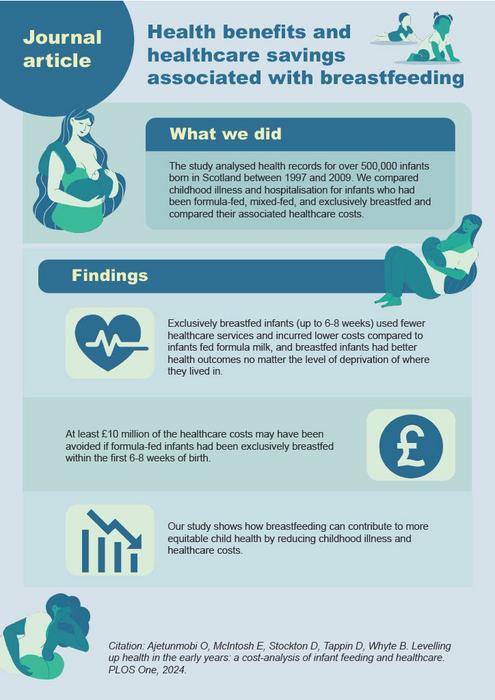
Breastmilk can promote equitable child health and save healthcare costs by reducing childhood illnesses and healthcare utilization in the early years, according to a new study published this week in the open-access journal PLOS ONE by Tomi Ajetunmobi of the Glasgow Centre for Population Health, Scotland, and colleagues.
Breastfeeding has previously been found to promote development and prevent disease among infants. In Scotland – as well as other developed countries – low rates of breastfeeding in more economically deprived areas are thought to contribute to inequalities in early childhood health. However, government policies to promote child health have made little progress and more evidence on the effectiveness of interventions may be needed.
In the new study, researchers used administrative datasets on 502,948 babies born in Scotland between 1997 and 2009. Data were available on whether or not infants were breastfed during the first 6-8 weeks, the occurrence of ten common childhood conditions from birth to 27 months, and the details of hospital admissions, primary care consultations and prescriptions.
Among all infants included in the study, 27% were exclusively breastfed, 9% mixed fed and 64% formula fed during the first 6-8 weeks of life. The rates of exclusively breastfed infants ranged from 45% in the least deprived areas to 13% in the most deprived areas.
The researchers found that, within each quintile of deprivation, exclusively breastfed infants used fewer healthcare services and incurred lower costs compared to infants fed any formula milk. On average, breastfed infants had lower average costs of hospital care per admission (£42) compared to formula-fed infants (£79) in the first six months of life and fewer GP consultations (1.72, 95% CI: 1.66 – 1.79) than formula-fed infants (1.92 95% CI: 1.88 – 1.94). At least £10 million of healthcare costs could have been avoided if all formula-fed infants had instead been exclusively breastfed for the first 6-8 weeks of life, the researchers calculated.
The authors conclude that breastfeeding has a significant health and economic benefit and that increasing breastfeeding rates in the most deprived areas could contribute to the narrowing of inequalities in the early years.
#####
In your coverage please use this URL to provide access to the freely available article in PLOS ONE:
Citation: Ajetunmobi O, McIntosh E, Stockton D, Tappin D, Whyte B (2024) Levelling up health in the early years: A cost-analysis of infant feeding and healthcare. PLoS ONE 19(5): e0300267.
Author Countries: UK
Funding: The original study was jointly funded by the Scottish Collaboration of Public Health Research and Policy (SCPH/08) and the Glasgow Centre for Population Health. The funders had no role in the study design, data-linkage/analyses, decision to publish or preparation of this manuscript.
Journal
PLoS ONE
Method of Research
Observational study
Subject of Research
People
Article Title
Levelling up health in the early years: A cost-analysis of infant feeding and healthcare
Article Publication Date
22-May-2024
COI Statement
The authors have declared that no competing interests exist.
Cite Scienmag News
Nathaniel Bowman. (May 22, 2024). Health and economic benefits of breastfeeding quantified. Scienmag. https://scienmag.com/health-and-economic-benefits-of-breastfeeding-quantified/
Nathaniel Bowman. "Health and economic benefits of breastfeeding quantified." Scienmag, 22 May 2024, https://scienmag.com/health-and-economic-benefits-of-breastfeeding-quantified/. Accessed 3 September 2026.
Nathaniel Bowman. "Health and economic benefits of breastfeeding quantified." Scienmag. May 22, 2024. https://scienmag.com/health-and-economic-benefits-of-breastfeeding-quantified/

