


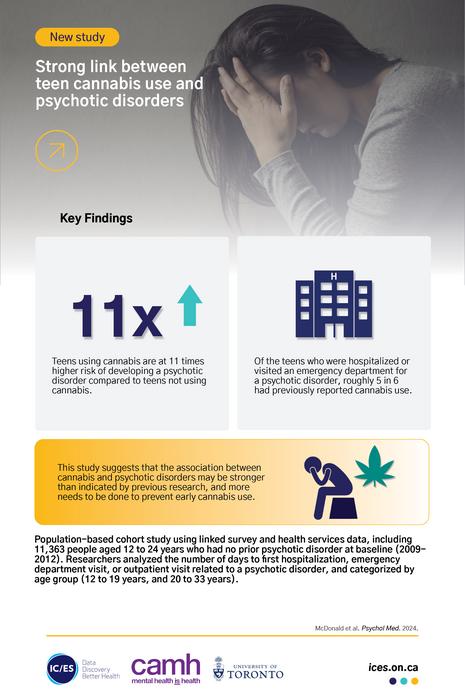
Toronto, ON, May 22, 2024 – A new study published in the journal Psychological Medicine estimates that teens using cannabis are at 11 times higher risk of developing a psychotic disorder compared to teens not using cannabis.

Credit: ICES
Toronto, ON, May 22, 2024 – A new study published in the journal Psychological Medicine estimates that teens using cannabis are at 11 times higher risk of developing a psychotic disorder compared to teens not using cannabis.
This finding suggests that the association between cannabis and psychotic disorders may be stronger than indicated by previous research, which has relied largely on older data when cannabis was less potent than today. For context, the average THC potency of cannabis in Canada has increased from roughly 1% in 1980 to 20% in 2018.
Researchers from the University of Toronto, the Centre for Addiction and Mental Health (CAMH), and ICES, linked recent population-based survey data from over 11,000 youth in Ontario, Canada, to health service use records including hospitalizations, emergency department (ED) visits, and outpatient visits.
The study is the first to show an age-dependent association between self-reported cannabis use and subsequent psychotic disorder diagnosis, which adds to a growing body of research on the mental health risks associated with cannabis.
“We found a very strong association between cannabis use and risk of psychotic disorder in adolescence. Surprisingly, we didn’t find evidence of association in young adulthood,” says lead author André McDonald, who conducted the study at ICES as part of his PhD at the University of Toronto. McDonald is now a postdoctoral fellow at the Peter Boris Centre for Addictions Research and the Michael G. DeGroote Centre for Medicinal Cannabis Research at McMaster University. “These findings are consistent with the neurodevelopmental theory that teens are especially vulnerable to the effects of cannabis.”
Of the teens who were hospitalized or visited an ED for a psychotic disorder, roughly 5 in 6 had previously reported cannabis use. McDonald points out that, “the vast majority of teens who use cannabis will not develop a psychotic disorder, but according to these data, most teens who are diagnosed with a psychotic disorder likely have a history of cannabis use.”
The researchers could not completely rule out reverse causation, in that teens with psychotic symptoms may have been self-medicating with cannabis before receiving a clinical diagnosis. They also could not account for potentially important factors such as genetics and history of trauma. These limitations make it impossible to say definitively that teen cannabis use causes psychotic disorders. The authors also note that their estimates are only approximate, suggesting that further studies with larger samples are required.
Nevertheless, the findings add to worries about early cannabis use, particularly in the wake of legalization.
“As commercialized cannabis products have become more widely available, and have a higher THC content, the development of prevention strategies targeting teens is more important than ever,” says senior author Susan Bondy, an affiliate scientist at ICES and associate professor at the University of Toronto’s Dalla Lana School of Public Health.
McDonald adds, “Canadian youth are among the heaviest users of cannabis in the world. If we follow the precautionary principle, the bottom line is that more needs to be done to prevent early cannabis use.”
The study, “Age-dependent association of cannabis use with risk of psychotic disorder” was published in Psychological Medicine.
Authors: McDonald AJ, Kurdyak P, Rehm J, Roerecke M, Bondy SJ.
ICES is an independent, not-for-profit research and analytics institute that uses population-based health information to produce knowledge on a broad range of healthcare issues. ICES leads cutting-edge studies and analyses evaluating healthcare policy, delivery, and population outcomes. ICES knowledge is highly regarded in Canada and abroad and is widely used by government, hospitals, planners, and practitioners to make decisions about healthcare delivery and to develop policy. For the latest ICES news, follow us on X, formerly Twitter: @ICESOntario
The Centre for Addiction and Mental Health (CAMH) is Canada’s largest mental health and addiction teaching hospital and a world leading research centre in this field. CAMH combines clinical care, research, education, policy development and health promotion to help transform the lives of people affected by mental illness and addiction. CAMH is fully affiliated with the University of Toronto, and is a Pan American Health Organization/World Health Organization Collaborating Centre. For more information, please visit camh.ca or follow @CAMHnews on Twitter.
Journal
Psychological Medicine
Method of Research
Observational study
Subject of Research
People
Article Title
Age-dependent association of cannabis use with risk of psychotic disorder
Article Publication Date
22-May-2024
Cite Scienmag News
Ophelia Keating. (May 22, 2024). New evidence suggests link between teen cannabis use and psychotic disorders may be stronger than previously thought. Scienmag. https://scienmag.com/new-evidence-suggests-link-between-teen-cannabis-use-and-psychotic-disorders-may-be-stronger-than-previously-thought/
Ophelia Keating. "New evidence suggests link between teen cannabis use and psychotic disorders may be stronger than previously thought." Scienmag, 22 May 2024, https://scienmag.com/new-evidence-suggests-link-between-teen-cannabis-use-and-psychotic-disorders-may-be-stronger-than-previously-thought/. Accessed 5 September 2026.
Ophelia Keating. "New evidence suggests link between teen cannabis use and psychotic disorders may be stronger than previously thought." Scienmag. May 22, 2024. https://scienmag.com/new-evidence-suggests-link-between-teen-cannabis-use-and-psychotic-disorders-may-be-stronger-than-previously-thought/

