
Saturday, September 5, 2026
Science
No Result
View All Result
  • Login
  • HOME
  • SCIENCE NEWS
  • CONTACT US
  • HOME
  • SCIENCE NEWS
  • CONTACT US
No Result
View All Result
Scienmag
No Result
View All Result
Home Science News Technology and Engineering

How AI helps programming a quantum computer

May 21, 2024
in Technology and Engineering
Katie Riggs
By Katie Riggs Scienmag Editorial Profile - Quantum Physics
Reading Time: 3 mins read
0
How AI helps programming a quantum computer
66
SHARES
603
VIEWS
Share on FacebookShare on Twitter
ADVERTISEMENT

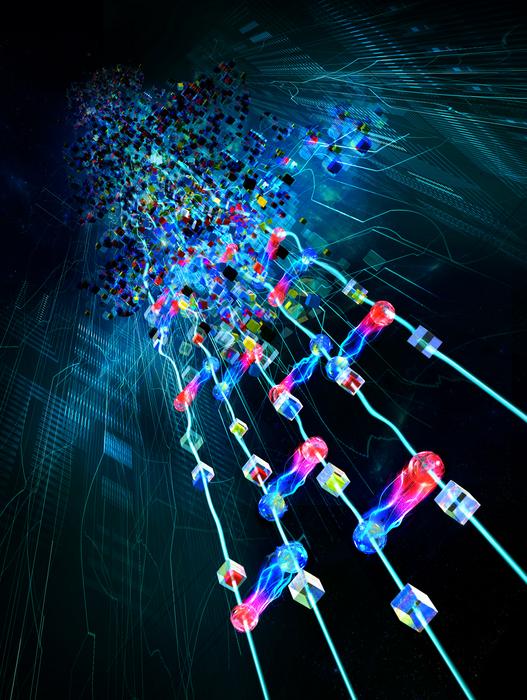
Generative models like diffusion models are one of the most important recent developments in Machine Learning (ML), with models as Stable Diffusion and Dall.e revolutionizing the field of image generation. These models are able to produce high quality images based on some text description. “Our new model for programming quantum computers does the same but, instead of generating images, it generates quantum circuits based on the text description of the quantum operation to be performed”, explains Gorka Muñoz-Gil from the Department of Theoretical Physics of the University of Innsbruck, Austria.

How AI helps programming a quantum computer

Credit: University of Innsbruck/Harald Ritsch

Generative models like diffusion models are one of the most important recent developments in Machine Learning (ML), with models as Stable Diffusion and Dall.e revolutionizing the field of image generation. These models are able to produce high quality images based on some text description. “Our new model for programming quantum computers does the same but, instead of generating images, it generates quantum circuits based on the text description of the quantum operation to be performed”, explains Gorka Muñoz-Gil from the Department of Theoretical Physics of the University of Innsbruck, Austria.

To prepare a certain quantum state or execute an algorithm on a quantum computer, one needs to find the appropriate sequence of quantum gates to perform such operations. While this is rather easy in classical computing, it is a great challenge in quantum computing, due to the particularities of the quantum world. Recently, many scientists have proposed methods to build quantum circuits with many relying machine learning methods. However, training of these ML models is often very hard due to the necessity of simulating quantum circuits as the machine learns. Diffusion models avoid such problems due to the way how they are trained. “This provides a tremendous advantage”, explains Gorka Muñoz-Gil, who developed the novel method together with Hans J. Briegel and Florian Fürrutter. “Moreover, we show that denoising diffusion models are accurate in their generation and also very flexible, allowing to generate circuits with different numbers of qubits, as well as types and numbers of quantum gates.” The models also can be tailored to prepare circuits that take into consideration the connectivity of the quantum hardware, i.e. how qubits are connected in the quantum computer. “As producing  new circuits is very cheap once the model is trained, one can use it to discover new insights about quantum operations of interest”, Gorka Muñoz-Gil names another potential of the new method.

The method developed at the University of Innsbruck produces quantum circuits based on user specifications and tailored to the features of the quantum hardware the circuit will be run on. This marks a significant step forward in unleashing the full extent of quantum computing. The work has now been published in Nature Machine Intelligence and was financially supported by the Austrian Science Fund FWF and the European Union, among others.

Publication: Quantum circuit synthesis with diffusion models. Florian Fürrutter, Gorka Muñoz-Gil, and Hans J. Briegel. Nature Machine Intelligence 2024 DOI: [arXiv: 2311.02041]


Journal

Nature Machine Intelligence

DOI

10.1038/s42256-024-00831-9

Method of Research

Computational simulation/modeling

Article Title

Quantum circuit synthesis with diffusion models

Article Publication Date

20-May-2024

Subject of Research: Technology and Engineering

Article Title: How AI helps programming a quantum computer

Article References: Original research article

Image Credits: AI Generated

DOI: Not provided

Keywords: Not provided

Cite Scienmag News

Katie Riggs. (May 21, 2024). How AI helps programming a quantum computer. Scienmag. https://scienmag.com/how-ai-helps-programming-a-quantum-computer/

Katie Riggs. "How AI helps programming a quantum computer." Scienmag, 21 May 2024, https://scienmag.com/how-ai-helps-programming-a-quantum-computer/. Accessed 5 September 2026.

Katie Riggs. "How AI helps programming a quantum computer." Scienmag. May 21, 2024. https://scienmag.com/how-ai-helps-programming-a-quantum-computer/

Share26Tweet17
Previous Post

Economies in South China and Indochina set to suffer under precipitation extremes brought about by climate change

Next Post

New research reveals that prehistoric seafloor pockmarks off the California coast are maintained by powerful sediment flows

Related Posts

Study Reveals Why Some Residents Prepare for Disasters in Squamish
Technology and Engineering

Study Reveals Why Some Residents Prepare for Disasters in Squamish

September 5, 2026
Global research trends in childhood Mycoplasma pneumoniae pneumonia studies
Technology and Engineering

Global research trends in childhood Mycoplasma pneumoniae pneumonia studies

September 5, 2026
Rodent inhalation exposure methods and dosimetry modeling for micro-nanoplastics
Technology and Engineering

Rodent inhalation exposure methods and dosimetry modeling for micro-nanoplastics

September 5, 2026
Surfactant-aided hydrothermal synthesis boosts MnWO4 nanomaterial electrochemical performance
Technology and Engineering

Surfactant-aided hydrothermal synthesis boosts MnWO4 nanomaterial electrochemical performance

September 5, 2026
Multimodal fusion boosts recognition of teen sports and abnormal health behaviors
Technology and Engineering

Multimodal fusion boosts recognition of teen sports and abnormal health behaviors

September 5, 2026
Olive Waste Biochar Boosts CO2 Conversion to Methane
Technology and Engineering

Olive Waste Biochar Boosts CO2 Conversion to Methane

September 5, 2026
Next Post
New research reveals that prehistoric seafloor pockmarks off the California

New research reveals that prehistoric seafloor pockmarks off the California coast are maintained by powerful sediment flows

  • Mothers who receive childcare support from maternal grandparents show more optimized

    Mothers who receive childcare support from maternal grandparents show more parental warmth, finds NTU Singapore study

    27656 shares
    Share 11059 Tweet 6912
  • University of Seville Breaks 120-Year-Old Mystery, Revises a Key Einstein Concept

    1061 shares
    Share 424 Tweet 265
  • Bee body mass, pathogens and local climate influence heat tolerance

    682 shares
    Share 273 Tweet 171
  • Researchers record first-ever images and data of a shark experiencing a boat strike

    546 shares
    Share 218 Tweet 137
  • Groundbreaking Clinical Trial Reveals Lubiprostone Enhances Kidney Function

    531 shares
    Share 212 Tweet 133
Science

Embark on a thrilling journey of discovery with Scienmag.com—your ultimate source for cutting-edge breakthroughs. Immerse yourself in a world where curiosity knows no limits and tomorrow’s possibilities become today’s reality!

RECENT NEWS

  • University students both embody and resist discrimination, intersectional study reveals
  • Study Reveals Why Some Residents Prepare for Disasters in Squamish
  • Yolk-shell zeolite nanoreactors resist poisons to cut NOx emissions
  • Golgi and GRAF1-mediated endocytosis reveal hidden early stages of cilium formation

Categories

  • Agriculture
  • Anthropology
  • Archaeology
  • Athmospheric
  • Biology
  • Biotechnology
  • Blog
  • Bussines
  • Cancer
  • Chemistry
  • Climate
  • Earth Science
  • Editorial Policy
  • Marine
  • Mathematics
  • Medicine
  • Pediatry
  • Policy
  • Psychology & Psychiatry
  • Science Education
  • Social Science
  • Space
  • Technology and Engineering

Subscribe to Blog via Email

Enter your email address to subscribe to this blog and receive notifications of new posts by email.

Join 5,151 other subscribers

© 2025 Scienmag - Science Magazine

Welcome Back!

Login to your account below

Forgotten Password?

Retrieve your password

Please enter your username or email address to reset your password.

Log In
No Result
View All Result
  • HOME
  • SCIENCE NEWS
  • CONTACT US

© 2025 Scienmag - Science Magazine

Discover more from Science

Subscribe now to keep reading and get access to the full archive.

Continue reading