

Saturday, September 5, 2026
Science
No Result
View All Result
  • Login
  • HOME
  • SCIENCE NEWS
  • CONTACT US
  • HOME
  • SCIENCE NEWS
  • CONTACT US
No Result
View All Result
Scienmag
No Result
View All Result
Home Science News Medicine

Estrogen-Stimulated Cell Regeneration Protects Female Kidneys from Disease

September 4, 2025
in Medicine
Ophelia Keating
By Ophelia Keating Scienmag Editorial Profile - Health Services Research
Reading Time: 2 mins read
0
Estrogen-Stimulated Cell Regeneration Protects Female Kidneys from Disease
66
SHARES
597
VIEWS
Share on FacebookShare on Twitter
ADVERTISEMENT

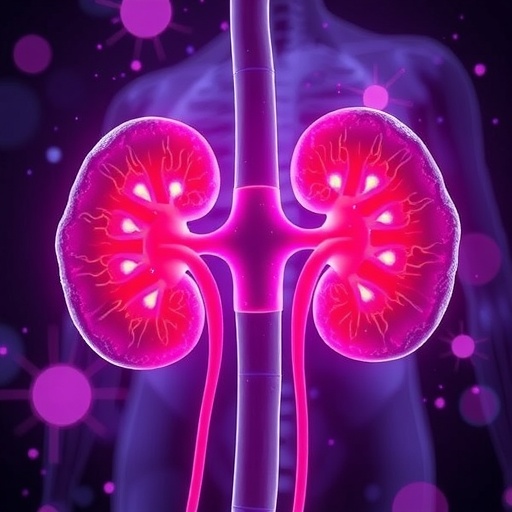
A new study in mice provides insights into why females in their reproductive years appear to be relatively protected from chronic kidney disease, a leading public health concern. The study reports that estrogen-regulated signaling promotes the regeneration of key filtration cells in female kidneys. The study also links pregnancy complications like preeclampsia to failures in this regenerative process. Chronic kidney disease (CKD) – which affects more than 10% of the global population – is a leading public health concern, not only because it can lead to fatal kidney failure, but also because it increases the risk of cardiovascular disease. Within the next 20 years, CKD is expected to become the fifth leading cause of death globally. Previous research has shown that sex differences play a notable role in disease progression: men are at higher risk for CKD, while women of reproductive age appear to be relatively protected. Although this suggests that female sex hormones, like progesterone and estrogen, may have a protective effect in the development of CKD, the mechanisms underlying the observed sex-based differences in disease susceptibility remain poorly understood.


Through lineage tracing, single-cell RNA sequencing, and an analysis of mouse models and human tissue and urine samples, Carolina Conte and colleagues show that female kidneys possess a greater capacity to regenerate key filtering cells, called podocytes, from renal progenitor cells. The cells are regenerated through estrogen receptor–dependent signaling, which protects against kidney disease and hypertension during reproductive years. What’s more, the authors found that this effect intensified in pregnant mice as kidneys adapted to a higher workload. However, when this regenerative capability is compromised, such as in preeclampsia, mouse mothers face heightened long-term risks of kidney disease and hypertension. At the same time, their offspring are predisposed to poor nephron development, low birth weight, and later-life cardiovascular and renal problems. According to Conte et al., the findings indicate that preeclampsia may arise from a failure of kidney progenitor cells to supply sufficient podocytes, linking maternal kidney health directly to pregnancy outcomes. This link offers new insights into potential therapeutic opportunities.


For reporters interested in topics related to research integrity, study co-author Paola Romagnani commented, “in nephrology and biomedical research, recent efforts have emphasized transparency through data sharing, standardized protocols, and independent replication. I believe future progress should focus on wider adoption of open-access datasets and stronger international collaborations, which are essential to ensure reproducibility and maintain trust in scientific findings.”


Journal

Science

DOI

10.1126/science.adp4629

Article Title

Estrogen-regulated renal progenitors determine pregnancy adaptation and preeclampsia

Article Publication Date

4-Sep-2025

Media Contact

Science Press Package Team

American Association for the Advancement of Science/AAAS

scipak@aaas.org

Journal

Science

DOI

10.1126/science.adp4629

Article Title

Estrogen-regulated renal progenitors determine pregnancy adaptation and preeclampsia

Article Publication Date

4-Sep-2025

Subject of Research: Medicine

Article Title: Estrogen-Stimulated Cell Regeneration Protects Female Kidneys from Disease

Article References: Original research article

Image Credits: AI Generated

DOI: Not provided

Keywords: cardiovascular disease risk factors, chronic kidney disease prevention, estrogen and kidney filtration cells, Estrogen-stimulated cell regeneration, female hormones and disease susceptibility, female kidney health, mouse models in kidney research, preeclampsia and kidney regeneration, pregnancy complications and kidney health, public health concerns in kidney disease, reproductive years and kidney disease, sex differences in chronic kidney disease

Cite Scienmag News

Ophelia Keating. (September 4, 2025). Estrogen-Stimulated Cell Regeneration Protects Female Kidneys from Disease. Scienmag. https://scienmag.com/estrogen-stimulated-cell-regeneration-protects-female-kidneys-from-disease/

Ophelia Keating. "Estrogen-Stimulated Cell Regeneration Protects Female Kidneys from Disease." Scienmag, 4 September 2025, https://scienmag.com/estrogen-stimulated-cell-regeneration-protects-female-kidneys-from-disease/. Accessed 5 September 2026.

Ophelia Keating. "Estrogen-Stimulated Cell Regeneration Protects Female Kidneys from Disease." Scienmag. September 4, 2025. https://scienmag.com/estrogen-stimulated-cell-regeneration-protects-female-kidneys-from-disease/


Tags: cardiovascular disease risk factorschronic kidney disease preventionestrogen and kidney filtration cellsEstrogen-stimulated cell regenerationfemale hormones and disease susceptibilityfemale kidney healthmouse models in kidney researchpreeclampsia and kidney regenerationpregnancy complications and kidney healthpublic health concerns in kidney diseasereproductive years and kidney diseasesex differences in chronic kidney disease
Share26Tweet17
Previous Post

AI Enhances LIGO’s Capabilities: A Leap Forward in Gravitational Wave Research

Next Post

Chiral Magnetic Nanohelices Enable Room-Temperature Spin Control in Spintronics Breakthrough

Related Posts

Deep brain stimulation eases severe tinnitus over two years of follow-up
Medicine

Deep brain stimulation eases severe tinnitus over two years of follow-up

September 5, 2026
PET/CT reveals bone uptake of amyloid tracer in AL amyloidosis
Medicine

PET/CT reveals bone uptake of amyloid tracer in AL amyloidosis

September 5, 2026
New atrioventricular valve regurgitation emerges after transcatheter aortic valve replacement
Medicine

New atrioventricular valve regurgitation emerges after transcatheter aortic valve replacement

September 5, 2026
MicroRNAs curb scar-forming liver cells, enabling fibrosis regression in zebrafish
Medicine

MicroRNAs curb scar-forming liver cells, enabling fibrosis regression in zebrafish

September 5, 2026
ARPP21 identified as major ALS gene in French cohorts
Medicine

ARPP21 identified as major ALS gene in French cohorts

September 5, 2026
Refractory Status Epilepticus in Mexico: Clinical Features and Management from 102 Patients
Medicine

Refractory Status Epilepticus in Mexico: Clinical Features and Management from 102 Patients

September 5, 2026
Next Post
Chiral Magnetic Nanohelices Enable Room-Temperature Spin Control in Spintronics Breakthrough

Chiral Magnetic Nanohelices Enable Room-Temperature Spin Control in Spintronics Breakthrough

  • Mothers who receive childcare support from maternal grandparents show more optimized

    Mothers who receive childcare support from maternal grandparents show more parental warmth, finds NTU Singapore study

    27656 shares
    Share 11059 Tweet 6912
  • University of Seville Breaks 120-Year-Old Mystery, Revises a Key Einstein Concept

    1061 shares
    Share 424 Tweet 265
  • Bee body mass, pathogens and local climate influence heat tolerance

    682 shares
    Share 273 Tweet 171
  • Researchers record first-ever images and data of a shark experiencing a boat strike

    546 shares
    Share 218 Tweet 137
  • Groundbreaking Clinical Trial Reveals Lubiprostone Enhances Kidney Function

    531 shares
    Share 212 Tweet 133
Science

Embark on a thrilling journey of discovery with Scienmag.com—your ultimate source for cutting-edge breakthroughs. Immerse yourself in a world where curiosity knows no limits and tomorrow’s possibilities become today’s reality!

RECENT NEWS

  • Deep brain stimulation eases severe tinnitus over two years of follow-up
  • Vaginal estrogen versus moisturizer in aromatase inhibitor users: randomized trial
  • New bispecific TCR-like antibody targets PRAME complex for cancer immunotherapy
  • Tuning AlCrCuFeNbNi high-entropy alloys for nuclear fuel cladding performance

Categories

  • Agriculture
  • Anthropology
  • Archaeology
  • Athmospheric
  • Biology
  • Biotechnology
  • Blog
  • Bussines
  • Cancer
  • Chemistry
  • Climate
  • Earth Science
  • Editorial Policy
  • Marine
  • Mathematics
  • Medicine
  • Pediatry
  • Policy
  • Psychology & Psychiatry
  • Science Education
  • Social Science
  • Space
  • Technology and Engineering

Subscribe to Blog via Email

Enter your email address to subscribe to this blog and receive notifications of new posts by email.

Join 5,151 other subscribers

© 2025 Scienmag - Science Magazine

Welcome Back!

Login to your account below

Forgotten Password?

Retrieve your password

Please enter your username or email address to reset your password.

Log In
No Result
View All Result
  • HOME
  • SCIENCE NEWS
  • CONTACT US

© 2025 Scienmag - Science Magazine

Discover more from Science

Subscribe now to keep reading and get access to the full archive.

Continue reading