


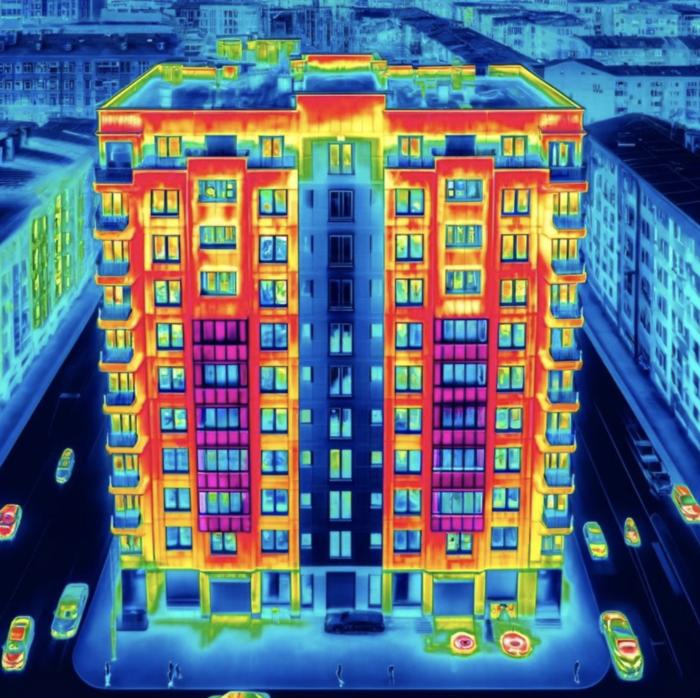
University of Waterloo researchers have developed a new method that can lead to significant energy savings in buildings. The team identified 28 major heat loss regions in a multi-unit residential building with the most severe ones being at wall intersections and around windows. A potential energy savings of 25 per cent is expected if 70 per cent of the discovered regions are fixed.
Building enclosures rely on heat and moisture control to avoid significant energy loss due to airflow leakage, which makes buildings less comfortable and more costly to maintain. This problem will likely be compounded by climate change due to volatile temperature fluctuations. Since manual inspection is time-consuming and infrequently done due to a lack of trained personnel, energy inefficiency becomes a widespread problem for buildings.
Researchers at Waterloo, which is a leader in sustainability research and education and a catalyst forenvironmental innovation, solutions and talent, created an autonomous, real-time platform to make buildings more energy efficient. The platform combines artificial intelligence, infrared technology, and a mathematical model that quantifies heat flow to better identify areas of heat loss in buildings.

Credit: University of Waterloo
University of Waterloo researchers have developed a new method that can lead to significant energy savings in buildings. The team identified 28 major heat loss regions in a multi-unit residential building with the most severe ones being at wall intersections and around windows. A potential energy savings of 25 per cent is expected if 70 per cent of the discovered regions are fixed.
Building enclosures rely on heat and moisture control to avoid significant energy loss due to airflow leakage, which makes buildings less comfortable and more costly to maintain. This problem will likely be compounded by climate change due to volatile temperature fluctuations. Since manual inspection is time-consuming and infrequently done due to a lack of trained personnel, energy inefficiency becomes a widespread problem for buildings.
Researchers at Waterloo, which is a leader in sustainability research and education and a catalyst forenvironmental innovation, solutions and talent, created an autonomous, real-time platform to make buildings more energy efficient. The platform combines artificial intelligence, infrared technology, and a mathematical model that quantifies heat flow to better identify areas of heat loss in buildings.
Using the new method, the researchers conducted an advanced study on a multi-unit residential building in the extreme climate of Canadian prairies, where elderly residents reported discomfort and higher electricity bills due to increased demand for heating in their units. Using AI tools, the team trained the program to examine thermal images in real time, achieving 81 percent accuracy in detecting regions of heat loss in the building envelope.
“The almost 10 per cent increase in accuracy with this AI-based model is impactful, as it enhances occupants’ comfort as well as reduces energy bills,” said Dr. Mohamad Araji, director of Waterloo’s Architectural Engineering Program and head of the Symbiosis Lab, an interdisciplinary group at the university that specializes in developing innovative building systems and building more environmentally friendly buildings.
The new AI tools helped to remove the element of human error in examining the results and increased the speed of getting the data analyzed by a factor of 12 compared to traditional building inspection methods.
Future expansions to this work will include utilizing drones equipped with cameras to inspect high-rise buildings.
“The hope is that our methodology can be used to analyze buildings and lead to millions in energy savings in a much faster way than previously possible,” Araji said.
More information about this work can be found in a research paper published recently by Energy Conversion and Management.
Journal
Energy Conversion and Management
Cite Scienmag News
Sloane Callahan. (May 15, 2024). Using AI to improve building energy use and comfort. Scienmag. https://scienmag.com/using-ai-to-improve-building-energy-use-and-comfort/
Sloane Callahan. "Using AI to improve building energy use and comfort." Scienmag, 15 May 2024, https://scienmag.com/using-ai-to-improve-building-energy-use-and-comfort/. Accessed 4 September 2026.
Sloane Callahan. "Using AI to improve building energy use and comfort." Scienmag. May 15, 2024. https://scienmag.com/using-ai-to-improve-building-energy-use-and-comfort/

