


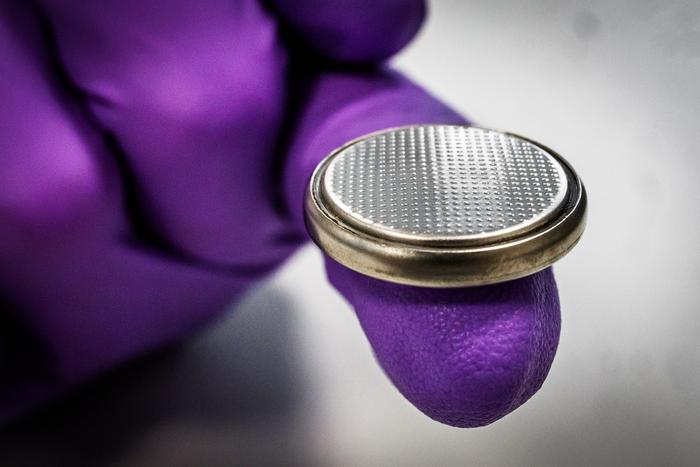
A battery made from zinc and lignin that can be used over 8000 times. This has been developed by researchers at Linköping University, Sweden, with a vision to provide a cheap and sustainable battery solution for countries where access to electricity is limited. The study has been published in the journal Energy & Environmental Materials.

Credit: Thor Balkhed
A battery made from zinc and lignin that can be used over 8000 times. This has been developed by researchers at Linköping University, Sweden, with a vision to provide a cheap and sustainable battery solution for countries where access to electricity is limited. The study has been published in the journal Energy & Environmental Materials.
“Solar panels have become relatively inexpensive, and many people in low-income countries have adopted them. However, near the equator, the sun sets at around 6 PM, leaving households and businesses without electricity. The hope is that this battery technology, even with lower performance than the expensive Li-ion batteries, will eventually offer a solution for these situations,” says Reverant Crispin, professor of organic electronics at Linköping University.
His research group at the Laboratory of Organic Electronics, together with researchers at Karlstad University and Chalmers, has developed a battery that is based on zinc and lignin, two cost-effective and environmentally friendly materials. In terms of energy density, it is comparable to lead-acid batteries but without the lead, which is toxic.
The battery is stable, as it can be used over 8000 cycles while maintaining about 80% of its performance. Additionally, the battery retains its charge for approximately one week, significantly longer than other similar zinc-based batteries that discharge in just a few hours.
Although zinc-based batteries are already on the market, primarily as non-rechargeable batteries, they are predicted to complement and, in some cases, replace lithium-ion batteries in the long run when the feature of rechargeability is properly introduced.
“While lithium-ion batteries are useful when handled correctly, they can be explosive, challenging to recycle, and problematic in terms of environmental and human rights issues when specific elements like cobalt are extracted. Therefore, our sustainable battery offers a promising alternative where energy density is not critical,” says Ziyauddin Khan, a researcher at the Laboratory of Organic Electronics at LiU.
The issue with zinc batteries has primarily been poor durability due to zinc reacting with the water in the battery’s electrolyte solution. This reaction leads to the generation of hydrogen gas and dendritic growth of the zinc, rendering the battery essentially unusable.
To stabilise the zinc, a substance called potassium polyacrylate based water-in-polymer salt electrolyte (WiPSE) is used. What the researchers at Linköping have now demonstrated is that when WiPSE is used in a battery containing zinc and lignin, stability is very high.
“Both zinc and lignin are super cheap, and the battery is easily recyclable. And if you calculate the cost per usage cycle, it becomes an extremely cheap battery compared to lithium-ion batteries,” says Ziyauddin Khan.
Currently, the batteries developed in the lab are small. However, the researchers believe that they can create large batteries, roughly the size of a car battery, thanks to the abundance of both lignin and zinc at low cost. However, mass production would require the involvement of a company.
Reverant Crispin asserts that Sweden’s position as an innovative country enables it to assist other nations in adopting more sustainable alternatives.
“We can view it as our duty to help low-income countries avoid making the same mistakes we did. When they build their infrastructure, they need to start with green technology right away. If unsustainable technology is introduced, it will be used by billions of people, leading to a climate catastrophe,” says Reverant Crispin.
Journal
Energy & Environmental Materials
Article Title
Water-in-Polymer Salt Electrolyte for Long-Life Rechargeable Aqueous Zinc-Lignin Battery
Article Publication Date
7-May-2024
Cite Scienmag News
Faith Mcneil. (May 14, 2024). Eco-friendly and affordable battery for low-income countries. Scienmag. https://scienmag.com/eco-friendly-and-affordable-battery-for-low-income-countries/
Faith Mcneil. "Eco-friendly and affordable battery for low-income countries." Scienmag, 14 May 2024, https://scienmag.com/eco-friendly-and-affordable-battery-for-low-income-countries/. Accessed 4 September 2026.
Faith Mcneil. "Eco-friendly and affordable battery for low-income countries." Scienmag. May 14, 2024. https://scienmag.com/eco-friendly-and-affordable-battery-for-low-income-countries/

