


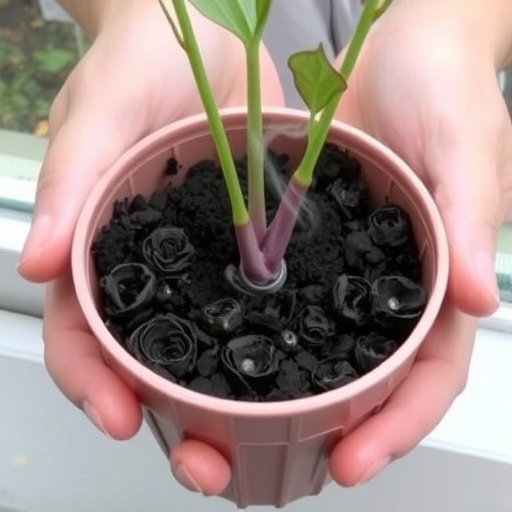
In a groundbreaking study relating to air quality and environmental sustainability, researchers from Brazil have delved into the use of activated biochar, derived from the invasive aquatic plant Eichhornia crassipes, for the removal of volatile organic compounds (VOCs) via a temperature swing adsorption process. This innovative approach not only offers a solution to air pollution but also addresses the issue of invasive species management, thereby combining ecological restoration with advanced material science.
Eichhornia crassipes, commonly known as water hyacinth, is notorious for its rapid growth and environmental impacts, often outcompeting native species and disrupting aquatic ecosystems. The disposal of this invasive plant is a challenge for many regions, especially in tropical and subtropical climates where it can proliferate unchecked. In light of its proliferation, researchers have sought to turn this environmental nuisance into an opportunity by converting it into a useful material for air purification.
Activated biochar is a carbon-rich material produced through the pyrolysis of organic matter, which leads to a large surface area and numerous adsorption sites. This makes it particularly effective for capturing pollutants like VOCs, which are emitted by various industrial processes, household products, and vehicle exhausts. VOCs are a significant concern due to their contribution to atmospheric pollution and their potential health effects, including respiratory issues and other long-term health risks.
The study conducted by Menezes and colleagues represents a significant step toward sustainability by exploring how to maximize the value of biodegradable waste streams like water hyacinth. Prior research has demonstrated the potential of biochar for carbon sequestration and soil enhancement, but its applications in air quality management, particularly via the temperature swing adsorption process, are still being explored. This new research aims to fill that gap, investigating the efficiency of biochar produced from water hyacinth in capturing a variety of VOCs.
Utilizing temperature swing adsorption involves the sequential heating and cooling of the activated biochar to enhance the capture and release of VOCs. This process not only improves the adsorption capacity of the biochar but also allows for the regeneration of the material, making it a more sustainable solution compared to other methods that may require significant amounts of energy or lead to waste. The study meticulously explores the parameters that influence adsorption, such as temperature, humidity, and the specific types of VOCs present.
Preliminary results from the experiments indicate that activated biochar from water hyacinth exhibits a formidable capacity for VOC removal, outperforming some conventional adsorbent materials. This is promising for applications in urban environments, where the concentration of airborne pollutants is often high. The ability to harness local invasive species for this purpose could significantly reduce costs associated with both removal and treatment of VOCs.
Moreover, the implications for environmental policy are profound. Governments and municipalities could incentivize the harvesting of water hyacinth for biochar production, offering a dual benefit of improving air quality while managing an invasive species. This could foster community involvement and potentially develop new green industries focused on sustainability.
As air quality continues to be a pressing global issue, this study highlights an innovative technique that could revolutionize our approach to pollution control. The simple transformation of a widespread invasive species into a valuable resource exemplifies how creative research can yield significant environmental benefits. It also sets a precedent for other researchers to explore similar pathways with other invasive plants, effectively turning ecological problems into materials that can enhance human health and the environment.
The advantages of using activated biochar from Eichhornia crassipes extend beyond mere VOC removal. This technology can lead to a reduction in the overall burden of air pollution and can serve as a model for future research endeavors aimed at discovering under-utilized biomass resources. Beyond air quality, research exploring the benefits of biochar in water filtration systems and agricultural amendments continues to gain momentum, making it a valuable topic of exploration.
Looking ahead, further studies will focus on refining the process parameters and scaling up production to evaluate the feasibility of implementing these systems in urban areas plagued by high levels of VOCs. As cities increasingly grapple with pollution and its associated health risks, the role of activated biochar could become indispensable. Community awareness campaigns could also support these endeavors, highlighting the value of environmental stewardship.
The current research, conducted by Menezes et al., signifies a pivotal shift toward promoting sustainability through innovative waste management strategies. As awareness for these solutions grows, funding opportunities may increase, paving the way for groundbreaking advancements in environmental science. This synergy between ecological restoration and air purification is not just a theoretical concept; it signifies the future of environmental interventions.
As more data comes to light regarding the efficacy of activated biochar from invasive species, we may soon witness the implementation of scalable projects designed to tackle urban pollution while simultaneously managing the threats posed by invasive flora. This research will undoubtedly inspire a new wave of ecological innovation that prioritizes both the planet’s health and the well-being of its inhabitants.
In summary, the remarkable study on VOC removal through activated biochar derived from Eichhornia crassipes not only provides an avenue for effective air purification but serves as a model for other nations facing similar environmental challenges. By effectively harnessing local resources, we can develop sustainable solutions that benefit both the environment and public health, marking a step forward in our global fight against pollution.
Menezes, R.S.G., Cordeiro, J.L.C., de Andrade, R.C. et al. VOC removal on activated biochar prepared from the invasive aquatic plant Eichhornia crassipes for air decontamination by temperature swing adsorption process.
Environ Sci Pollut Res (2025). https://doi.org/10.1007/s11356-025-36854-x
Cite Scienmag News
Violet Maxwell. (August 29, 2025). Air Purification Using Eichhornia Crassipes Biochar. Scienmag. https://scienmag.com/air-purification-using-eichhornia-crassipes-biochar/
Violet Maxwell. "Air Purification Using Eichhornia Crassipes Biochar." Scienmag, 29 August 2025, https://scienmag.com/air-purification-using-eichhornia-crassipes-biochar/. Accessed 1 September 2026.
Violet Maxwell. "Air Purification Using Eichhornia Crassipes Biochar." Scienmag. August 29, 2025. https://scienmag.com/air-purification-using-eichhornia-crassipes-biochar/


