


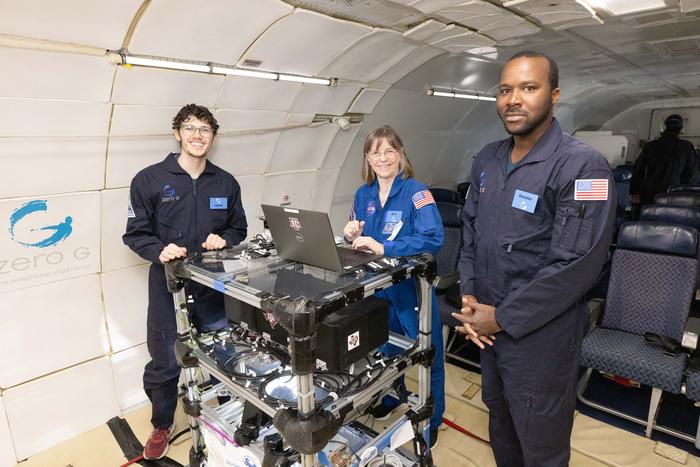
SAN ANTONIO — May 13, 2024 —Southwest Research Institute is studying the process of boiling liquids under partial gravity conditions in a series of parabolic flights. The internally funded project, conducted in collaboration with Texas A&M University, aims to better understand how liquids boil on different surfaces in partial gravity. Boiling liquids will likely be required during future extended space missions to the Moon or Mars to support surface power, life support systems, cryogenic fuel production and in situ resource utilization.
“We have so little data about how boiling works in reduced gravity,” said SwRI’s Kevin Supak, who leads the project. “Our experiment studies boiling in conditions that simulate lunar and Martian gravity levels using four different surfaces to examine how bubbles initiate and detach.”
The payload container includes four heated surfaces, each with a different surface treatment, submerged in a specialized fluid that boils at the relatively low temperature of 135 degrees Fahrenheit. The experiments will demonstrate whether engineered surfaces could improve boiling and bubble detachment in reduced gravity.
“When you’re boiling water on the stove, you’ll notice different bubble sizes and behavior between a stainless pot and a nonstick pot,” Supak said. “This is because at the microscopic level, the surfaces look different and their roughness affects how bubbles initially form and stick to the surface. Rougher surfaces tend to form smaller bubbles and initiate boiling faster than smoother ones.”
SwRI’s Materials Engineering Department designed the surface treatments studied in the experiment to evaluate how different material surface characteristics affect the boiling process.
“Bubble sizes, distribution and surface temperatures will be studied on three variations of stainless-steel surface treatments and one highly structured plastic surface,” Supak explained. “It is difficult to simulate how boiling would work on the lunar and Martian surfaces in experiments conducted on Earth. However, parabolic flight tests offer researchers brief periods of partial gravity to gain more insight into these complicated processes.”
In April, SwRI research engineers Dr. Eugene Hoffman, Dr. Akbar Whizin, and Emilio Gordon accompanied the experiment on a parabolic flight campaign from Ft. Lauderdale aboard a reduced gravity aircraft. They gathered data and observations during two flights at multiple gravity levels.
“If we’re going to establish a sustained presence in space or on other worlds, boiling is a necessity,” Supak said. “On Earth, we rely on gravity to help separate liquids and gasses through buoyancy. On the lunar or Martian surface, the lower buoyancy force will result in different boiling behavior. We need to know how hot to make surfaces to ensure efficient and safe heat transfer. This flight test will produce data that are directly applicable to improving our understanding of these processes.”
For more information visit https://www.swri.org/industries/fluids-engineering.

Credit: Southwest Research Institute
SAN ANTONIO — May 13, 2024 —Southwest Research Institute is studying the process of boiling liquids under partial gravity conditions in a series of parabolic flights. The internally funded project, conducted in collaboration with Texas A&M University, aims to better understand how liquids boil on different surfaces in partial gravity. Boiling liquids will likely be required during future extended space missions to the Moon or Mars to support surface power, life support systems, cryogenic fuel production and in situ resource utilization.
“We have so little data about how boiling works in reduced gravity,” said SwRI’s Kevin Supak, who leads the project. “Our experiment studies boiling in conditions that simulate lunar and Martian gravity levels using four different surfaces to examine how bubbles initiate and detach.”
The payload container includes four heated surfaces, each with a different surface treatment, submerged in a specialized fluid that boils at the relatively low temperature of 135 degrees Fahrenheit. The experiments will demonstrate whether engineered surfaces could improve boiling and bubble detachment in reduced gravity.
“When you’re boiling water on the stove, you’ll notice different bubble sizes and behavior between a stainless pot and a nonstick pot,” Supak said. “This is because at the microscopic level, the surfaces look different and their roughness affects how bubbles initially form and stick to the surface. Rougher surfaces tend to form smaller bubbles and initiate boiling faster than smoother ones.”
SwRI’s Materials Engineering Department designed the surface treatments studied in the experiment to evaluate how different material surface characteristics affect the boiling process.
“Bubble sizes, distribution and surface temperatures will be studied on three variations of stainless-steel surface treatments and one highly structured plastic surface,” Supak explained. “It is difficult to simulate how boiling would work on the lunar and Martian surfaces in experiments conducted on Earth. However, parabolic flight tests offer researchers brief periods of partial gravity to gain more insight into these complicated processes.”
In April, SwRI research engineers Dr. Eugene Hoffman, Dr. Akbar Whizin, and Emilio Gordon accompanied the experiment on a parabolic flight campaign from Ft. Lauderdale aboard a reduced gravity aircraft. They gathered data and observations during two flights at multiple gravity levels.
“If we’re going to establish a sustained presence in space or on other worlds, boiling is a necessity,” Supak said. “On Earth, we rely on gravity to help separate liquids and gasses through buoyancy. On the lunar or Martian surface, the lower buoyancy force will result in different boiling behavior. We need to know how hot to make surfaces to ensure efficient and safe heat transfer. This flight test will produce data that are directly applicable to improving our understanding of these processes.”
For more information visit https://www.swri.org/industries/fluids-engineering.
Cite Scienmag News
Grant Pearson. (May 13, 2024). SwRI studies boiling processes in partial gravity aboard parabolic flights. Scienmag. https://scienmag.com/swri-studies-boiling-processes-in-partial-gravity-aboard-parabolic-flights/
Grant Pearson. "SwRI studies boiling processes in partial gravity aboard parabolic flights." Scienmag, 13 May 2024, https://scienmag.com/swri-studies-boiling-processes-in-partial-gravity-aboard-parabolic-flights/. Accessed 4 September 2026.
Grant Pearson. "SwRI studies boiling processes in partial gravity aboard parabolic flights." Scienmag. May 13, 2024. https://scienmag.com/swri-studies-boiling-processes-in-partial-gravity-aboard-parabolic-flights/

