


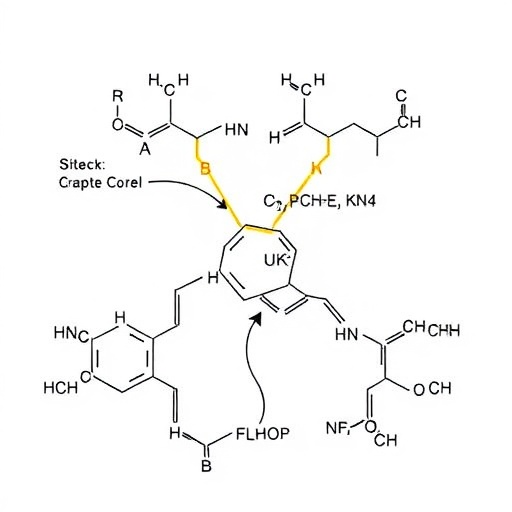
In the relentless pursuit of new frontiers in medicinal chemistry, the transition from flat, aromatic molecules toward three-dimensional, saturated frameworks has become a paradigm-shifting strategy. The incorporation of sp³ hybridized carbons into drug candidates—commonly referred to as the increase of F_sp³ (fraction of sp³ carbons)—significantly enhances molecular complexity, thereby improving pharmacokinetic properties such as solubility, metabolic stability, and target specificity. However, despite its tremendous potential to revolutionize drug design, the controlled and predictable synthesis of these saturated architectures, particularly multi-substituted cycloalkanes, remains a formidable synthetic challenge owing to their three-dimensional stereochemical complexity.
Building on decades of organic synthesis research, a team led by Li, Liu, Gao, and colleagues at the forefront of organometallic catalysis has now unveiled a pioneering cobalt-catalyzed approach that achieves diastereodivergent hydroalkylation of methylenecyclohexanes. This cutting-edge method enables chemists to exercise fine-tuned control over the stereochemistry of substituents positioned on the same or opposite faces of cyclohexane rings, a feat that conventional synthetic routes have struggled to deliver with consistent selectivity. This breakthrough thus marks a significant leap forward in accessing the full stereoisomeric landscape of multi-substituted cycloalkanes and piperidines, scaffolds prized for their pivotal roles in pharmaceutical compounds.
The essence of this novel catalytic system lies in the strategic manipulation of ligands coordinated to cobalt, which modulates the stereochemical outcome of the hydroalkylation reaction. Unlike traditional approaches where reaction parameters often dictate a fixed diastereomeric outcome, the ligand-controlled catalytic platform here permits a programmable divergence, enabling chemists to selectively synthesize either cis or trans isomers of the target molecules. This exceptional level of stereochemical governance opens new avenues for the rational design of molecules with predefined three-dimensional topologies, enhancing the exploration of chemical space previously confined by stereochemical constraints.
From a mechanistic standpoint, the hydroalkylation process is initiated by the activation of methylenecyclohexanes through cobalt-mediated coordination and subsequent migratory insertion steps. The choice of ligand significantly influences the transition states involved, steering the approach of alkyl radicals or nucleophiles either to the same or opposite face of the cyclohexane ring. This precise control is critical because the spatial arrangement of substituents in cycloalkanes profoundly impacts their biological interactions, dictating receptor binding potency and selectivity.
Notably, the application of cobalt as the central metal in the catalytic cycle is itself a noteworthy advancement. Cobalt’s earth-abundance and relatively low toxicity offer sustainable alternatives to traditionally employed noble metals such as palladium or platinum. Its flexible redox properties and unique coordination chemistry underpin the robust reactivity and selectivity demonstrated in this system. Furthermore, the cobalt catalyst exhibits remarkable functional group tolerance and adaptability, operating efficiently across a broad substrate scope that includes not only disubstituted cyclohexanes and piperidines but also more heavily substituted cyclohexane derivatives.
The methodology’s capability to deliver all stereoisomers of multi-substituted cycloalkanes transcends the long-standing limitations imposed by classic synthetic tactics, which frequently yield only a subset of possible diastereomers with unpredictable stereochemical fidelity. This inclusive construction toolkit empowers medicinal chemists to synthesize stereochemically well-defined compounds rapidly, facilitating comprehensive structure-activity relationship studies that are essential for modern drug discovery pipelines. The access to diverse stereoisomeric forms may unlock previously inaccessible biological activities and optimize drug candidates’ therapeutic indices.
Importantly, the divergence in product stereochemistry is achieved under mild reaction conditions, preserving functional groups that are often incompatible with harsh reagents or extreme environments. This operational simplicity enhances the practical applicability of the discovered catalytic system, making it an attractive approach for late-stage functionalization in complex molecule synthesis. The potential of this approach extends beyond small molecules to possibly embrace larger, biologically relevant frameworks where stereochemical complexity is paramount.
The team’s optimization of ligand frameworks reveals intricate electronic and steric effects that govern the diastereoselectivity, providing insightful guidelines for catalyst design in future endeavors. By altering ligand bite angles, donor-acceptor properties, and steric bulk, the researchers could delicately balance competing reaction pathways, effectively encoding selectivity into the catalyst architecture. This ligand-tuning strategy might inspire broader applications across other transition-metal catalyzed transformations seeking stereochemical control.
Moreover, this cobalt-catalyzed hydroalkylation process may reshape the synthetic strategies for constructing piperidines—saturated nitrogen-containing heterocycles prominent in many pharmaceuticals and natural products. The ability to access all stereoisomers of disubstituted piperidines enriches the chemical toolbox available for developing novel therapeutics targeting central nervous system disorders, infectious diseases, and oncology.
Given the increasing demand for stereochemically rich molecules in drug discovery and chemical biology, this work represents a vital contribution to the field of synthetic methodology. It addresses a critical synthetic bottleneck that has long stymied access to structurally complex molecules with well-defined three-dimensional architectures. By providing an operationally straightforward and mechanistically rational approach to diastereodivergent synthesis, the research bridges fundamental organometallic chemistry with applied medicinal science.
Beyond pharmaceutical applications, such advancements portend significant impact in agrochemical development, materials science, and molecular probes for diagnostics. The expanded stereochemical diversity achievable through this cobalt catalysis might enable fine-tuning of physical properties such as crystallinity, solubility, and bioavailability, factors crucial across various disciplines.
In summary, the report by Li and colleagues heralds a transformative stage in the synthesis of multi-substituted cycloalkanes, surmounting the stereochemical rigidity of traditional methods through a cobalt-catalyzed, ligand-controlled platform that exquisitely navigates diastereomeric landscapes. This strategic infusion of three-dimensional molecular complexity, coupled with robust synthetically accessible routes, is poised to accelerate the discovery of next-generation therapeutics and functional molecules.
As the chemical community continues to embrace the challenge of escaping flatland in molecular design, such advancements in stereocontrolled catalysis underscore the potential of transition metal systems to unlock unprecedented chemical space. The implications of this work will likely stimulate further innovation, inspiring chemists to devise new catalytic strategies that combine sustainability, selectivity, and synthetic efficiency, propelling molecular science into new realms of complexity and functionality.
Cite Scienmag News
Bethany Barker. (August 5, 2025). Diastereodivergent Routes to Multi-Substituted Cycloalkanes. Scienmag. https://scienmag.com/diastereodivergent-routes-to-multi-substituted-cycloalkanes/
Bethany Barker. "Diastereodivergent Routes to Multi-Substituted Cycloalkanes." Scienmag, 5 August 2025, https://scienmag.com/diastereodivergent-routes-to-multi-substituted-cycloalkanes/. Accessed 4 September 2026.
Bethany Barker. "Diastereodivergent Routes to Multi-Substituted Cycloalkanes." Scienmag. August 5, 2025. https://scienmag.com/diastereodivergent-routes-to-multi-substituted-cycloalkanes/


