


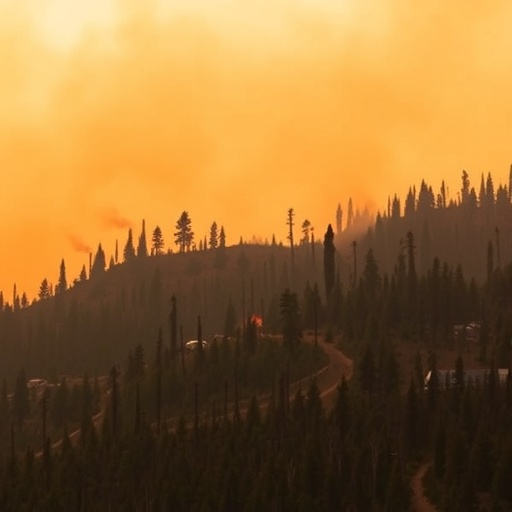
As wildfires escalate in frequency and intensity across the United States, the complexity of these environmental disasters is transforming at a pace that outstrips traditional management strategies. Beyond the immediate ecological and socio-economic impacts, wildfires are exerting profound pressures on the institutions tasked with managing them. New research reveals that adapting to these evolving challenges demands a fundamental reevaluation of institutional structures, coordination networks, and resource allocation frameworks to keep pace with the growing intricacy of wildfire dynamics.
The study, conducted by Nowell, Jones, and McGovern and published in Nature Climate Change, delves deeply into the institutional ramifications of changing wildfire characteristics over the past two decades, from 1999 to 2020. By systematically analyzing incident data across the United States, the authors identified five key dimensions tied to what they define as institutional complexity: governance, logistics, strategic management, resource scarcity, and network coordination. Each of these dimensions reflects a critical axis along which wildfires push institutions to adapt and evolve.
At the heart of this research lies a sophisticated assessment of how wildfire incidents themselves have grown in complexity, presenting more challenging scenarios that strain existing institutional frameworks. Governance complexity refers to the multiplicity of authorities and jurisdictions involved in wildfire response, often spanning local, state, and federal levels, which necessitates intricate coordination and legal agreements. Logistic complexity addresses the operational challenges of mobilizing personnel, equipment, and supplies in volatile and shifting wildfire conditions.
Strategic management complexity captures the nuanced decision-making required as fire behavior becomes less predictable due to climate change-driven environmental shifts. Resource scarcity, a growing concern, reflects tightening budgets, personnel shortages, and equipment limitations in the face of increasing wildfire demands. Finally, network coordination complexity details the expanding web of inter-agency relationships and partnerships that ensnare wildfire management in a delicate balance of collaboration and competition.
The paper’s findings underscore national trends pointing to a marked increase in these complexity indicators, signaling an elevated institutional demand that current frameworks are struggling to meet. Yet, the analysis also highlights heterogeneous regional patterns, revealing that institutional adaptation is neither uniform nor linear. For example, in western regions, which experience some of the most intense and frequent wildfires, jurisdictional complexity—that is, the number and diversity of entities involved in managing incidents—has noticeably increased. Conversely, eastern regions have shown a decrease in this type of complexity, suggesting divergent institutional challenges and adaptive responses across the country.
This regional variation is particularly significant because it implies that a one-size-fits-all approach to wildfire management reform may be insufficient or even counterproductive. The increasing demands in the west, driven in part by prolonged droughts, higher temperatures, and more extensive wildland-urban interfaces, require institutions to develop greater agility, flexibility, and interconnectivity in their responses. Meanwhile, the relative reduction of jurisdictional complexity in the east may reflect consolidation or streamlined governance models, but also raises questions about potential vulnerabilities should wildfire behaviors change abruptly in those regions.
The intricate linkages between environmental change and institutional adaptation highlighted in the study offer crucial insights into the feedback loops that can either exacerbate or mitigate wildfire impacts. For instance, increased institutional complexity may enhance resilience by allowing for more diversified expertise and resource mobilization; but it can also hamper rapid decision-making if agencies become entangled in bureaucratic inertia. Similarly, resource scarcity underpins many institutional challenges, as escalating firefighting costs strain public budgets, compelling agencies to contend with trade-offs between immediate suppression and long-term landscape management.
Underpinning these dynamics is the escalating unpredictability of wildfire behavior itself. Climate change has ushered in unprecedented shifts in temperature, humidity, wind patterns, and vegetation growth cycles, all combining to make fire spread faster, burn hotter, and ignite more frequently. This environmental reality demands institutions capable of dynamically integrating scientific forecasting, real-time data analytics, and adaptive operational planning in a manner that exceeds previous benchmarks of wildfire governance.
The authors suggest that a vital pathway forward lies in recognizing and addressing the complex institutional demands as integral to wildfire adaptation strategies. This includes investing in cross-jurisdictional governance models equipped with clear protocols and delegated authorities, enhancing inter-agency communication platforms that can function effectively under crisis conditions, and deploying advanced logistical support networks that optimize resource distribution despite scarcity.
Moreover, the study emphasizes the importance of developing adaptive capacity within fire management institutions—not only through technological innovation but also via cultivating institutional cultures that are receptive to change, collaboration, and learning. This cultural shift is imperative because no amount of technology alone will suffice if human systems remain rigid, siloed, or resistant to evolving realities on the ground.
The researchers also caution that institutional adaptation is fraught with potential trade-offs. Deploying widespread coordination mechanisms may improve information flow but could introduce delays due to stakeholder negotiation processes. Similarly, expanding jurisdictional complexity might leverage local knowledge and resources but risks diffusing accountability. Striking the right balance requires nuanced, evidence-based policy design tailored to regional contexts and continuous evaluation.
Importantly, this study’s longitudinal approach—examining data over two decades—provides a rare empirical backbone to what has often been an anecdotal or conceptual discussion about wildfire institutional complexity. By anchoring their analysis in quantitative trends and comparative regional assessments, Nowell and colleagues furnish wildfire policymakers, researchers, and practitioners with concrete evidence to support transformative governance reforms.
Their work calls for an integrative research agenda that bridges environmental science, organizational theory, public administration, and emergency management to devise scalable institutional innovations. This interdisciplinary imperative is essential because wildfire is no longer solely an environmental hazard but a multifaceted societal challenge demanding holistically adaptive institutions.
In a broader context, the urgency of institutional adaptation highlighted by this study mirrors global challenges of responding to complex climate impacts where traditional systems and governance models fail to keep pace. Lessons learned from the wildfire management arena could inform other areas where environmental change intersects with institutional constraints, such as flood management, public health crises, and urban resilience.
As wildfires continue to reshape landscapes and communities, the findings underscore that resilience rests not only on ecological restoration or firefighting capacity but fundamentally on our institutions’ capacity to adapt, evolve, and respond to complexity. This paradigm shift mandates substantial investments in institutional diagnostics, scenario planning, and collaborative governance models that reflect the intricate realities of 21st-century wildfire risk.
Ultimately, the study by Nowell, Jones, and McGovern serves as a clarion call for wildfire governance reform—a call supported by rigorous data and analytical depth, which recognizes that confronting escalating wildfire complexity is as much an institutional challenge as it is an environmental one. Meeting this challenge will determine the resilience of landscapes, ecosystems, and human societies in the wildfire era.
Cite Scienmag News
Rosalind W. (June 26, 2025). Rising Wildfire Complexity Demands Institutional Adaptation. Scienmag. https://scienmag.com/rising-wildfire-complexity-demands-institutional-adaptation/
Rosalind W. "Rising Wildfire Complexity Demands Institutional Adaptation." Scienmag, 26 June 2025, https://scienmag.com/rising-wildfire-complexity-demands-institutional-adaptation/. Accessed 29 August 2026.
Rosalind W. "Rising Wildfire Complexity Demands Institutional Adaptation." Scienmag. June 26, 2025. https://scienmag.com/rising-wildfire-complexity-demands-institutional-adaptation/


