

Monday, July 20, 2026
Science
No Result
View All Result
  • Login
  • HOME
  • SCIENCE NEWS
  • CONTACT US
  • HOME
  • SCIENCE NEWS
  • CONTACT US
No Result
View All Result
Scienmag
No Result
View All Result
Home Science News Technology and Engineering

Gentle defibrillation for the heart

April 23, 2024
in Technology and Engineering
Reading Time: 2 mins read
0
Gentle defibrillation for the heart
66
SHARES
599
VIEWS
Share on FacebookShare on Twitter
ADVERTISEMENT

Cardiac arrhythmias account for around 15-20% of annual deaths worldwide. In case of acute and life-threatening arrhythmias, defibrillators can be used to restart the regular beating of the heart. A strong electrical pulse brings cardiac activity to a brief standstill before it can be resumed in an orderly way. Whereas this treatment can save lives very effectively, the strong electrical pulses can also have negative side effects such as damage of the heart tissue or strong pain.

Arrhythmia_optogenetics

Credit: © MPI-DS, Biomedical Physics Group

Cardiac arrhythmias account for around 15-20% of annual deaths worldwide. In case of acute and life-threatening arrhythmias, defibrillators can be used to restart the regular beating of the heart. A strong electrical pulse brings cardiac activity to a brief standstill before it can be resumed in an orderly way. Whereas this treatment can save lives very effectively, the strong electrical pulses can also have negative side effects such as damage of the heart tissue or strong pain.

“We developed a new and much milder method which allows the heart to get back into the right rhythm,” says Stefan Luther, Max Planck Research Group leader at the MPI-DS and professor the University Göttingen Medical Center. “Our results show that it is possible to control the cardiac system with much lower energy intensity,” he continues.

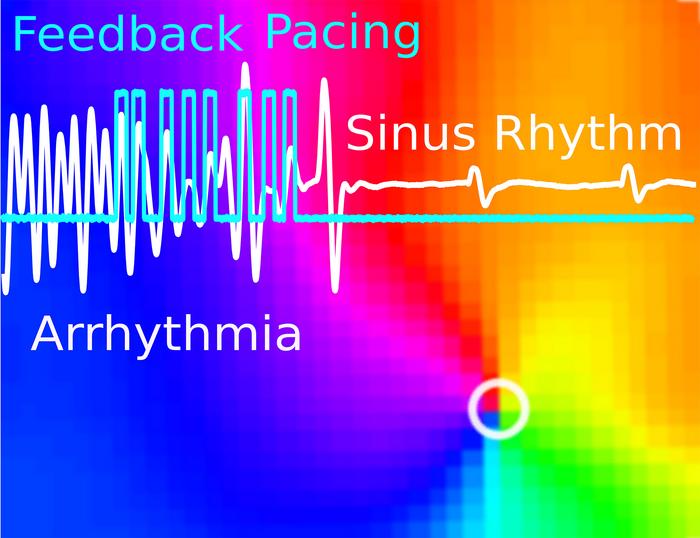
To test their method, the scientists used genetically modified mouse hearts that can be stimulated by light. In this setting, a sequence of optical light pulses is triggered using a closed-loop pacing algorithm. Each pulse is triggered in response to the measured arrhythmic activity. With this pacing protocol, the team was able to effectively control and terminate cardiac arrhythmias even at low energy intensities that do not activate the heart, but only modulate its excitability.

“Instead of administering a single high-energy shock to restore normal heart rhythm, we use our understanding of the dynamics of cardiac arrhythmias to gently terminate them.” explains Sayedeh Hussaini, first author of the study. “This results in a subtle treatment method with far less energy per pulse, more than 40 times less compared to the conventional strategy” she reports.

The research team will also use these findings to improve the control of arrhythmias using electrical pulses. This may result in advanced defibrillators causing less pain and side-effects for patients.


Journal

Chaos An Interdisciplinary Journal of Nonlinear Science

DOI

10.1063/5.0191519

Method of Research

Experimental study

Subject of Research

Animal tissue samples

Article Title

Efficient termination of cardiac arrhythmias using optogenetic resonant feedback pacing

Article Publication Date

25-Mar-2024

Share26Tweet17
Previous Post

Unlocking spin current secrets: a new milestone in spintronics

Next Post

New research develops forest extent map for Mexico

Related Posts

Topological Jackiw-Rebbi States in Photonic Van der Waals Heterostructures
Technology and Engineering

Topological Jackiw-Rebbi States in Photonic Van der Waals Heterostructures

July 19, 2026
Neonatal Monocyte Iron Handling Drives Immunometabolic Responses in Sepsis
Technology and Engineering

Neonatal Monocyte Iron Handling Drives Immunometabolic Responses in Sepsis

July 18, 2026
Carbonation-Empowered Offshore Deep Cement Mixing Enables Undredged Land Reclamation
Technology and Engineering

Carbonation-Empowered Offshore Deep Cement Mixing Enables Undredged Land Reclamation

July 18, 2026
Noninvasive Acoustic Assessment of Feeding Skills in Preterm Infants With BPD
Technology and Engineering

Noninvasive Acoustic Assessment of Feeding Skills in Preterm Infants With BPD

July 18, 2026
Journal Cyborg and Bionic Systems Impact Factor Hits 20.9, Ranks Top Four
Technology and Engineering

Journal Cyborg and Bionic Systems Impact Factor Hits 20.9, Ranks Top Four

July 18, 2026
Delayed vs Early Cord Clamping in Preterm Twins: Echocardiography Study
Technology and Engineering

Delayed vs Early Cord Clamping in Preterm Twins: Echocardiography Study

July 18, 2026
Next Post
New research develops forest extent map for Mexico

New research develops forest extent map for Mexico

  • Mothers who receive childcare support from maternal grandparents show more

    Mothers who receive childcare support from maternal grandparents show more parental warmth, finds NTU Singapore study

    27656 shares
    Share 11059 Tweet 6912
  • University of Seville Breaks 120-Year-Old Mystery, Revises a Key Einstein Concept

    1061 shares
    Share 424 Tweet 265
  • Bee body mass, pathogens and local climate influence heat tolerance

    682 shares
    Share 273 Tweet 171
  • Researchers record first-ever images and data of a shark experiencing a boat strike

    546 shares
    Share 218 Tweet 137
  • Groundbreaking Clinical Trial Reveals Lubiprostone Enhances Kidney Function

    531 shares
    Share 212 Tweet 133
Science

Embark on a thrilling journey of discovery with Scienmag.com—your ultimate source for cutting-edge breakthroughs. Immerse yourself in a world where curiosity knows no limits and tomorrow’s possibilities become today’s reality!

RECENT NEWS

  • Rannasangpei crocin-1 improves valproate-induced autism-like behaviors by reducing oxidative stress
  • Sleep Quality Links Synergistically with Frailty to Increase Cardiometabolic Multimorbidity in Elderly Chinese
  • Gut Microbiome Metabolites Shape Development of Stress-Related Mental Disorders
  • Cognitive reserve helps older adults resist frailty and recover better

Categories

  • Agriculture
  • Anthropology
  • Archaeology
  • Athmospheric
  • Biology
  • Biotechnology
  • Blog
  • Bussines
  • Cancer
  • Chemistry
  • Climate
  • Earth Science
  • Editorial Policy
  • Marine
  • Mathematics
  • Medicine
  • Pediatry
  • Policy
  • Psychology & Psychiatry
  • Science Education
  • Social Science
  • Space
  • Technology and Engineering

Subscribe to Blog via Email

Success! An email was just sent to confirm your subscription. Please find the email now and click 'Confirm Follow' to start subscribing.

Join 5,146 other subscribers

© 2025 Scienmag - Science Magazine

Welcome Back!

Login to your account below

Forgotten Password?

Retrieve your password

Please enter your username or email address to reset your password.

Log In
No Result
View All Result
  • HOME
  • SCIENCE NEWS
  • CONTACT US

© 2025 Scienmag - Science Magazine
