


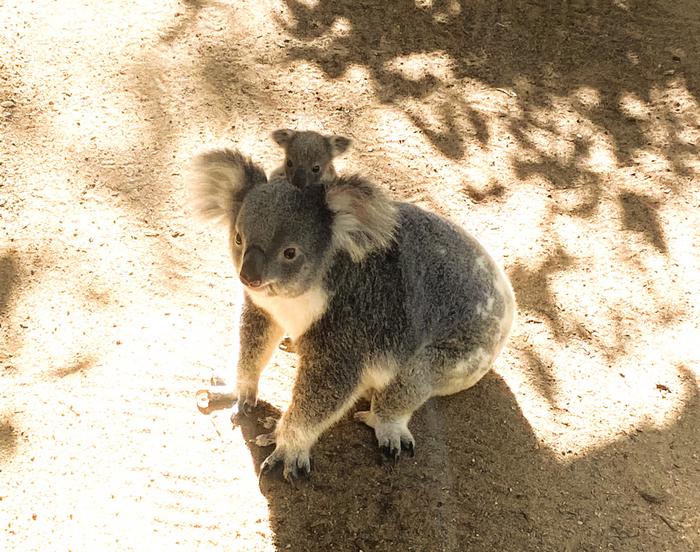
A team of conservation and policy researchers have called for a logging loophole within the proposed Great Koala National Park to be urgently remedied to stem the tide of harmful outcomes impacting the South East Australian koala population.

Credit: Carley Rosengreen
A team of conservation and policy researchers have called for a logging loophole within the proposed Great Koala National Park to be urgently remedied to stem the tide of harmful outcomes impacting the South East Australian koala population.
Led by Adjunct Senior Research Fellow Timothy Cadman, from Griffith University’s Institute for Ethics, Governance and Law, the new report published in the International Journal of Social Quality highlighted exclusion of prime koala habitat from logging within the proposed park was inconsistent with koala protection efforts.
Dr Cadman said the plans needed to also consider the integrity of the broader reserve habitat system and be accorded the requisite status of World Heritage.
The Great Koala National Park is set to cover 300,000 hectares of state forest and existing national parks from Grafton to Kempsey in Northern New South Wales.
The Park, to act as a safe haven for east coast koala populations impacted by bushfires, development and logging, was proposed more than a decade ago, with the current New South Wales Labor Government putting the plans into action.
However, a loophole that allowed logging to continue in areas zoned plantation was contradictory to the overall purpose of the park proposal, according to Dr Cadman.
“Creating a park which includes forestry presents a permanent threat to koalas. They live in the best habitat, and could end up being caught in a logging zone,” he said.
“Pressure has mounted on successive governments to take decisive action to protect these iconic creatures from further decline, and yet the current proposal could actually make the situation worse.
“We need an integrated approach that protects koalas at the landscape level. This is essential in the face of expanding human populations and escalating environmental threats posed by climate change.”
Dr Cadman added that the existing natural and planted forests represented a diverse mix of eucalypt and rainforest species, along with a mosaic of forest age-classes and interconnected habitat, which was crucial for the park’s integrity and the koalas’ viability.
“The integrity of the proposed park must be considered, and the best way to ensure that is World Heritage. We can’t have a park full of holes,” he said.
“An assessment that focuses on the habitat the koala lives in will be critical to the integrity and viability of the Great Koala National Park. We have to think like a koala. If they don’t discriminate between a natural forest or a plantation, then neither should we.
“The time to act is now. Protecting koalas requires a concerted effort from government to support First Nation communities and local residents through job creation and sustainable infrastructure development. Culture is as important as nature if we want the park to be a success.
“By establishing a conservation-effective national park and prioritising habitat protection at the same time, we can secure a future where koalas thrive in their natural environment.”
The paper ‘Koalas, Climate, Conservation and the Community: A Case Study of the Proposed Great Koala National Park, New South Wales, Australia’ has been published in the International Journal of Social Quality.
Journal
International Journal of Social Quality
Subject of Research
Animals
Article Title
Koalas, Climate, Conservation and the Community: A Case Study of the Proposed Great Koala National Park, New South Wales, Australia
Cite Scienmag News
Courtney Benton. (April 23, 2024). Urgent need for logging loophole remedy within proposed koala national park. Scienmag. https://scienmag.com/urgent-need-for-logging-loophole-remedy-within-proposed-koala-national-park/
Courtney Benton. "Urgent need for logging loophole remedy within proposed koala national park." Scienmag, 23 April 2024, https://scienmag.com/urgent-need-for-logging-loophole-remedy-within-proposed-koala-national-park/. Accessed 4 September 2026.
Courtney Benton. "Urgent need for logging loophole remedy within proposed koala national park." Scienmag. April 23, 2024. https://scienmag.com/urgent-need-for-logging-loophole-remedy-within-proposed-koala-national-park/

