


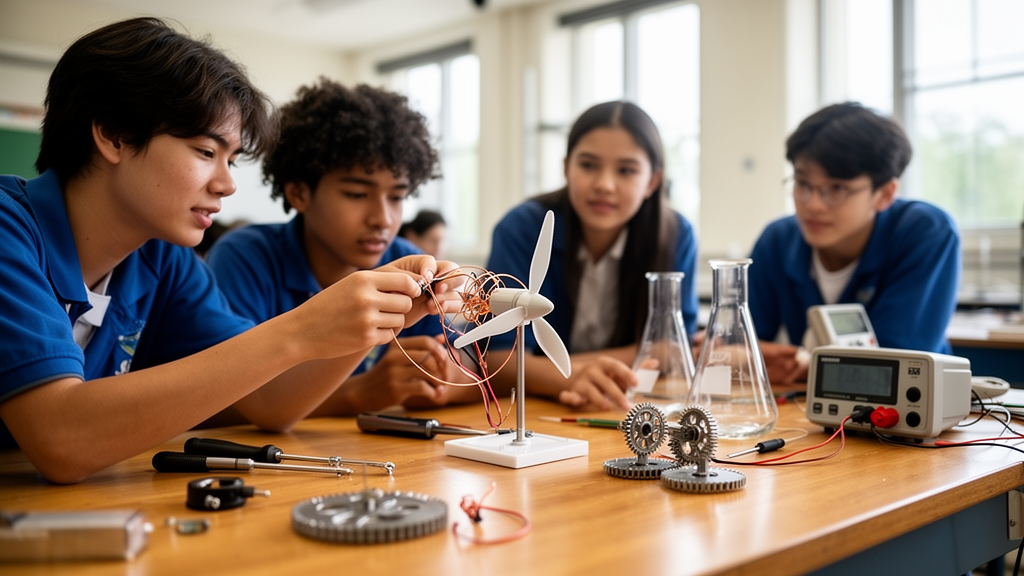
A quantitative meta-analysis synthesizing nineteen independent empirical studies has demonstrated that structured scientific problem-solving approaches significantly increase students’ scientific creativity across diverse educational environments. Evaluating twenty-one distinct effect sizes encompassing 1,756 student participants, the research team found that active, student-centered pedagogies produce substantial positive impacts compared to conventional instructional baselines. Under a fixed-effects statistical model, the interventions generated a pooled standardized mean difference of Hedge’s g = 0.97 with a 95 percent confidence interval spanning from 0.87 to 1.07, demonstrating a statistically significant overall benefit with Z = 20.46 and p < 0.0001. When analyzed through a random-effects framework to accommodate contextual variations across the underlying literature, the estimated effect size rose to Hedge’s g = 1.33 with a 95 percent confidence interval between 0.80 and 1.86. The data indicate that pedagogical frameworks engaging learners directly in authentic problem formulation, iterative investigation, and solution design cultivate measurable improvements in cognitive originality, intellectual flexibility, and generative scientific reasoning.
The study grounds its conceptual foundations in established theoretical frameworks that define scientific creativity as the capacity to generate novel, valuable, and scientifically relevant hypotheses, experiments, and technical artifacts. Rather than treating creativity as an innate, unguided trait, the researchers evaluated it through models such as the Scientific Structure Creativity Model developed by Hu and Adey. This analytical model divides creative competency into a product dimension encompassing scientific phenomena and technical objects, a process dimension involving imaginative hypothesis generation, and a trait dimension characterized by fluency, flexibility, and originality. The investigators noted that contemporary educational requirements increasingly demand cognitive skills that extend beyond rote memorization or algorithmic exercise completion. Grounded in constructivist learning theories, scientific problem-solving methodologies systematically map onto the formal stages of the scientific method, explicitly requiring learners to define open-ended problems, articulate testable hypotheses, design variable-controlled experimental protocols, interpret complex data sets, and evaluate conclusions through empirical criteria.
To assemble a rigorous empirical corpus, the investigators executed a systematic literature review following the Preferred Reporting Items for Systematic Reviews and Meta-Analyses guidelines. The initial bibliographic search across Google Scholar, the Education Resources Information Center, ScienceDirect, and Scopus-indexed journals yielded an aggregate pool of 2,852 candidate articles published between 2000 and 2023. The search strategy utilized targeted combinations of key descriptors, including scientific creativity, creativity in science, and science education, while intentionally omitting restrictive pedagogical acronyms from the primary query strings to avoid excluding studies that applied problem-solving interventions without naming them in their titles or abstracts. After initial title and abstract screenings eliminated non-conforming literature, thirty-five full-text papers underwent detailed scrutiny against explicit inclusion criteria requiring comparative intervention designs, clear measures of scientific creativity, and adequate statistical reporting. Ultimately, nineteen peer-reviewed articles providing twenty-one effect sizes met all methodological requirements, while sixteen candidate papers were excluded due to single-group designs, absent variance statistics, or non-English publication.
The resulting dataset captures a diverse cross-section of educational environments, disciplinary domains, and participant demographics totaling 1,756 students across varied instructional settings. Publication dates among the qualified investigations showed a marked acceleration after 2020, reflecting expanding global interest in empirical assessments of creative competence in science classrooms. Geographically, the clear majority of the included studies originated from Asian institutions, accompanied by smaller cohorts conducted within European and African educational institutions, reflecting targeted regional policy commitments to modernizing science, technology, engineering, and mathematics curricula. In terms of research methodology, quasi-experimental designs predominated across the corpus, supplemented by a modest number of randomized true-experimental trials and mixed-methods research configurations. Academic levels ranged from primary classrooms through higher education institutions, with the largest concentration centered on secondary school pupils. Disciplinary areas encompassed physics, biology, chemistry, general science, and integrated STEM programs, with individual sample cohorts spanning from 19 participants to more than 100 students per study cohort.
Statistical evaluation of the twenty-one effect sizes revealed significant heterogeneity across the analyzed interventions, highlighting that the magnitude of instructional impact is heavily modulated by contextual implementation factors. Heterogeneity testing yielded a Cochran’s Q statistic of 310.62 with 20 degrees of freedom, reaching statistical significance at p < 0.0001, accompanied by an inconsistency index I-squared of 93.56 percent. This high I-squared metric confirms that more than ninety-three percent of the observed variance across the reported findings stems from true differences among study characteristics rather than random sampling fluctuations. To account for this variability, the authors calculated Hedges’ g using Meta-Essentials version 1.5, applying sample-size corrections to eliminate the positive estimation bias that frequently distorts small-sample experimental cohorts. Despite the substantial contextual variance across the underlying literature, effect size estimates consistently remained to the right of the null origin across all subgroup forest plots, verifying that active problem-solving interventions reliably outmatched passive lecture-based instruction across diverse conditions.
Subgroup analyses parsing individual pedagogical models revealed that project-based learning and problem-based learning generated the most pronounced enhancements in scientific creativity scores. Project-based learning achieved the single highest individual pedagogical effect size at Hedge’s g = 2.10, indicating an exceptionally large practical benefit for participating students. The researchers attributed this profound effect to the sustained, multifaceted nature of project work, which obligates learners to navigate real-world physical constraints, iteratively refine prototypes, and construct tangible technical or scientific artifacts over extended inquiry cycles. Problem-based learning similarly produced an impressive effect size of Hedge’s g = 1.49. In problem-based frameworks, instructional sequences center upon ill-defined, authentic scientific dilemmas that demand collaborative inquiry, metacognitive self-regulation, and systematic information synthesis. While problem-based learning places less emphasis on engineering tangible physical products than project-based designs, its explicit focus on problem formulation and evidence-based hypothesis negotiation provides a fertile structure for fostering cognitive originality and flexible perspective-shifting.
The meta-analysis further identified strong creative performance within integrated multi-method curricula and dedicated STEM or STEAM educational contexts, while pure inquiry-based learning recorded more modest gains. Combined pedagogical models—which deliberately integrate problem-based exploration, project design phases, and interdisciplinary contexts—yielded a combined effect size of Hedge’s g = 1.43, demonstrating that hybrid instructional strategies successfully leverage complementary cognitive mechanisms. Standalone STEM and STEAM interventions recorded a large effect size of Hedge’s g = 1.21, reinforcing that integrating science with engineering design, technology, and artistic perspectives encourages students to apply cross-disciplinary mental models to technical problem-solving. In contrast, pure inquiry-based learning demonstrated a moderate effect size of Hedge’s g = 0.43. Although inquiry-based methods systematically guide learners through question formulation and empirical data collection, the authors observed that its heavily structured procedural frameworks can restrict open-ended divergent thinking unless instructors provide deliberate cognitive scaffolding that encourages non-linear experimentation and inventive hypothesis generation.
Moderator analyses identified educational stage, intervention duration, disciplinary domain, and social learning structure as critical variables governing instructional efficacy. When classified by academic level, college-level interventions demonstrated the largest creative gains at Hedge’s g = 3.21, outperforming primary and secondary school cohorts whose developmental readiness for self-directed inquiry requires more extensive external guidance. Analyzing intervention length revealed an inverse relationship between duration and effect size: short-term programs lasting up to six weeks achieved the highest impact at Hedge’s g = 1.85, whereas multi-month programs experienced diminishing returns, likely reflecting novelty effects, cognitive fatigue, or routine habituation over time. Across subject areas, integrated STEM and STEAM environments generated larger creative gains than isolated single-discipline classrooms such as pure biology, where heavy conceptual memorization frequently constricted divergent exploratory activities. Furthermore, collaborative classroom configurations consistently outperformed individualized study formats, indicating that peer discourse, cognitive co-construction, and shared problem negotiation serve as primary drivers for creative conceptual breakthroughs.
To evaluate the validity of the synthesis, the authors conducted thorough publication bias diagnostics utilizing both graphical inspections and quantitative statistical tests. A standard error funnel plot exhibited visual asymmetry, indicating a possible underrepresentation of smaller studies reporting non-significant or unfavorable outcomes. Kendall’s rank correlation test yielded a tau of 0.41 with a statistically significant p-value of 0.01, confirming a positive relationship between study size and reported effect magnitude, while Egger’s linear regression test produced a significant intercept of 5.99 with p = 0.00. However, subsequent failsafe number calculations demonstrated that the primary findings remain statistically robust against selective reporting bias. Rosenthal’s failsafe N indicated that 362 missing null-result studies would be required to reduce the cumulative significance to zero, Orwin’s failsafe metric yielded a threshold of 539 missing studies to nullify the effect, and Fisher’s method produced an N of 146 with p = 0.00, confirming that the observed pedagogical advantages cannot be dismissed as an artifact of selective journal publication.
Despite the strong statistical support for active scientific problem-solving, the researchers outlined important methodological limitations that warrant careful interpretation when translating these findings into educational practice. The overall synthesis relied on a relatively compact corpus of nineteen eligible articles, reflecting a historical shortage of quantitative intervention research dedicated specifically to measuring scientific creativity outcomes. The absence of long-term longitudinal evaluations across the primary literature leaves unresolved whether student creative gains endure after instructional modules terminate or whether they fade without continuous reinforcement. For classroom practitioners and curriculum designers, the evidence indicates that structured, collaborative, project-driven frameworks provide a robust and scientifically validated mechanism for developing higher-order creative problem-solving capabilities in modern science education.
Subject of Research: Meta-analytic evaluation of scientific problem-solving approaches and STEM contexts on student scientific creativity
Article Title: Fostering scientific creativity in science education through scientific problem-solving approaches and STEM contexts: a meta-analysis
Article References: Pinar, F. I. L., Panergayo, A. A. E., Sagcal, R. R., Acut, D. P., Roleda, L. S., & Prudente, M. S. (2025). Fostering scientific creativity in science education through scientific problem-solving approaches and STEM contexts: a meta-analysis. Disciplinary and Interdisciplinary Science Education Research, 7(1), Article 18. https://doi.org/10.1186/s43031-025-00137-9
Image Credits: AI Generated
DOI: 10.1186/s43031-025-00137-9
Keywords: scientific creativity, project-based learning, problem-based learning, inquiry-based learning, STEM education, STEAM education, meta-analysis, Hedges g, Scientific Structure Creativity Model, educational interventions, quasi-experimental research, constructivist pedagogy, collaborative learning, publication bias, PRISMA protocol, effect size analysis, science education research
Cite Scienmag News
Courtney Benton. (November 12, 2026). Project-Based and Problem-Based Learning Substantially Enhance Scientific Creativity in Science Education. Scienmag. https://scienmag.com/project-based-and-problem-based-learning-substantially-enhance-scientific-creativity-in-science-education/
Courtney Benton. "Project-Based and Problem-Based Learning Substantially Enhance Scientific Creativity in Science Education." Scienmag, 12 November 2026, https://scienmag.com/project-based-and-problem-based-learning-substantially-enhance-scientific-creativity-in-science-education/. Accessed 12 November 2026.
Courtney Benton. "Project-Based and Problem-Based Learning Substantially Enhance Scientific Creativity in Science Education." Scienmag. November 12, 2026. https://scienmag.com/project-based-and-problem-based-learning-substantially-enhance-scientific-creativity-in-science-education/




