


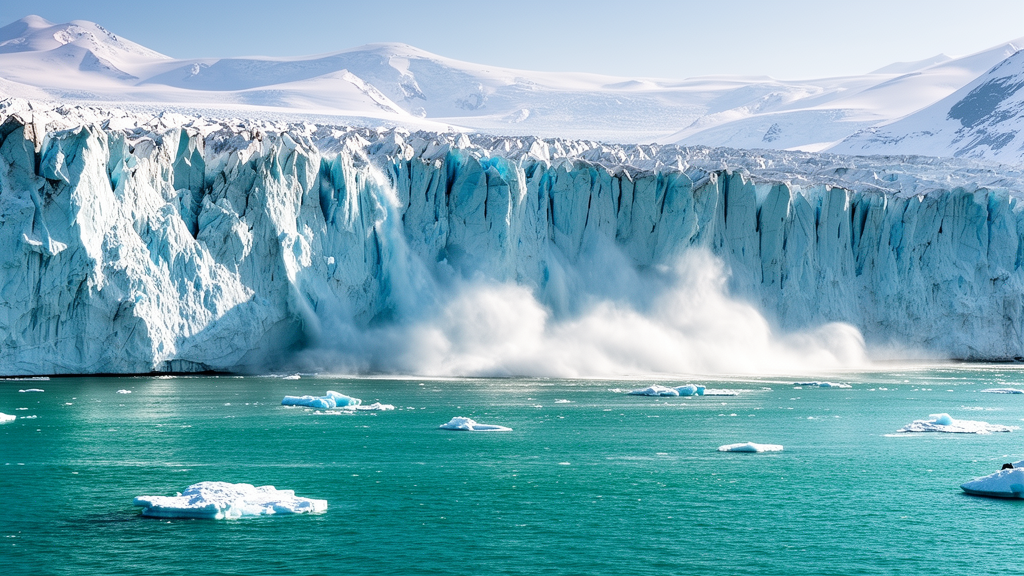
In an assessment published in The Cryosphere, thirteen international glaciological modeling groups participating in the Calving Model Intercomparison Project demonstrated that numerical ice models can accurately implement prescribed calving rates while maintaining smoothly evolving physical properties across simulated ice fronts. Calving accounts for roughly two-thirds of ice loss from the Greenland Ice Sheet and approximately half from the Antarctic Ice Sheet. Despite its vital role in controlling ice shelf buttressing and regulating oceanic discharge, calving has historically been simplified or held fixed in large-scale simulations. By establishing standardized benchmarks across idealized geometries, the CalvingMIP initiative provides the first systematic multi-model evaluation confirming that diverse numerical algorithms reliably reproduce continuous calving dynamics, reinforcing scientific confidence in model projections of future ice sheet mass balance and global sea level rise.
Dynamic ice-shelf calving in large-scale ice models has traditionally lagged behind parameterizations of oceanic basal melting and coupled thermodynamic interactions. Many simulations evaluated under the Ice Sheet Model Intercomparison Project for CMIP6 treated calving rates as equal to frontal ice velocities, keeping calving fronts geographically static over multi-century simulations. Glaciologists attribute this simplification to major computational hurdles: calving operates across disparate temporal and spatial scales, presenting a moving boundary between ice and ocean alongside semi-stochastic fracture events. Furthermore, Antarctic observational records generally span only several decades, capturing few advance-and-retreat cycles for model calibration. To establish clarity, CalvingMIP drew a formal operational distinction between a calving law, which dictates ice loss based on physical stress or damage, and a calving algorithm, which numerically removes the designated ice volume within the model grid.
To evaluate model performance, CalvingMIP established four fundamental principles that numerical ice sheet formulations should satisfy during continuous calving. First, models must accurately apply a specified rate of ice loss across sub-grid scales, ensuring front positions track smoothly rather than locking onto discrete computational grid boundaries. Second, simulated ice properties at the calving margin, including velocity and thickness, must evolve smoothly over time to prevent numerical oscillations that could distort coupled calving laws. Third, algorithmic behavior must remain independent of spatial grid orientation, ensuring calving rates do not distort along diagonal or rotated coordinate axes. Fourth, the implementation must preserve realistic physical couplings between front migration, overall ice sheet extent, grounding line positions, and floating-to-grounded ice area ratios. The initial phase focused on continuous calving over centuries, representing the long-term temporal average of discrete events.
The protocol subjected participating models to two synthetic domains initialized from ice-free conditions under a uniform surface mass balance of 0.3 meters per year. The first configuration, the Circular Domain, featured radial bedrock bathymetry rising to a central dome 900 meters above sea level and descending to minus 2000 meters at its 800-kilometer boundary. Spun up to steady state with a stationary circular calving front at a radius of 750 kilometers, the domain provided an exact analytical solution for verifying front positions. Over a 1000-year transient run, models retreated their calving front sinusoidally for 500 years, reaching a maximum retreat rate of 300 meters per year at year 250 and decelerating to zero at year 500. During the subsequent 500 years, the front advanced outward, peaking at 300 meters per year at year 750.
The second configuration, the Thule Domain, introduced mathematically defined bedrock topography using polar coordinates to produce complex ice shelf geometries, including both confined and open embayments. Spanning an area comparable to a quarter of the Antarctic Ice Sheet, Thule standardized on an initial steady state grown from zero ice thickness where ice remained ungrounded across the submerged Benett ridges beneath the North and South Tsalal ice shelves. In Thule, models executed a 500-year sinusoidal retreat peaking at 750 meters per year at year 250, while strictly prohibiting calving across grounded ice boundaries. Over the final 500 years, models simulated unconstrained advance by setting calving rates to zero meters per year, allowing fronts to migrate outward at local ice velocities without risk of unphysically exceeding forward ice motion.
Participating research groups deployed diverse numerical architectures, divided between level-set tracking schemes and fractional-area volume methods. The finite-volume adaptive-mesh model BISICLES utilized the shallow shelf approximation and an advected cell-centered area fraction based on a pseudo-volume-of-fluid scheme, refining cell resolutions from 5 kilometers to 0.625 kilometers around boundaries. The Community Ice Sheet Model implemented the Depth-Integrated Viscosity Approximation and incremental remapping on a structured horizontal grid, calculating lateral calving as a thickness reduction rate within boundary cells and interpolating front positions. Elmer/Ice utilized the finite element method with linear Galerkin formulations on Gmsh unstructured hybrid meshes, applying backward Euler time stepping and BiCGStab solvers to advect a signed-distance level-set function. Six configurations of the Ice-sheet and Sea-level System Model evaluated unstructured meshes across shallow shelf, mono-layer higher-order, and Blatter-Pattyn physics.
Other participating modeling systems incorporated distinct computational solutions to track frontal migration. The hybrid Kori model combined shallow ice and shallow shelf approximations across a 5-kilometer finite-difference grid, updating its normalized level-set function implicitly with two-point stencils. The Parallel Ice Sheet Model executed shallow shelf calculations on a 5-kilometer grid, determining sub-grid calving through an upwind transport scheme and a nine-cell diagnostic stencil that applied calving fluxes antiparallel to terminal velocity vectors. The Úa finite-element model solved implicit shallow shelf equations on adaptive meshes down to 2 kilometers, employing a streamline upwind Petrov-Galerkin level-set scheme and Heaviside basal melting. The Utrecht Finite Volume Ice-Sheet Model evaluated Depth-Integrated Viscosity on irregular triangular meshes, while Yelmo utilized a 321-by-321 finite-difference grid, removing calved ice across positive level-set ocean points via localized melt sink terms.
In the Circular Domain, twelve of thirteen participating models tracked the expected calving front position within a 5-kilometer target envelope along the orthogonal profile, and eleven remained within the envelope along the diagonal profile. The Utrecht Finite Volume Ice-Sheet Model fell approximately 10 kilometers short of the envelope at maximum retreat, linked to its coarser 20-kilometer resolution and fractional-area estimation. Ice speeds evolved smoothly across most models, although Yelmo exhibited velocity oscillations of approximately 25 percent along diagonal transects during retreat, accompanied by front thickness deviations of up to 30 percent. ULB Kori showed a 20-meter-per-year velocity difference and a 20-meter thickness offset between transects. Domain quadrant symmetries remained high across all participating groups, with area discrepancies never exceeding 0.5 percent, demonstrating that coordinate orientation does not inherently bias circular calving dynamics.
The complex bathymetry of the Thule Domain introduced greater variance across model outputs, though general evolutionary patterns remained coherent along Caprona Ice Shelf and Halbrane Ice Stream. Most models exhibited accelerating frontal velocities during retreat followed by deceleration during advance along Caprona, with oscillations confined to less than 5 percent of total speed. Halbrane front speeds generally decreased during retreat and leveled off after 250 years, although PIK PISM recorded a velocity increase after 250 years and accelerated retreat after 350 years, likely stemming from regular-grid sub-grid interpolation. Calving margins thickened progressively as fronts retreated into deeper ice upstream. Yelmo displayed substantial thickness asymmetry, with advancing margins up to 300 meters thinner than retreating margins. Quadrant area asymmetry remained below 0.05 percent for most models, aside from a transient 20 percent asymmetry spike in Kori around year 600.
Structural ice shelf variations in Thule exerted pronounced controls on grounding line positions and ice volume distributions. At peak retreat after 500 years, floating ice shelf areas contracted by roughly 70 percent across the majority of models, whereas grounded ice areas decreased by at most 5 percent. PIK PISM proved an exception, experiencing a grounding area contraction down to 85 percent of its initial extent, reflecting thinner overall ice geometry compared to the thicker ice state simulated by Kori. Across floating ice shelves, thickness varied by plus or minus 20 percent relative to multi-model averages. Spatial front geometries displayed localized differences, with Elmer/Ice, PISM, and BISICLES exhibiting less retreat along the western flank of Caprona Ice Shelf where calving rates were applied parallel to ice velocity vectors rather than perpendicular to front geometry, illustrating buttressing sensitivity.
Crucially, the CalvingMIP intercomparison revealed no systematic divergence in performance between level-set formulations and fractional-area volume algorithms, confirming that both mathematical methodologies can accurately simulate ice front migration when properly resolved. Differences between model outputs stemmed primarily from sub-grid interpolation techniques, mesh resolution limits, and local numerical implementations rather than underlying algorithmic paradigms. Furthermore, multi-configuration tests within the Ice-sheet and Sea-level System Model demonstrated that calving algorithms perform consistently across shallow shelf, mono-layer higher-order, and Blatter-Pattyn stress approximations. The benchmarking exercise prompted widespread code refinements, including shock-capturing schemes and updated vector formulations. Having validated the core capability of ice models to execute prescribed calving rates, the CalvingMIP community is preparing subsequent phases to evaluate physical calving laws, continuous versus discontinuous approaches, and stochastic representations of individual fracturing events for enhanced global sea level projections.
Subject of Research: Numerical modeling and intercomparison of ice shelf calving algorithms in ice sheet models
Article Title: The implementation and effectiveness of Calving Algorithms in numerical ice models (CalvingMIP)
Article References: Jordan, J. R., Pattyn, F., Abele, D., Albrecht, T., Alvarez-Solas, J., Barnes, J. M., Berends, T. J., Bernales, J. A., Blasco, J., Cheng, G., Choi, Y., Cornford, S. L., Garcia-Molina, C., Gillet-Chaulet, F., Gudmundsson, G. H., Humbert, A., Leguy, G. R., Lipscomb, W. H., Montoya, M., … Zwinger, T. (2026). The implementation and effectiveness of Calving Algorithms in numerical ice models (CalvingMIP). The Cryosphere, 20(11), 6453-6475. https://doi.org/10.5194/tc-20-6453-2026
Image Credits: AI Generated
Keywords: CalvingMIP, ice calving, numerical ice sheet models, calving algorithms, sea level rise, level-set method, fractional area method, ice shelf buttressing, grounding line migration, ice sheet mass balance, shallow shelf approximation, Depth-Integrated Viscosity Approximation, Circular Domain, Thule domain, Caprona Ice Shelf, Halbrane Ice Stream, ice flow dynamics, glaciology
Cite Scienmag News
Sloane Callahan. (November 11, 2026). Numerical Ice Sheet Models Accurately Simulate Calving Rates Across Intercomparison Benchmark. Scienmag. https://scienmag.com/numerical-ice-sheet-models-accurately-simulate-calving-rates-across-intercomparison-benchmark/
Sloane Callahan. "Numerical Ice Sheet Models Accurately Simulate Calving Rates Across Intercomparison Benchmark." Scienmag, 11 November 2026, https://scienmag.com/numerical-ice-sheet-models-accurately-simulate-calving-rates-across-intercomparison-benchmark/. Accessed 22 November 2026.
Sloane Callahan. "Numerical Ice Sheet Models Accurately Simulate Calving Rates Across Intercomparison Benchmark." Scienmag. November 11, 2026. https://scienmag.com/numerical-ice-sheet-models-accurately-simulate-calving-rates-across-intercomparison-benchmark/




