Published in the AAPPS Bulletin, a recent review article by Golda Komalan Satheedas, Akhil Jhingan, and Sugathan Pullahnhiotan details the facility’s capabilities and highlights key experimental findings from the past two decades. The study, which serves as a comprehensive overview of the detector array’s role in nuclear physics, emphasizes how precise neutron measurements allow researchers to probe the time scales and mechanisms of fission in heavy and near super-heavy nuclei.
Nuclear fission, first discovered in 1938, remains a central area of research in nuclear physics due to its technological applications and its unique capacity to reveal the dynamic evolution of microscopic many-body systems. While early models, such as Bohr’s liquid drop model, provided a foundational understanding, they could not fully explain observed fission properties. Modern research requires the consideration of single-particle effects, including nuclear pairing and shell effects, which necessitate advanced experimental methods. The NAND facility addresses this need by measuring neutrons emitted during the fission process, providing data that helps distinguish between different reaction mechanisms and evolutionary stages of the fissioning nucleus.
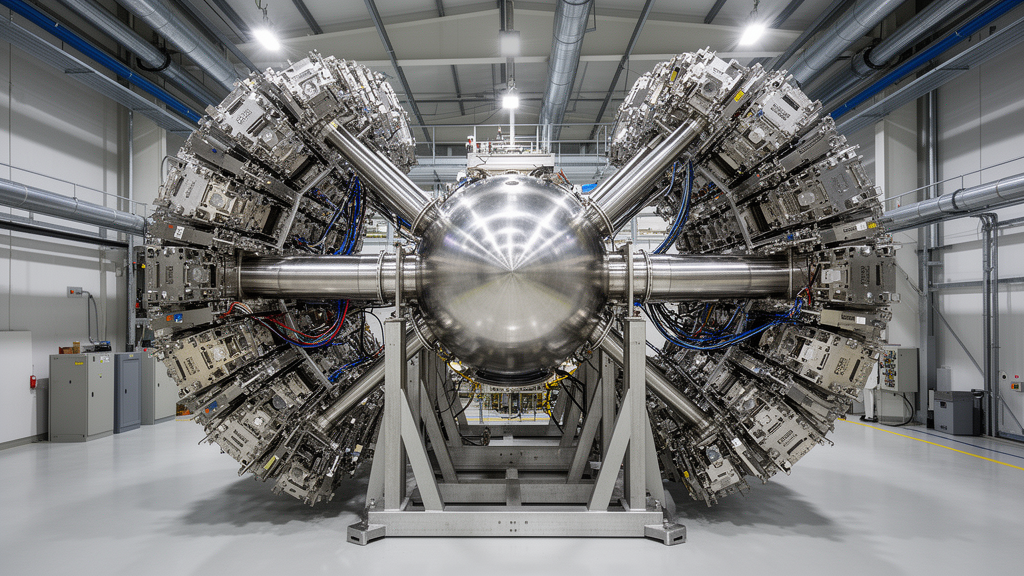
The NAND facility is a large detector array installed in Beam Hall II of IUAC, designed specifically for neutron time-of-flight (ToF) measurements. The array consists of 100 liquid scintillator detectors mounted on a semi-spherical geometry, covering approximately 3.3% of the full 4π solid angle. Each detector contains a BC501 organic liquid scintillator in a 5-inch by 5-inch cylindrical cell coupled to a 5-inch diameter photo-multiplier tube. The detectors are positioned at a fixed distance of 175 cm from the target position, a configuration that provides good energy resolution for the emitted neutrons. This setup enables precise measurement of neutron multiplicity, which is crucial for understanding the de-excitation of very heavy nuclei.
Complementary to the neutron detectors, the facility includes two large area position-sensitive Multi-Wire Proportional Counters (MWPCs) for detecting fission fragments. These detectors, with an active area of 16 cm by 11 cm, are placed 17 to 25 cm from the target and achieve a position resolution of approximately 1.2 mm and a time resolution of 600 ps. Additionally, an array of 16 hybrid detector telescopes (HYTAR) is used for measuring fission fragment angular distributions. The combination of high-granularity neutron detection and precise fragment tracking makes NAND a versatile tool for exploring fission dynamics using heavy ions accelerated by IUAC’s 15 UD Pelletron and superconducting booster linear accelerator.
One of the primary research areas enabled by NAND is the investigation of nuclear dissipation in fission reactions. The observation of excess pre-scission neutrons compared to theoretical predictions has been attributed to the hindrance of fission due to dissipation effects. Experiments using NAND extracted pre-scission neutron multiplicities for fissioning nuclei near mass A = 200, such as 212, 214, and 216Ra. These studies revealed that statistical models underpredict experimental neutron multiplicities in the absence of nuclear dissipation. By incorporating a reduced friction coefficient, the models were able to reproduce the experimental data, confirming that dissipation slows down the fission process and increases the likelihood of neutron emission during the pre-fission phase.
Research has also focused on the role of entrance channel mass asymmetry in influencing fission dynamics. For reactions forming the same compound nucleus through different projectile-target combinations, the mass asymmetry parameter significantly affects the reaction outcome. Experiments at NAND compared the fission of 208Rn formed in reactions 30Si + 178Hf and 48Ti + 160Gd. This finding highlights the importance of entrance channel dynamics in determining the neutron yield and the overall fission mechanism.
Quasi-fission, a non-compound nuclear process where the di-nuclear system re-separates without achieving full equilibration, poses a major challenge in the synthesis of superheavy elements. NAND experiments have utilized neutron multiplicity as a probe to disentangle quasi-fission from fusion-fission events. In a study of 256Rf formed in the reaction 48Ti + 208Pb, researchers observed a strong correlation between pre-scission neutron multiplicity and total kinetic energy (TKE). The data indicated that low TKE events were associated with higher pre-scission neutron multiplicities, a signature of fast quasi-fission where more excitation energy is available for neutron emission near the scission point.
The facility has also been instrumental in studying multi-chance fission, a phenomenon where fission occurs after the evaporation of one or more neutrons. In experiments with 227Pa, mass-gated pre-scission neutron multiplicities were analyzed using the GEneral description of Fission observables (GEF) model. The results showed that at lower excitation energies, shell effects persist, leading to asymmetric fission modes that are dominant in late-chance fission. As excitation energy increases, these shell effects fade, resulting in more symmetric fission. This work underscores the necessity of incorporating multi-chance fission into data analysis to accurately interpret fission observables at higher energies.
Beyond fission dynamics, the NAND facility supports research in other areas of nuclear physics, including the study of asymmetric fission in neutron-deficient nuclei. Experiments on 198Po and 186Pt revealed indications of asymmetric mass partitions up to tens of MeV above the fission barrier, extending the region of mass-asymmetric fission previously observed in beta-delayed fission of 180Hg. The facility’s versatility also allows for quasi-elastic scattering measurements, which are used to extract fusion barrier distributions for reactions producing nuclei close to the superheavy region. These measurements provide quantitative estimates of fusion barriers, which are essential for optimizing the synthesis of superheavy elements.
Looking forward, the integration of the High Current Injector (HCI) system with the LINAC is expected to expand the capabilities of the NAND facility. The HCI, equipped with a high-temperature superconducting electron cyclotron resonance ion source, will provide new ion beams with higher charge states and intensities. This advancement will enable the study of reaction dynamics in the superheavy mass region and facilitate the collection of high-fold neutron-fission coincidence data. Such data will be crucial for disentangling fusion-fission and quasi-fission events in reactions using heavy projectiles, offering deeper insights into the fundamental processes governing nuclear structure and dynamics.
The engineering and calibration protocols of the facility played a decisive role in achieving high measurement precision while suppressing background interferences. NAND originally began operation in 2006 with 26 detectors before expanding to its current 100-detector array in 2015. To minimize extraneous scattering that could distort neutron measurements, the dome-shaped frame supporting the eight detector rings was constructed from hollow mild steel pipes, while a four-millimeter-thick stainless steel vacuum chamber enclosed the target area. Intrinsic detection efficiency across neutron energies up to 10 MeV was established using prompt neutrons from a spontaneous fission californium-252 source mounted on a parallel-plate avalanche counter at a threshold of approximately 120 keV electron equivalent, showing close agreement with FLUKA Monte Carlo simulations. In addition, offline measurements using an americium-beryllium source determined that the cross-talk probability between adjacent detectors was restricted to approximately 4.6×10⁻⁴, rising to roughly 1.38×10⁻³ in reactions emitting three neutrons per fission fragment.
Beyond the primary liquid scintillators, several dedicated auxiliary detector systems support reaction monitoring inside the scattering chamber. Elastic scattering of incident beam particles is tracked by two 300-micrometer-thick silicon detectors positioned at plus and minus 13 degrees relative to the beam axis. Light charged particles, such as protons and alpha particles, are recorded by sixteen cesium iodide crystals coupled to photodiodes, which separate particle types using pulse-shape discrimination based on the ballistic deficit method. Signals from the neutron detectors are routed into custom NIM electronic modules that perform pulse shaping, constant-fraction timing, and zero-cross-time discrimination before being digitized by a VME-based data acquisition system operating on Linux.
Detailed statistical model analyses of fission data have provided deeper insight into nuclear dissipation. In studies of radium and neptunium-227, the extracted pre-scission multiplicities indicated that the post-saddle stage between saddle and scission contributes more heavily to neutron emission and grows more rapidly with excitation energy than the pre-saddle stage. Model calculations for neptunium-227 formed via silicon-30 bombarding gold-197 required a reduced friction coefficient of 10 zs⁻¹, confirming substantial dissipation in highly fissile actinides. Furthermore, incorporating the collective enhancement of level density and the tilting of compound nucleus spin orientation accounted for the observed temperature independence of friction strength, demonstrating the necessity of selecting comprehensive input parameters when modeling fissile systems.
Future instrumentation initiatives aim to extend NAND’s detection scope into transfer-induced fission and pre-equilibrium emissions. Incorporating an annular position-sensitive silicon detector in the forward cone will allow researchers to identify transfer products alongside fission fragments, opening investigations into nuclei far from stability. Concurrently, developing fast-timing parallel-plate avalanche counters as time-zero start detectors, alongside planned silicon detectors, will facilitate absolute velocity and direct total kinetic energy measurements. Operating the booster accelerator with light ions such as carbon-12, nitrogen-14, and oxygen-16 up to roughly 10 MeV per nucleon will also allow the array and cesium iodide detectors to isolate forward-peaked pre-equilibrium particle emissions from fully equilibrated compound nuclear decay.
Subject of Research: Nuclear fission dynamics and neutron detection at the IUAC NAND facility
Article Title: Nuclear fission research using NAND facility at IUAC
Article References: Komalan Satheedas, G., Jhingan, A., & Pullahnhiotan, S. (2025). Nuclear fission research using NAND facility at IUAC. AAPPS Bulletin, 35(1), Article 19. https://doi.org/10.1007/s43673-025-00160-y
Image Credits: AI Generated
DOI: 10.1007/s43673-025-00160-y
Keywords: nuclear fission, neutron detection, IUAC, NAND facility, heavy ion physics, quasi-fission, nuclear dissipation, time-of-flight, superheavy elements, compound nucleus, Nuclear, fission
Cite Scienmag News
Katie Riggs. (November 11, 2026). IUAC Neutron Array Reveals Nuclear Fission Dynamics. Scienmag. https://scienmag.com/iuac-neutron-array-reveals-nuclear-fission-dynamics/
Katie Riggs. "IUAC Neutron Array Reveals Nuclear Fission Dynamics." Scienmag, 11 November 2026, https://scienmag.com/iuac-neutron-array-reveals-nuclear-fission-dynamics/. Accessed 11 November 2026.
Katie Riggs. "IUAC Neutron Array Reveals Nuclear Fission Dynamics." Scienmag. November 11, 2026. https://scienmag.com/iuac-neutron-array-reveals-nuclear-fission-dynamics/