


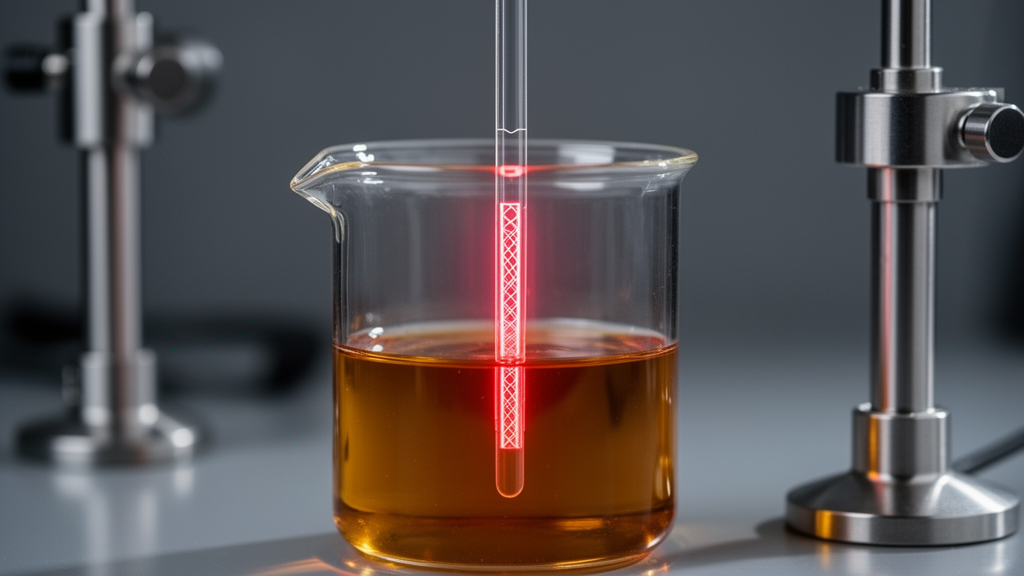
Researchers have developed a highly sensitive optical sensor capable of measuring ethanol concentrations in blended petrol across the entire range from zero to one hundred percent by volume. The device utilizes a weakly tilted fiber Bragg grating, a specific type of optical fiber sensor, to detect minute changes in the refractive index of the fuel mixture. This approach addresses the growing need for accurate fuel quality assurance as bio-ethanol blending becomes increasingly common worldwide. The study, published in the journal Discover Sensors, demonstrates that the sensor can quantify ethanol content with a resolution of approximately 0.1% by volume, a level of precision that surpasses many previously reported methods in the literature.
The motivation for this research stems from the global shift toward using bio-ethanol as a fuel additive. Ethanol blending in petrol increases the octane number, which improves fuel stability and allows engines to withstand higher compression before auto-ignition. Furthermore, ethanol is a renewable resource produced through the fermentation of materials such as sugarcane, molasses, and corn. Countries like Brazil and India are actively increasing their ethanol blending ratios to meet future fuel demands and reduce carbon emissions. However, the quality of the blend is critical; if the ethanol content or water levels are not within permissible standards, it can cause engine malfunction due to ethanol’s hygroscopic nature.
Existing methods for detecting ethanol in fuel, such as gas chromatography, Raman spectroscopy, and infrared spectroscopy, often face limitations regarding portability and measurement complexity. These commercial methods may require specific sample preparation or large equipment that is not suitable for all field conditions. Optical fiber-based sensing technologies have emerged as a promising alternative due to their immunity to electromagnetic interference, chemical ruggedness, and ability to perform remote, in-situ measurements. Among these, fiber Bragg gratings offer a robust platform for sensing the surrounding medium, though previous designs often suffered from cross-sensitivities or limited dynamic ranges.
The sensor described in this study is a tilted fiber Bragg grating inscribed in a standard telecommunication single-mode Corning SMF-28 fiber. Because this type of fiber is not inherently photosensitive, the researchers first photo-sensitized it using a hydrogen-loading process under high pressure and temperature. The grating was then inscribed using ultraviolet radiation from a copper vapor laser. The internal tilt angle of the grating planes was set to approximately eight degrees, a specific choice designed to cover the refractive index range of both pure ethanol and petrol. This tilt angle determines which cladding modes are excited and, consequently, the measurable refractive index range and sensitivity of the sensor.
The operating principle of the sensor relies on the spectral shift of the cut-off mode in the transmission spectrum. In a tilted fiber Bragg grating, light is coupled into various cladding modes, each with a specific effective refractive index. When the refractive index of the surrounding medium, in this case the ethanol-petrol mixture, matches the effective index of a particular cladding mode, that mode becomes leaky and its transmission intensity drops sharply. This point is known as the cut-off mode. As the ethanol concentration changes, the refractive index of the mixture changes, causing the cut-off mode wavelength to shift. By monitoring this spectral shift, the sensor can determine the ethanol concentration.
A key advantage of this design is the simultaneous and independent measurement of temperature. The core mode of the tilted fiber Bragg grating is insensitive to the surrounding medium’s refractive index but is sensitive to temperature and strain. By using the core mode wavelength as a reference, the researchers could eliminate temperature cross-sensitivities from the ethanol concentration measurements. This differential measurement technique ensures that the spectral shifts observed in the cladding modes are attributed solely to changes in ethanol concentration, provided that strain effects are minimized through proper mounting of the fiber in the liquid sample holder.
For the experimental validation, ethanol blended petrol samples were prepared using high-precision micropipettes to minimize mixing errors. The samples covered the full range of 0% to 100% ethanol by volume. All measurements were conducted at a constant temperature of approximately 25 degrees Celsius to avoid complications arising from temperature-dependent changes in the refractive index of the analyte. The transmission spectra were recorded using an optical spectrum analyzer and an unpolarized amplified spontaneous emission light source. The researchers carefully avoided bending or twisting the fiber during measurements, as these actions could introduce geometric birefringence and polarization-dependent loss, which would affect the cladding mode resonances.
The results showed an excellent linear relationship between the cut-off mode wavelength and the ethanol concentration. The regression coefficient, or R-squared value, was 0.99949, indicating a highly linear response throughout the investigated range. The observed sensitivity of the sensor was 251.52 plus or minus 1.8 picometers per percent by volume of ethanol. This sensitivity is defined by the slope of the linear fit of the cut-off wavelength against concentration. The error bars in the data, which represent the standard deviations from three repetitive measurements, were magnified by a factor of one thousand for visual clarity in the graphical presentation of the results.
The resolution of the sensor was determined by analyzing the measurement noise relative to the sensitivity. The measurement noise was calculated as the mean of the standard deviations for each ethanol concentration measured, yielding a value of 0.00985 nanometers. Using the standard formula for resolution, which is three times the noise divided by the sensitivity, the calculated resolution was approximately 0.1% by volume. This means the sensor can detect and quantify changes in ethanol concentration as small as one-tenth of a percent. The limit of detection was estimated to be approximately 0.08% by volume, based on the noise from a black sample with zero ethanol concentration.
In addition to ethanol concentration, the sensor was tested for its ability to measure temperature. The core mode spectral position was monitored over a temperature range of 30 to 100 degrees Celsius. The data showed excellent linearity in this range, with an observed temperature sensitivity of 9.67 picometers per degree Celsius. This capability allows the sensor to provide dual-parameter output, measuring both the ethanol content and the sample temperature simultaneously. This is particularly useful in field applications where temperature fluctuations could otherwise introduce errors into the concentration readings if not accounted for.
The study compares the performance of this tilted fiber Bragg grating sensor with other fiber grating-based ethanol sensors reported in the literature. The comparative data highlights that the present sensor offers a combination of high sensitivity, high resolution, and a wide dynamic range that is superior to many earlier designs. Previous sensors often required functional coatings, which could compromise chemical ruggedness, or used intensity-based interrogation schemes that are prone to source intensity fluctuations. The current design does not require any coating material for ethanol detection, making it more physically and chemically rugged and easier to fabricate and implement.
The researchers also addressed potential sources of error in the measurement process. Temperature variations were minimized by maintaining the samples at a constant temperature and using the core mode for differential correction. Strain effects were mitigated by properly mounting the TFBG in the liquid sample holder and taking wavelength measurements relative to the core mode. Volume measurement errors during sample preparation were minimized by using high-precision micropipettes. The inherent polarization sensitivity of the TFBG was managed by strictly avoiding bending or twisting of the fiber, which could otherwise alter the cladding mode resonances and affect the determination of the cut-off wavelength.
This work demonstrates the potential of weakly tilted fiber Bragg gratings as a robust tool for fuel quality monitoring. The ability to measure ethanol concentration across the full blending range with high linearity and resolution makes this sensor suitable for practical applications in the fuel industry. The elimination of temperature cross-sensitivity through differential measurement and the lack of need for external coatings enhance the sensor’s reliability and ease of use. As the adoption of bio-ethanol fuels continues to grow, such precise and rugged sensing technologies will play a crucial role in ensuring fuel quality and engine performance.
The study concludes that the tilted fiber Bragg grating sensor provides a viable and accurate method for ethanol concentration measurement in ethanol blended petrol. The high sensitivity and wide dynamic range address the limitations of previous sensing technologies. The simultaneous measurement of temperature and concentration further adds to the utility of the sensor. This research contributes to the field of optical fiber sensing by showcasing the capabilities of TFBGs in chemical detection applications, particularly in the context of renewable fuel quality assurance.
Subject of Research: Optical fiber sensing for ethanol concentration measurement in blended petrol
Article Title: High sensitivity wide range ethanol concentration measurements in ethanol blended petrol using weakly tilted fiber Bragg grating
Article References: Saini, P. K., Kumar, J., & Prakash, O. (2026). High sensitivity wide range ethanol concentration measurements in ethanol blended petrol using weakly tilted fiber Bragg grating. Discover Sensors, 2(1), Article 31. https://doi.org/10.1007/s44397-026-00066-w
Image Credits: AI Generated
DOI: 10.1007/s44397-026-00066-w
Keywords: ethanol, petrol, fiber Bragg grating, optical sensor, refractive index, fuel quality, tilted fiber, spectral shift, bio-fuel, sensing technology, High, sensitivity
Cite Scienmag News
Denise Maddox. (November 11, 2026). Fiber Grating Sensor Measures Ethanol in Petrol with High Precision. Scienmag. https://scienmag.com/fiber-grating-sensor-measures-ethanol-in-petrol-with-high-precision/
Denise Maddox. "Fiber Grating Sensor Measures Ethanol in Petrol with High Precision." Scienmag, 11 November 2026, https://scienmag.com/fiber-grating-sensor-measures-ethanol-in-petrol-with-high-precision/. Accessed 16 November 2026.
Denise Maddox. "Fiber Grating Sensor Measures Ethanol in Petrol with High Precision." Scienmag. November 11, 2026. https://scienmag.com/fiber-grating-sensor-measures-ethanol-in-petrol-with-high-precision/




