


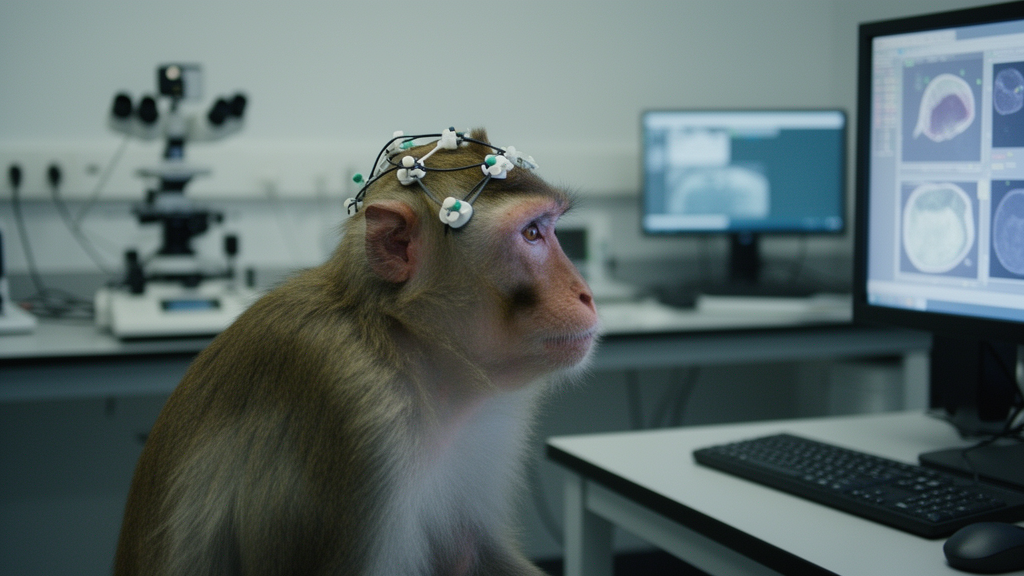
New conceptual information presented during visual scenes influences neural activity in primate attention and scene-processing brain regions, occurring specifically between eye fixations as individuals interpret unfolding events. The peer-reviewed findings indicate that visual processing operates as a continuous mechanism, wherein the brain systematically compares semantic information acquired across distinct visual glimpses to construct meaningful interpretations of complex environments.
The study, published in JNeurosci by researchers led by Vinay Raghavan from the City College of New York, investigated how humans and monkeys derive meaning from dynamic scenes. The investigative team assessed eye movements alongside neural activity while human participants and macaques observed full-length movies as well as short video sequences.
During the viewing of full-length films, the researchers observed that the appearance of novel semantic information directly altered neural responses within cortical networks dedicated to attention and scene processing.
To examine the temporal dynamics of this phenomenon, the investigators evaluated deeper brain recordings obtained from a separate cohort of human participants and two female macaques watching short video clips. These targeted recordings detected early, rapid bursts of neural activity in attention and scene-processing regions when the videos introduced new semantic details, with this rapid response occurring exclusively during the intervals between eye fixations.
Raghavan explained that the engagement of brain regions outside conventional visual cortices points toward a higher-order, abstract mental architecture. According to the researchers, this predictive system may anticipate upcoming visual content between momentary pauses in eye movements, enabling primates to rapidly generate semantic meaning from sequential visual inputs.
The research team highlighted that these findings carry significant implications for computational visual systems and artificial intelligence. Raghavan noted that it is possible the learning strategy in this study trained neural networks and the primate brain to produce a semantic novelty signal, suggesting that this learning strategy could be implemented to train new vision models in AI.
The research was published in JNeurosci on November 9, 2026, under the title ‘During Natural Vision, Semantic Novelty Modulates Fixation-Related Processing in Primate Cortex,’ with the authors declaring no competing financial interests. Established in 1981, JNeurosci communicates neuroscience research across diverse specialties. The journal is published by the Society for Neuroscience, a nonprofit organization founded in 1969 that now includes nearly 35,000 scientists and physicians in more than 95 countries.
Subject of Research: Primate neural visual processing and fixation-related semantic scene perception
Article Title: Exploring how primates create meaning from visual scenes
Article References: Exploring how primates create meaning from visual scenes. Original publication (Bibliographic details unavailable.)
Image Credits: AI Generated
DOI: Not provided
Keywords: visual processing, semantic novelty, primate cortex, eye fixations, macaques, scene processing, attention brain areas, neural activity, City College of New York, Vinay Raghavan, JNeurosci, Society for Neuroscience, artificial intelligence vision models, deep brain recordings, predictive mental systems, natural vision
Cite Scienmag News
Cassandra Pierce. (November 11, 2026). Semantic Novelty Modulates Brain Activity Between Eye Fixations in Primates. Scienmag. https://scienmag.com/semantic-novelty-modulates-brain-activity-between-eye-fixations-in-primates/
Cassandra Pierce. "Semantic Novelty Modulates Brain Activity Between Eye Fixations in Primates." Scienmag, 11 November 2026, https://scienmag.com/semantic-novelty-modulates-brain-activity-between-eye-fixations-in-primates/. Accessed 17 November 2026.
Cassandra Pierce. "Semantic Novelty Modulates Brain Activity Between Eye Fixations in Primates." Scienmag. November 11, 2026. https://scienmag.com/semantic-novelty-modulates-brain-activity-between-eye-fixations-in-primates/




