

Thursday, November 12, 2026
Science
No Result
View All Result
  • Login
  • HOME
  • SCIENCE NEWS
  • CONTACT US
  • HOME
  • SCIENCE NEWS
  • CONTACT US
No Result
View All Result
Scienmag
No Result
View All Result
Home Science News Medicine

Brief CPR Training Improves Compression Quality After Prior Dispatcher Simulation

November 11, 2026
in Medicine
Ophelia Keating
By Ophelia Keating Scienmag Editorial Profile - Health Services Research
Reading Time: 2 mins read
0
Brief CPR Training Improves Compression Quality After Prior Dispatcher Simulation

Brief CPR Training Improves Compression Quality After Prior Dispatcher Simulation

65
SHARES
587
VIEWS
Share on FacebookShare on Twitter
ADVERTISEMENT

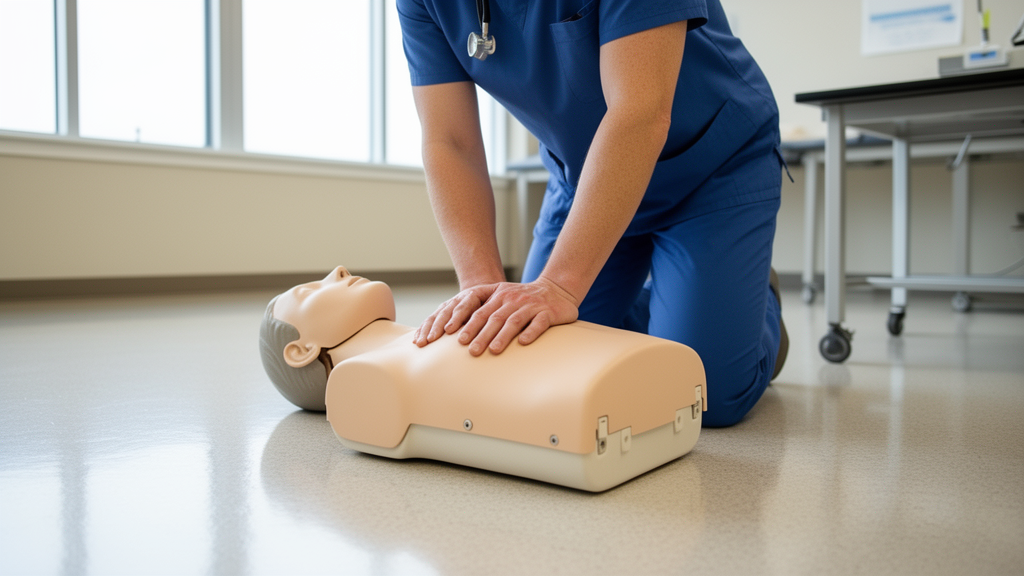
A brief hands-on basic life support training intervention significantly improved chest compression performance and provider confidence among individuals who had previously undergone dispatcher-assisted CPR simulation, according to findings from a quasi-experimental follow-up study. The post-training evaluation demonstrated substantial gains in compression depth, full recoil, and high-quality cardiopulmonary resuscitation metrics when participants were re-evaluated six months after their initial simulation trials.

The research addressed a recognized gap in bystander resuscitation care, where dispatcher-assisted cardiopulmonary resuscitation—delivered via telephone or video guidance—frequently yields suboptimal compression quality despite facilitating immediate intervention. Investigators evaluated whether pairing prior dispatcher-assisted CPR exposure with an additional concise training session could overcome these persistent quality limitations.

The investigation was structured as a quasi-experimental follow-up trial enrolling 40 participants divided into 20 pairs from an earlier randomized dispatcher-assisted CPR simulation study. All participant pairs had completed an initial baseline assessment during the prior trial. Approximately six months later, following the administration of a brief basic life support training session, the cohort completed a repeat dispatcher-assisted CPR assessment using a sensor-equipped manikin connected to SkillReporter software.

Researchers focused on primary objective metrics of chest compression quality, evaluating compression depth, rate, chest recoil, overall high-quality CPR performance, and high-quality chest compression fraction. Following the educational session, pair-level median compression depth rose from 3.6 centimeters to 5.1 centimeters (p < 0.001), while the proportion of compressions achieving correct depth surged from 1 percent at baseline to 67 percent (p < 0.001). Furthermore, compressions with complete chest wall recoil increased from 85 percent to 95 percent (p = 0.007).

Marked improvements were also documented across broader execution metrics, with the median volume of high-quality CPR compressions increasing from 2 to 507 compressions (p < 0.001) and the high-quality chest compression fraction rising from 0 percent to 57 percent (p = 0.001). Among secondary outcomes, the time required to initiate chest compressions declined from 100 seconds to 74 seconds (p < 0.001), while self-reported participant confidence doubled from a median score of 4 out of 10 to 8 out of 10 (p < 0.001).

In contrast to the improvements in depth and recoil, the researchers observed no statistically significant changes in hand position accuracy or correct compression rate between the baseline and post-training assessments. The authors concluded that brief hands-on basic life support training offers meaningful educational value as an adjunct to dispatcher-assisted programs, demonstrating that even concise subsequent instruction can yield measurable improvements in simulated resuscitation mechanics compared with baseline dispatcher guidance alone.

Subject of Research: Chest compression performance following brief basic life support training

Article Title: Incremental improvement in chest compression performance following brief BLS training after dispatcher-assisted CPR exposure

Article References: Saenpan, K., Thanuk, P., Tangpaisarn, T., Phungoen, P., & Sriphrom, S. (2026). Incremental improvement in chest compression performance following brief BLS training after dispatcher-assisted CPR exposure. BMC Emergency Medicine. https://doi.org/10.1186/s12873-026-01792-5

Image Credits: AI Generated

DOI: 10.1186/s12873-026-01792-5

Keywords: cardiopulmonary resuscitation, basic life support, dispatcher-assisted CPR, chest compression depth, compression recoil, compression rate, compression fraction, bystander CPR, video-assisted CPR, telephone-assisted CPR, SkillReporter, resuscitation simulation, manikin assessment, CPR quality metrics, time to CPR initiation, hand position accuracy, emergency medical dispatch

Cite Scienmag News

Ophelia Keating. (November 11, 2026). Brief CPR Training Improves Compression Quality After Prior Dispatcher Simulation. Scienmag. https://scienmag.com/brief-cpr-training-improves-compression-quality-after-prior-dispatcher-simulation/

Ophelia Keating. "Brief CPR Training Improves Compression Quality After Prior Dispatcher Simulation." Scienmag, 11 November 2026, https://scienmag.com/brief-cpr-training-improves-compression-quality-after-prior-dispatcher-simulation/. Accessed 12 November 2026.

Ophelia Keating. "Brief CPR Training Improves Compression Quality After Prior Dispatcher Simulation." Scienmag. November 11, 2026. https://scienmag.com/brief-cpr-training-improves-compression-quality-after-prior-dispatcher-simulation/

Tags: basic life supportbystander CPRcardiopulmonary resuscitationchest compression depthcompression fractioncompression ratecompression recoilCPR quality metricsdispatcher-assisted CPRemergency medical dispatchhand position accuracymanikin assessmentresuscitation simulationSkillReportertelephone-assisted CPRtime to CPR initiationvideo-assisted CPR
Share26Tweet16
Previous Post

RNA TRHDE-AS1 Suppresses Melanoma Growth by Regulating SPRED1 and MAPK Pathway

Next Post

Magnetite Co-Loading Rescues Mechanical Strength in Electrospun Recycled Plastic Nanofibers

Related Posts

Room-Air Oxygen Levels Improve COVID-GRAM In-Hospital Mortality Predictions in Retrospective Study
Medicine

Room-Air Oxygen Levels Improve COVID-GRAM In-Hospital Mortality Predictions in Retrospective Study

November 12, 2026
Perspective Urges WHO Overhaul to Restore Scientific Independence and Trust
Medicine

Perspective Urges WHO Overhaul to Restore Scientific Independence and Trust

November 12, 2026
Radiofrequency Microtenotomy Shows No Superiority Over Resistance Training in Plantar Fasciopathy
Medicine

Radiofrequency Microtenotomy Shows No Superiority Over Resistance Training in Plantar Fasciopathy

November 12, 2026
Specific Screen Media Domains Link to Child Behavioural Problems at Age Six
Psychology & Psychiatry

Specific Screen Media Domains Link to Child Behavioural Problems at Age Six

November 12, 2026
Stem Cell Subgroup Shows Retinal Regeneration Efficacy in Degeneration Models
Medicine

Stem Cell Subgroup Shows Retinal Regeneration Efficacy in Degeneration Models

November 12, 2026
Murinized Bimagrumab Analogue Boosts Muscle and Improves Cardiometabolic Remodelling in Mice
Medicine

Murinized Bimagrumab Analogue Boosts Muscle and Improves Cardiometabolic Remodelling in Mice

November 12, 2026
Next Post
Magnetite Co-Loading Rescues Mechanical Strength in Electrospun Recycled Plastic Nanofibers

Magnetite Co-Loading Rescues Mechanical Strength in Electrospun Recycled Plastic Nanofibers

  • Mothers who receive childcare support from maternal grandparents show more optimized

    Mothers who receive childcare support from maternal grandparents show more parental warmth, finds NTU Singapore study

    27656 shares
    Share 11059 Tweet 6912
  • University of Seville Breaks 120-Year-Old Mystery, Revises a Key Einstein Concept

    1061 shares
    Share 424 Tweet 265
  • Bee body mass, pathogens and local climate influence heat tolerance

    682 shares
    Share 273 Tweet 171
  • Researchers record first-ever images and data of a shark experiencing a boat strike

    546 shares
    Share 218 Tweet 137
  • Groundbreaking Clinical Trial Reveals Lubiprostone Enhances Kidney Function

    531 shares
    Share 212 Tweet 133
Science

Embark on a thrilling journey of discovery with Scienmag.com—your ultimate source for cutting-edge breakthroughs. Immerse yourself in a world where curiosity knows no limits and tomorrow’s possibilities become today’s reality!

RECENT NEWS

  • Room-Air Oxygen Levels Improve COVID-GRAM In-Hospital Mortality Predictions in Retrospective Study
  • Solar Radiation Thresholds Triggered Abrupt Cold and Drought in East Asia
  • Chinese Emotion Norms Reveal Distinct Category Patterns Across Five Affective States
  • Cardiac Mitochondrial Index Tracks Particulate Matter Exposure Effects in Rats

Categories

  • Agriculture
  • Anthropology
  • Archaeology
  • Athmospheric
  • Biology
  • Biotechnology
  • Blog
  • Bussines
  • Cancer
  • Chemistry
  • Climate
  • Earth Science
  • Editorial Policy
  • Marine
  • Mathematics
  • Medicine
  • Pediatry
  • Policy
  • Psychology & Psychiatry
  • Science Education
  • Science News
  • Social Science
  • Space
  • Technology and Engineering

Subscribe to Blog via Email

Enter your email address to subscribe to this blog and receive notifications of new posts by email.

Join 5,150 other subscribers

© 2026 Scienmag - Science Magazine

Welcome Back!

Login to your account below

Forgotten Password?

Retrieve your password

Please enter your username or email address to reset your password.

Log In
No Result
View All Result
  • HOME
  • SCIENCE NEWS
  • CONTACT US

© 2026 Scienmag - Science Magazine

Discover more from Science

Subscribe now to keep reading and get access to the full archive.

Continue reading

