


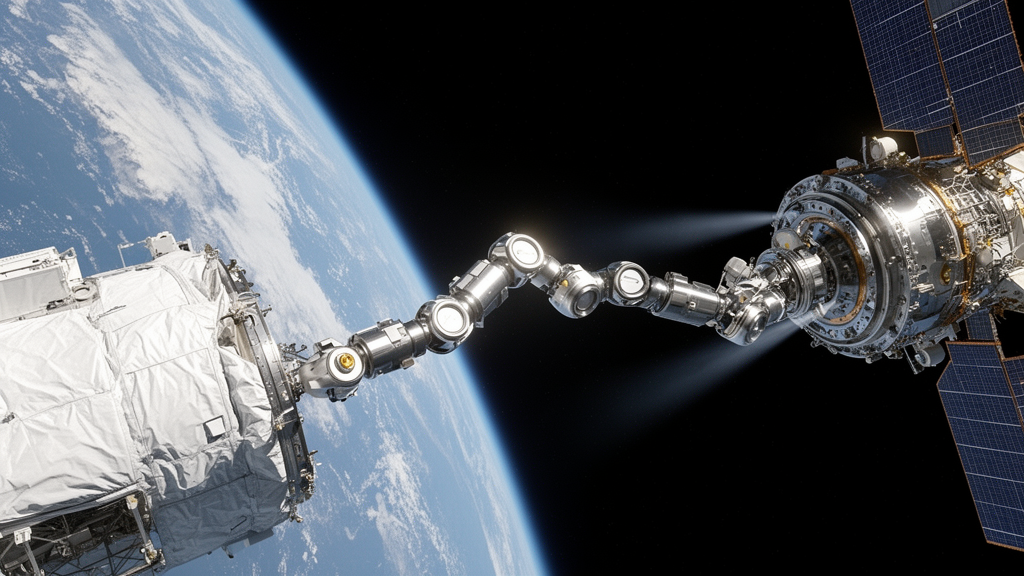
A research team led by Hadi Jahanshahi and Zheng Hong Zhu at York University in Toronto, Canada, has introduced space-robot-dq, an open-source Python library designed for the kinematics, dynamics, and resolved-rate control of free-floating space robot manipulators using dual quaternion algebra. Published as a technology and code article in Frontiers in Space Technologies within the Space Robotics section, the software addresses the fundamental challenge of robotic manipulation on spacecraft that lack a fixed ground base. Because an unanchored spacecraft platform reacts dynamically to manipulator arm movements to conserve momentum, the operational mapping between joint motions and end-effector motion changes continuously during orbital operations.
To model these complex physics, the library implements Product of Exponentials forward kinematics expressed directly in dual quaternion arithmetic, alongside both numerical and analytical Jacobians. For motion planning and control, the software provides optimization-based inverse kinematics, the classical Umetani–Yoshida generalized Jacobian developed for momentum-coupled mechanical systems, and closed-loop resolved-rate controllers designed to govern a momentum-conserving free-floating plant while explicitly handling base pose propagation. The architecture features a declarative configuration interface capable of supporting arbitrary N-degree-of-freedom serial kinematic chains composed of revolute joints.
The mathematical and software implementation of space-robot-dq underwent verification through 153 unit tests spanning four distinct robotic architectures, coupled with an evaluation across a 19-check benchmark suite. Independent validation demonstrated forward-kinematics agreement below 10⁻¹¹ meters when tested against two separate reference implementations that share no code with the library. Furthermore, dynamic evaluations verified the first-order-convergent stationarity of the complete system center of mass, while construction-level consistency checks confirmed that numerical momentum residuals remained at the 10⁻¹⁵ level.
The practical implications of dynamic coupling in free-floating systems were evaluated in two numerical control studies comparing the generalized Jacobian against a conventional fixed-base Jacobian model operating on the identical simulated plant. In a Cartesian trajectory tracking task executing a 0.27-meter maneuver, a controller relying on the fixed-base Jacobian accumulated 26.372 millimeters of root mean square position error despite feedback correction. In contrast, the controller operating with the generalized Jacobian tracked the desired trajectory with 0.2512 millimeters root mean square error, representing a 105-fold precision improvement that isolates the operational cost of neglecting momentum coupling.
A second control investigation examined an orbital capture-approach scenario where the manipulator end-effector maintained a full six-degree-of-freedom grasp pose against a client object tumbling at an angular rate of 5 degrees per second. Under generalized Jacobian control, the system maintained the grasp pose within 0.008429 millimeters and 0.000581 degrees root mean square error. When operated with the fixed-base formulation, the errors increased to 4.267 millimeters and 0.22 degrees, revealing 506-fold position and 379-fold attitude error discrepancies attributable entirely to unmodeled reaction dynamics.
During the tumbling target capture simulation, the spacecraft base drifts 2.4 degrees, an attitude cost the library quantifies for mission design. To ensure transparency and reproducibility, all computational results, performance metrics, and figures documented in the study are generated by a single deterministic script included directly in the public code repository.
Subject of Research: Open-source dual quaternion Python library for kinematics, dynamics, and control of free-floating space manipulators
Article Title: space-robot-dq: a Python library for dual quaternion kinematics, dynamics, and control of free-floating space robot manipulators
Article References: Jahanshahi, H., & Zhu, Z. H. G. (2026). space-robot-dq: A Python Library for Dual Quaternion Kinematics, Dynamics, and Control of Free-Floating Space Robot Manipulators. Frontiers in Space Technologies, 7, 1955127. https://doi.org/10.3389/frspt.2026.1955127
Image Credits: AI Generated
DOI: 10.3389/frspt.2026.1955127
Keywords: space robotics, dual quaternion algebra, free-floating manipulators, resolved-rate control, generalized Jacobian, momentum conservation, Python library, Umetani-Yoshida formulation, tumbling target capture, inverse kinematics, Product of Exponentials, base pose propagation, spacecraft dynamics, Cartesian tracking, open-source software, space technologies, kinematic chains
Cite Scienmag News
Grant Pearson. (November 11, 2026). Dual Quaternion Python Library Enhances Trajectory Tracking for Free-Floating Space Robots. Scienmag. https://scienmag.com/dual-quaternion-python-library-enhances-trajectory-tracking-for-free-floating-space-robots/
Grant Pearson. "Dual Quaternion Python Library Enhances Trajectory Tracking for Free-Floating Space Robots." Scienmag, 11 November 2026, https://scienmag.com/dual-quaternion-python-library-enhances-trajectory-tracking-for-free-floating-space-robots/. Accessed 11 November 2026.
Grant Pearson. "Dual Quaternion Python Library Enhances Trajectory Tracking for Free-Floating Space Robots." Scienmag. November 11, 2026. https://scienmag.com/dual-quaternion-python-library-enhances-trajectory-tracking-for-free-floating-space-robots/




